
Fergus Collinson
JANET PAUL
I've sometimes thought I'd like to make an anthology of people who slipped through the formal education net and came out with original minds: Edward Gibbon, Emily Bronte, William Blake, Samuel Palmer, James Hogg, Edward Lear, David Jones. That's only a sample: but it will do to show that self-education, away from the crowd, may make for freer spirits, for minds which can feel for profound and unusual connections.
The writers made quicker impact; the artists have been labelled 'comic' or ‘mystic' and what they have to communicate has taken longer to seep into educated awareness. But now there are people who would pass over a half-century of English painters for that small room full of the sepia-and-black Shoreham drawings of Samuel Palmer at the Ashmolean Museum in Oxford, because they have a visionary magic. Palmer communicates his own internal feeling for nature with such minute perception that he opens the sensibility of the viewer. We become more aware.

FERGUS COLLINSON Hattie Mae. She is being a fabulous green snowstorm Thurber Edmonds Raking Bowl woman 1985Acrylic on hardboard, 1200 x 600 mm.
Fergus Collinson, in his more vigorous, more brash exuberance, can also do this. Give yourself a chance to see the New Zealand scene through his eyes and words!
Collinson slipped through parts of the educational net because he became deaf when he was three years old. He was born in Owaka in South Otago in 1948. He wrote in 1982: In my childhood Owaka had five churches, two marvellous bakeries. There were no pubs or fish and chip shops. Four days a week a train puttered down the line from Balclutha. I was a social outcast as a kid. I went deaf at the age of three, and also had incredibly messy long-running colds. I couldn't hear what the teachers were saying at school, and being treated as a stupid deaf kid didn't help. My Mum and Dad decided to see what they could do about educating me after three unrewarding years at school. It was a brilliant decision, made against hassling from social workers, and people around them.
I've always loved painting, and through those marvellous Correspondence School librarians, I knew all about overseas art in High School. Hokusai was one of my favourites. Behind our place was a hill which turned Hokusai's favourite Prussian blue. I called it the Hokusai mountain, and tried again and again to paint it. I loved Vincent Van Gogh's blazing sunshine, and those interiors of his room . Rembrandt made me feel warm, his people were so timelessly human. Sydney Nolan's stuff about the Ned Kelly gang was incredibly exciting. He painted the scrubby ugliness of the Australian outback with the same kind of truth I 'knew' when I looked at the chopped-up, burnt-out South Otago scenery. His cut-away 'section' pictures of the life that goes on in houses made sense, and so did the way he happily ignored most of the commonly accepted ingredients of good painting. As with Hokusai, it was years before I produced paintings which paralleled Nolan . . . in 1974 I painted Waiting for the Train. It's a big painting showing a bunch of people inside a station. The sectional cutaway viewpoint contrasts the warm room with a bitingly cold South Island night outside. I wasn't copying Nolan, so much as instinctively choosing his viewpoint as the best way of depicting that reality.

FERGUS COLLINSON An Autumn, A Winter, A Spring 1978-79Acrylic on paper, 600 x 800 mm.
Collinson did two High School art courses by correspondence. He learned joinery. In the ‘60s he felt that 'self-worth was defined by economic success. If people like myself who were creative and handicapped weren't successful, it was obviously they, not society, were at fault'. He felt bad about himself then; now he can say 'I feel my life has been richer as a result of the way it has gone for me'. In the '70s he was excited about art as communication and he found out that most people don't realise art changes with the artist. 'If it doesn't it goes stale'. (When Gwen John tried to interest Rodin in a painter whose work she thought good, he asked 'But is it FRESH?')
Collinson was haunted by 'mood, and how to paint it'. He began to use colours to emphasise atmosphere. When his father died of cancer he painted two contrasting paintings about his death—one of a couple in a fridge-like hospital room, the other in church 'radiating the sense of warm peace that I was aware of at Dad's funeral'.

FERGUS COLLINSON Houpapa 1967Gouache on paper, 245 x 235 mm.
In 1974 Collinson came to Wellington. He got a part-time job in the Alexander Turnbull Library's Art Room. He was adept at lip-reading. If I was busy he would stand behind me and then bend right over so that his upside-down face could read my reply to his question. It was unnerving at first but we soon learned to communicate, especially with laughter. He had enormous courage and, with only minimal hearing, coped with a degree in Sociology and English and History at Victoria University by placing himself at lectures next to a diligent student who took copious and clearly-written notes.
Fergus Collinson is a man with a deep respect for life which he feels grows out of his Christianity. He wrote: I believe that because God made us we have value as people. The human experience has value, and I enjoy it, so life is a continuing search for ways of painting it . . . so I keep plugging away on my own, laughing at life, and really treasuring the occasional person . . . who comes from the heart rather than the head.
He writes poems and stories for childen. In 1983 he did illustrations for Elizabeth Smither's Tugboat Brother and learned from working on a small format.
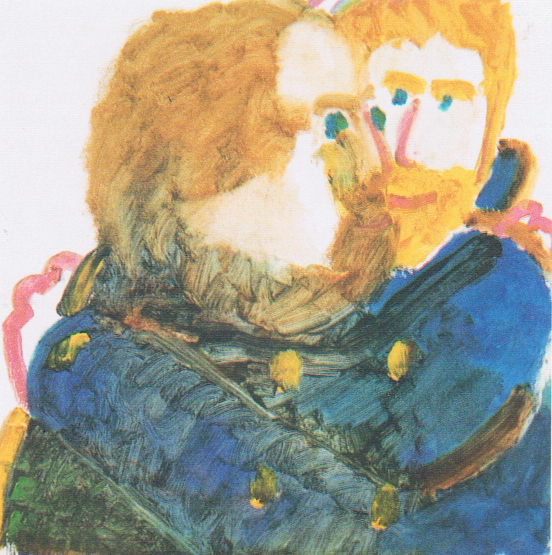
FERGUS COLLINSON Nick saying Hello Fergus 1983Acrylic on hardboard, 920 x 1020 mm.(Collection of William Dart, Auckland)
As with every artist he has certain 'key' paintings which hold an essence of what he was thinking and feeling at a particular time.
The early South Island painting of a steam train shows the detail of his observation and his flair for making paint create atmosphere.
There were lots of paintings in 1978. The painting of Gabriel's Gully seen through the knees of his patched jeans is An Autumn, a Winter, a Springtime from one of the big songs Liza Minelli sings in New York, New York. Collinson described how it came to be painted: 'I'm at Gabriel's Gully watching the chill autumn wind blowing dandelion seed-heads through the sky above my patched knees'.
In 1979 Collinson thumbed a ride in a train that sidled down a hill. He did three big paintings of that hill north of Chatto Creek and used the place-names as a 'poetry of movement'. He began to use oil on hardboard instead of acrylic on paper—achieving more luminous paint and compositions that 'look less cramped'.
By 1981 Fergus Collinson had renovated the old house he bought in Newtown. Since then his painting has grown out of his life there with friends and the music he has enjoyed. He believed 'if I painted my experience of living as honestly as possible, I'd end up painting universes of human experience'.
Hattie Mae, Nick Saying Hello Fergus, Belinda: the still point of the turning world . . . No regrets, I'll go on loving you, and his most recent painting rejoicing in the night from his back door, all rise like sparks from the warm fire of his feeling made vivid by his individual wit.
Janet Paul, publisher and painter, first knew Fergus Collinson when she was picture librarian at the Alexander Turnbull Library in the late 1970s.