
Some Earlier New Zealand Paintings from the Fletcher Collection
ANDREW MARTIN
Among those companies who have collected New Zealand paintings the Fletcher Group is pre-eminent. The Fletcher Collection is particularly rich in paintings of the Colonial period - but its scope stretches right up to the present day; and it includes some fine works by Colin McCahon, M.T. Woollaston, Gordon Walters, Milan Mrkusich, Eric Lee Johnson, Brent Wong, Michael Illingworth, Donald Binney, W.A. Sutton, Robert Ellis, Louise Henderson, Ray Thorburn, Ian Scott, Philip Trusttum and Geoff Thornley. The Fletcher Collection is in fact probably the most representative assembly of New Zealand painting now in existence outside a public institution. The present note, however, deals with some of the best of the earlier paintings.
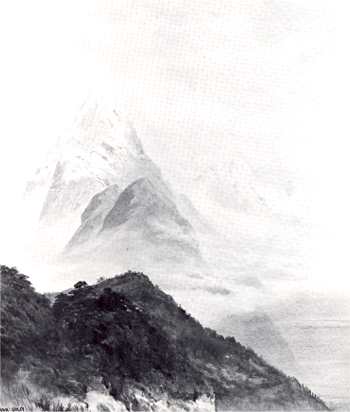
JOHN GULLY
Mitre Peak 1875
watercolour, 590 x 500 mm.
(The Fletcher Collection)
Fletchers began to collect early New Zealand paintings at the beginning of the 'sixties: initially as a result of the joint enthusiasm of J.C. Fletcher and George Fraser, at that time in charge of Fletchers' Sales and Services. They were later aided in their collecting by Mrs M. V. Fletcher and others.
At this time the earlier New Zealand painters were not as keenly sought after as they were to be by the end of the 'sixties - nor did they command the astronomical prices of the mid-'seventies. At the same time, the Auckland City Art Gallery's series of exhibitions of painters of the Colonial period and the earlier twentieth century was doing something to spread knowledge and stimulate interest. The first of them had been the exhibition of New Zealand Painting arranged by the Gallery for The Auckland Society of Arts on the occasion of the 1956 Festival of the Arts. It was made up of both early and contemporary artists, and had an introductory essay by Peter Tomory, with brief biographical notes. The New Zealand Painting exhibition was followed by a series on individual artists. The first was Una Platts' notable exhibition of paintings by John Barr Clarke Hoyte (the catalogue is still a standard source of reference). Then came James Crowe Richmond, John Kinder, John Gully, James Preston, James Nairn and Edward Fristrom, and so on. Much subsequent writing has been based on this pioneering work.
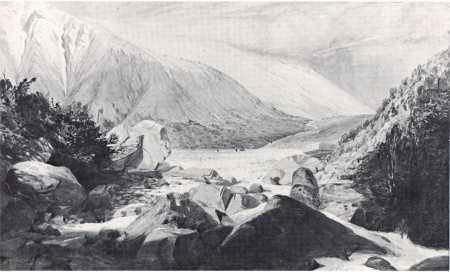
JAMES CROWE RICHMOND
Gorge in New Zealand's
West Coast 1870
watercolour, 390 x 650 mm.
(The Fletcher Collection)
The Fletcher Collection was begun almost by accident. Early in 1962 J.C. Fletcher was rung by George Walker Auctioneers and asked if he would be interested in purchasing five original paintings by john Barr Clarke Hoyte. Accompanied by George Fraser he inspected them at George Walkers' rooms (then in Queen Street, Auckland) and agreed to purchase them all for about £300. Among them were the watercolours Swagman on Bush Track and Tauranga Hotel, illustrated with this article. The five watercolours were hung in the old executive offices at Penrose, over the road from Fletcher House.
With the purchase of these Hoytes, and subsequently other New Zealand paintings from about the same period, the small private market in this country for such works may have been widened. It is felt at Fletchers that, as they spread the scope of their collecting, they helped to create an interest in New Zealand art in the business community that has benefited many artists and dealers.
When Fletcher House was being completed in 1968 Fletchers already had a worthwhile collection: but it was nowhere near extensive enough to cover the new sixth floor, let alone the other foyer areas and the more important offices. Fletchers set out to buy more paintings - an initiative that was helped by J.H. Churton, and people in the Auckland art scene such as Hamish Keith and Peter Webb.
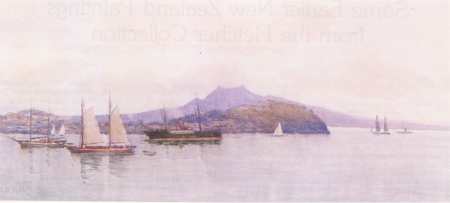
ALFRED WILSON WALSH
Auckland Harbour with
Ships in Foreground
watercolour 240 x 540 mm.
(The Fletcher Collection)
Later, Peter Bromhead, who had been called in as advisor on the interior decoration of Fletcher House, introduced a wide circle of New Zealand painters; and Fletchers' continuing interest in both earlier and contemporary painters was further satisfied by the co-operation of Mrs M. V. Fletcher, Petar Vuletic in Auckland and Peter McLeavey in Wellington.
By now it has become possible for Fletchers to hang on the walls of their board-rooms, executive offices and foyers about one-hundred-and-fifty oil paintings, watercolours and original prints by all the leading New Zealand artists. An interim catalogue of the Collection is about to be printed in a limited edition.
The two Hoytes from the Fletcher Collection illustrated below are both in a way unusual examples of his work. Hoyte is best known for his panoramic scenes of Auckland Harbour taken from various viewpoints, painted when he lived in Auckland in the eighteen-sixties; and for the watercolours of famous scenic spots - lakes, rivers and gorges. The watercolour Swagman on Bush Track, thought to have been made in the Coromandel area, is a more closed-in composition, painted in Hoyte's well-known purple-blues, tan-greens and yellow-ochres. The other, the Tauranga Hotel, incorporates more of his effects of distances defined by the 'wings' of the headlands, with his characteristic devices of the strategically-placed rigged ships, the sail with its reflection. It is probably a composite work using elements from various parts of the area.
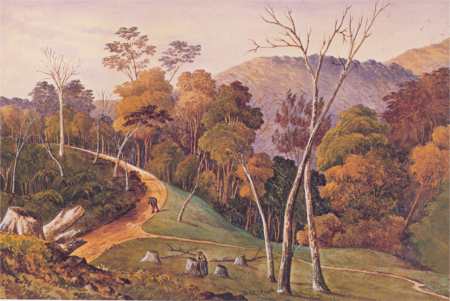
JOHN BARR CLARKE HOYT
Swagman on Bush Track
watercolour 290 x 440 mm.
(The Fletcher Collection)
The large Gully watercolour of Mitre Peak (above) is one of his typical alpine compositions, painted in the studio from sketches made on location. The work typically concentrates on the suggestion of effects of light and atmospheric distance, in the manner of the nineteenth century British masters of watercolour painting.
James Crowe Richmond was a lifelong friend of Gully, and his companion on many painting expeditions (they painted together at Milford Sound, at Lakes Manapouri and Te Anau and other parts of the country). Richmond developed his watercolour painting style from studying the works of his New Zealand contemporaries and those of other painters whom he admired, such as Turner, Girtin, John Sell Cotman.
Early in 1862, in his capacity as Provincial Secretary, Richmond made several overland journeys on horseback down the West Coast of the South Island and to Canterbury, adding all the time to his collection of landscape sketches. Voyages down the West Coast by the ketch Jane to the mouth of the Grey River and an overland journey from Nelson to the mouth of the Buller produced some of Richmond's best work. (Colin McCahon, introduction to James Crowe Richmond catalogue, A.C.A.G. 1957.) The Fletcher Collection's strong watercolour, Gorge in New Zealand's West Coast (illustrated above) is dated at the end of this decade.
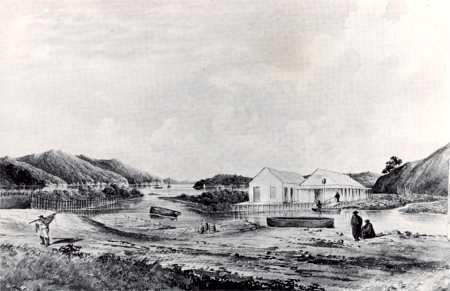
JOHN BARR CLARKE HOYT
Tauranga Hotel
watercolour 290 x 450 mm.
(The Fletcher Collection)
The Reverend John Kinder is considered important enough by Hamish Keith and Gordon Brown to warrant a chapter to himself in their book An Introduction to New Zealand Painting: 1839-1967. (Collins, London/Auckland, 1969. The pioneer work on Kinder was the catalogue by Hamish Keith and Ross Fraser to the Auckland City Art Gallery's exhibition of fifty-two works in 1958. See also Art New Zealand 2) Kinder's works certainly have a stylistic individuality about them that may seem to be lacking in the more traditionalist paintings of Gully and Richmond.
A man of deep culture and distinguished educational background, John Kinder emigrated to New Zealand in a spirit of high Victorian idealism in 1855 to take up the mastership of the Church of England grammar school in Parnell, Auckland. His painting was a spare-time activity, and his small watercolour landscapes, finished at leisure in a dotted and sponge-blotted technique, simplify and formalise the unruly New Zealand terrain, imposing an order that may have had something to do with his earlier years at Trinity College, where he read for honours in mathematics.
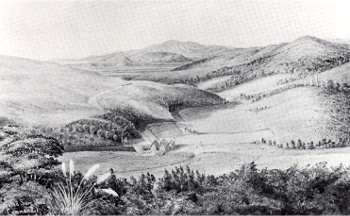
JOHN KINDER
Waiau Saw Mill, Coromandel 1861
watercolour 230 x 370 mm.
(The Fletcher Collection)
The bulk of Kinder's finished watercolours are in the Collection of the Auckland City Art Gallery. The one from the Fletcher Collection illustrated above, Waiau Saw Mill, Coromandel 1861 derives from notes taken on one of the many trips and holiday excursions he made during his earlier years in the Colony, and later worked up in the studio. Alfred Wilson Walsh and James McLachlan Nairn were both influenced as painters by the innovations of the Impressionists. Walsh (1859-1916) came to Otago with his parents during the gold rush days and later taught at the School of Art in Christchurch. A true original, he painted works in watercolour that with their spontaneity of handling and fresh, sparkling colour anticipate the more modern approach to landscape painting that Nairn was to bring to New Zealand. Walsh's Auckland Harbour with Ships in Foreground (above), in a spectrum of melting blues and mauves and emerald greens, is painted in a style standing perhaps half-way between the traditionalism of Gully and the bolder impressionism of Nairn.
Nairn arrived in Dunedin in 1890. He had been associated in the 1880s with a movement in Scottish painting known as the Glasgow School of impressionist painting. By his teaching here, by the example of the works he exhibited, and by his personal contact with fellow-artists who gathered around him at Pumpkin Cottage, his retreat at Silverstream in the Hutt Valley, he did much to bring this country up to date with what had happened in the European centres of art, and to provide a starting-point for twentieth century New Zealand painting.

JAMES McLACHLAN NAIRN
Wellington Harbour: Evans Bay
watercolour, 260 x 360 mm.
(The Fletcher Collection)
The adherents of the Glasgow School tended to paint in a somewhat lower key than the French: but this little watercolour sketch by Nairn of Wellington Harbour-Evans Bay uses a series of primary and secondary tints, with quite large areas of unbroken colour.