
New York and the Toronto Sculpture Conference
WYSTAN CURNOW
It'd been a bit bumpy, like the suspension was going, and the pilot, a solicitous sort, came on with these explanations and this prediction: we should be out of the woods in 5 minutes. I looked out of the window. And down: 37,000 feet. The South West. Same scene as, maybe, an hour back. That there isn't landscape, that's geology. What woods, I thought. Where? So I'm flying: back to New York to pick up where I left off in the last issue of Alt New Zealand. Which is not the reason Arts Council financed this pilgrimage, though it sits OK with me. Half my adult life in these/those United States, half in this/that New Zealand, when I fly, here or there, it's like I've got it together again, or I'm on a new leg of my life. But that's not the reason either.
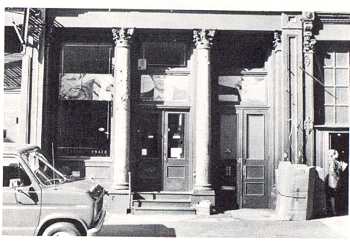
Exterior of
Franklin Furnace, New York
(photograph by Dara Birnbaum)
It's May 24, Wednesday. I deplane at Newark round midnight. Emus for Manhattan. The night is soft, and cool. Out this bus window the city's lights, millions strong, have a green tinge. I'm going home. Like I would be less than 3 weeks from now. Disembarking at Mangere, June 9, Friday, into that sunlit morning, the green near-genius. Going home, coming home - attention is all but total at such times. Othertimes, just minding where I am when I am there is an effort of will. 20,000 miles in three weeks - that's jet-lag all the way. I lunch on Sunset Boulevard, dine (or scoff) at San Francisco airport, breakfast over the great Pacific, and lunch again in Birkenhead, Auckland, with loved ones rotten with flu. Like that. Just agreeing to such changes is a test of appetite. Or speed. Maids hover, ice-cubes clink in drinks on a patio outside a Stella-studded living room in suburban Toronto. Bill Boyle is saying the Sculpture Conference cost a quarter of a million. To move - of a sudden - from there to: this cracked-concrete room at the Los Angeles Y, on my back with migraine, listening to pigeons: flap, shit, gobble, flap at my window in Starsky and Hutch country. . . To take the weight, full weight of juxtapositions, takes some speed. Mind speed. Which I had, most times.
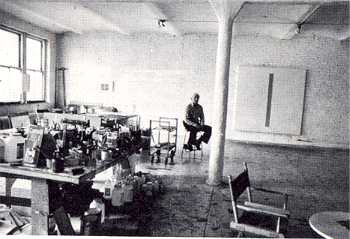
Robert Ellis
in Max Gimblett's SoHo,
New York studio
At the Port Authority terminal I get the D train downtown to Chrystie Street. This ten gallon bottle of Duty Free Johnny Walker is for me, Deiter and Kay, to do some justice to tonight. And in the morning I'll call up Jacki Apple, Len Lye and fix a date for our get together, and in the evening I will be received at the ViceConsul's reception for Greer Twiss, Rodney Kirk Smith, myself-official delegates all to the Toronto Sculpture Conference-and Bob Ellis, fellow traveller. Start working my passage, in fact. Meantime, I think I'll just sink slowly into me in the City.
I've good reasons for seeing Len Lye. First off I'd imagined it a privilege and a pleasure to meet this man. And so it was. Then, when Max Gimblett was in Auckland a week ago, he'd shown me photographs which were of paintings Len had done recently. Well, it's fifty years since Len Lye had painted. These I had to see. But best of all, I wanted to talk with him about No Trouble. The story on that is this: in 1928, Laura Riding and Robert Graves set up the Seizin Press to put out small collections of new poetry and prose, small editions handprinted on handmade paper, several with covers designed by one Len Lye. Then, in 1930, after moving to Majorca, they published his one and only book, No Trouble. All but unknown it is, but to be re-printed soon, if I get my way. In New Zealand what is more. To get it I'd need some background and, in the course of a day (Friday) I got two cassettes full, not to mention a cure for the common cold (countless glasses of rum and orange, two small polythene bags full of Vitamin C tablets and the company of one fast-talking, extraordinary 77 year old.)
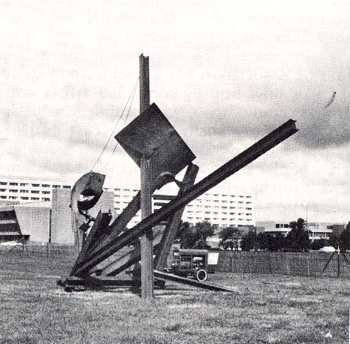
Stages in the construction
of the Mark di Suvero
(photograph by Tom Taylor)
The day before, Thursday that is, afternoon it was, and raining, walked crosstown to the Franklin Furnace Archive. And sure enough, there it was: NEW ZEALAND ARTISTS' BOOKS. I quote, from the Village Voice June 19: Books by Len Lye, New Zealand's major artistic export, painter Colin McCahon, Roger Peters, Gray Nicol, Terry Reid, Nicholas Spill, Bruce Barber, Jim Allen and others prove that New Zealand's distance has not muted its artistic liveliness. The books are mainly documents of that country's performance and art installation projects in recent years. An interesting glimpse of activities taking place half a world away, the show certainly refutes the classic chauvinistic attitudes of New Yorkers who believe that everything that's anything happens on our tight little island.
That's giving aid and comfort. For me, it was a reunion. Since I collected the books, compiled the catalogue and put the lot in the mail. The pleasure's all mine. Only a book show, but the first, so far as I know, show of New Zealand art in New York. And this reunion: with Jacki. We are pleased to see one another. She it was got, the idea of an exchange of artists' books between our tight little islands. She's telling me about her PS1 show when upstairs bounds this guy with the Irish-Ocker accent. Introduces himself as Noel Sheridan. So right away I introduce myself as Wystan Curnow. Because we'd exchanged mail, Auckland/Adelaide/ Adelaide/Auckland but never met. Memo (Arts Council): we antipodean art people can't go on meeting this way. Think of the money and the uncertainty. I really must go to my reception, so it's determined: I'll not get plastered, I'll leave in time to be downtown by 10:30 to pick up Noel and Jacki from Nacy Lewis' dance performance atThe Kitchen whence we'll go to Ali's Alley, Greene Street jazz place, and take in a set or two of James Blood Ulmer - 'The First Harmolodic Guitarist'.
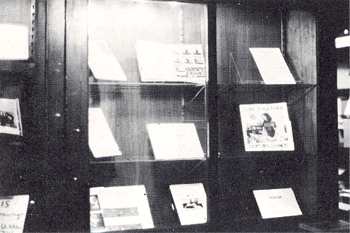
Display of
New Zealand Artists' Books
at Franklin Furnace Archive
I do mean to attend more to art and to more art than I do. Anyhow, there's too much art in New York. This time round I'd people to see and, for once, didn't expect art to get much of a look in. It didn't. There's a show of Alain Kirili I wished Greer might see. . . that sort of take. People get in the way. Friday night, I head for Max Gimblett's loft, picking my way among recumbent Bowery bums-this being, of course, Skid Row where the locals do have their territorial rights and do solicit support for their alternative life style. Max'd put up Bob, Greer and Rodney and there was this dinner party tonight for us all. Len shows some films. Claire Ferguson, fifty years his junior, shows slides for a performance she'll do three nights from now which, had she done in Christchurch, she'd have been arrested for. Claire's another expatriate, although Barry Lett's showed a piece of hers last year. Bob and Greer show slides of their work. All by way of introductions, conversations, sort of. Which was OK. Whereas the Art Gallery of Ontario's conjunction of Welcoming Party (plus buffet, opening remarks) for 1700 sculptors from everywhere, and its portentous Structures for Behaviour - New Sculptures by Robert Morris, David Rabinovitch, Richard Serra and George Trakas was not to be borne. I didn't go. Instead rested up in my neat dorm room at York, took a shower in the women's wash rooms - dug that structure for behaviour - and went and had a chat with Bronwynne Cornish.
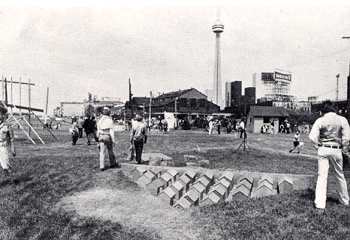
Performance - exhibition of Canadian sculpture at Toronto's Harbourfront: showing (foreground) Michael Czerewko's Growth Patterns
Things of the world get in the way, too. On Saturday (June 3rd) a plague of sculptors descends on Toronto's harbourfront. With picnic lunches. Is presented with 41 outdoor works scattered along a mile of foreshore. It's a beautiful day. There's the sea-lake Ontario actually. Billboards, expressways, railway yards with light towers, signal boxes, shunting, heaps of wooden cradles, old warehouses-a whole mess of interesting things. It was like art had no business being there. Michael Czerewko's Growth Patterns, held its ground, but was one of few that did. On York's campus, however, the art outdoors gets a run for its money. I taught at York (1970), a great grey Calder stabile out my office window. Since, they've added: 1 George Rickey, 1 Richard long, 1 Ted Bieler, and 20 (!) Anthony Caros. You could, I did, take timeout from all the talk with these pieces. Also, more, with the immense Mark di Suvero, in-the-making out on the fields during the Conference. Seeing Di Suvero drive that crane, you knew why most heavy metal sculpture looks prissy beside his. Sketching in the sky with 20 ft. H-beams, hard-hatted, making it UP as he went along. Delegate Nichols (Peter) couldn't restrain himself; he borrowed a hat and took a turn on the construction team. Now in Edmonton, at work on his most ambitious piece to date, for the Games Sculpture Symposium, Peter couldn't have had a better warm-up.
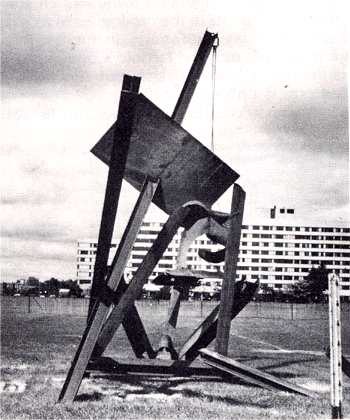
Stages in the construction
of the Mark di Suvero
(photograph by Tom Taylor)
How did they confer, these 1700 sculptors from everywhere? Well, there were 3 days of workshops. This is the list: bronze, iron and polyester casting, lost wax, machining, lasers, portable pneumatic tools, electronics, holography, fiberglass, welding, photography, micro-computer programming and ceramics. And, concurrently, 3 days of panel discussions and talks. The list of speakers included: Carl Andre, George Rickey, Robert Lippold, Robert Irwin, Les Levine, George Trakas, Dennis Oppenheim and Laurie Anderson (US sculptors); Anthony Caro, William Tucker, and Philip King (UK sculptors); Rosalind Krauss, Robert Pincus-Witten, Jack Brunham, Reyner Banham, Marshall Mcluhan (critics); Marcia Tucker, Henry Geldzahler, Rae Tyson (administrators and curators); Max Hutchinson, Ivan Karp (dealers). Toronto's was the 10th in a series of conferences begun in 1960, and was notable for a shift in emphasis away from technical to critical issues. The first held outside the US, it was, as intended, more international than its predecessors. However, few European or Third World artists were there and delegates were mostly Canadians and Americans.
And provincials, in the main. Whereas the speakers, they were from New York, in the main. So here was a situation. New York was the magnet, indeed: over 1000 provincials had to be turned away. And yet an undercurrent of antagonism to New York flowed quietly throughout the Conference. Panels performed to passive audiences of hundreds. Between sessions you try to 'confer' with your confreres. And what sort of work do you do? She, dumpy lady from the South: I do plastic representations of Other Worlds. What do you say? The woman on the bus, in the Stetson, slaps my knee when she cracks a funny. Shows me photos of her 15-foot, black, fiberglass, rhinoceros with chopper-blades on its head and tail out its arse - it's a symbol of Peace, she says, helping me out. Actually, I like the lady. What she's got to say about the art scene in Cincinnati, tool capital of the world, really interests me. Cities like Cincinnati, Cleveland, have immensely affluent support systems devoted all but exclusively to museums, called Opera, Ballet companies, Orchestras, or Art Museums. You've got to go to Chicago, Los Angeles, San Francisco, to compare with Auckland for the energy of the art being made there. The varieties of provincialism. Such a claim was greeted with incredulity by one Betty Collings of Columbus, Ohio. Turns out she was born in New Plymouth, left the desert (Wellington) in the late '50s. What ensued was a locking of horns between natives (delegates Twiss and Curnow) and this expatriate, which left the New Yorker, Pincus-Witten, a little dumb-founded. Worked out OK though. She now looks forward, as I do, to the possibility of her showing in New Zealand.
The panels I went to-excepting that on Performance-were a great success. No questions were answered or problems solved. 'Is object sculpture today burdened with too many traditional values to offer a fresh experience?' No one expects they will be. I got a few new ideas but that isn't the point either. When I spilt my drink on Joseph Kosuth's suit at a party in New York, I don't think I got a new take on his work. And if I had I would not have written about that being the origin of it. The articulateness was impressive, like it was part of their professionalism to handle such situations with style. Carl Andre's provocative assertions contrast with Englishman Scott's well-written talking. Why is it that Scott sets the tone of debate until Robert Irwin, the Californian, enters? What's the antagonism between Trakas and Irwin? Why do the Englishmen get squeezed out when the Americans start taking issue with one another? What do I make of Rosalind Krauss's apparent humourlessness?
For examples. What I come away with are questions arising from the unscripted responses - verbal, facial, gestural - elicited by the. situation. Which makes me sound some sort of predator, and the panelists objects on display. What then do you make of this story: the hostess is showing a group of Japanese sculptors this fine Eskimo carving of a polar bear. One takes it gently from her hands arid is off with it, like he'd got the ball, followed by his fellow countrymen down to the swimming pool. He walks out on to the diving board and ever so carefully puts the carving on the end and retreats while the rest arrange themselves round the pool and snap the bear to death.