
Exhibitions Auckland
A. LAND
Polaroids: A Group Show
The use of Polaroid materials has several disadvantages. In the first instance, the medium produces a unique 'one-off' image. Secondly, that image appears on a small picture unit that often makes it difficult for it to be 'read', especially once mounted behind glass and hung upon a wall. Finally, most of the emulsions must be exposed within a Polaroid camera, which precludes any selection of different lenses or any other accessories the photographer may wish to use.
There are advantages too: no film to be processed; and no time to be lost in hours of printing in the darkroom. The finished image is usually seen within a matter of minutes of exposure; and best of all, the colour dyes contained within the emulsion, particularly with SX-70 material, are capable of resolving the captured image in the most evocative and subtle range of colours.
PAUL JOHNS
Untitled work
Polaroid photograph
We saw, therefore, in some of the works in the Polaroids group show at Snaps Gallery, a statement about the Polaroid medium as well as the image itself. A casual snapshot style emerges that without care becomes a sloppy 'throw it away if it isn't any good' method of working that should be left for the tourist. Just because instant pictures are being made, the moment of exposure is of no less a degree of importance than its counterpart in the more traditional methods of photography, where it is but the beginning on the path to a final expressed print. 'Practice' may not 'make perfect': but it is apparent that there can be no substitute for extensive use of the Polaroid medium, especially if all of its subtle characteristics are to be captured along with the images.
The work of the newer photographers showing at Snaps, Dinah Bradley, Stephen Ballantyne and Ron Brownson, left something to be desired. Whilst they all showed competent work, it was little more than this. The rather spurious groupings used by Bradley (groups of four SX-70 images) in each of her two untitled works; and Brownson's use of a similar method of presentation in his work Dragons look better than horses 1962-1975, is questionable. In these instances some of the pictures grouped together would have worked as single images: but on these occasions the weak detracted from the strong among them. Viewed separately, Ballantyne's images were competent: but to exhibit three completely differing images, made in totally different styles, does not show a maturity in the all-critical process of selecting work that is to be seen by others.
ROD WILLS
Hitler in Paris
Polaroid photograph
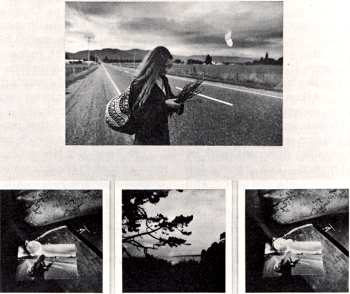
Paul Gilbert showed his work as groups also. Of his three triptychs: the sequence Time weighs heavy/ Time sheds light was the most effective. The incorporation of a black and white image in the triptych, and the use of the same image in the picture within a picture effect he contrived with the other SX-70 components of the work, was rather delightful.
Merilyn Tweedie, like Stephen Ballantyne, works with peel-apart Polaroid materials. (They were the only two exhibitors to do so.) Her two works, both untitled, were beautifully austere. Concerning herself with the aura that seems to exist around things she has successfully intruded into this space with her camera to capture a sense of mystery in the mundane, the image of a corner of a building being the most effective. A similar concern with the space into which the camera intrudes was evident in the work of Stuart Mackenzie. Of his five works, the two interior studies were the most dramatically successful. Table with flowers and Old gas heater with flowers were both visually rich yet at the same time very simple. The use of a flash has amplified the already present 'aura' in the subject to a startling degree. His other works were concerned with the same thing, but were not as successful due to the visual complexity of each image.
PAUL GILBERT
Time Weighs Heavy / Time Sheds Light
montage incorporating Polaroid photographs
Anne Noble showed a unique approach with her work by presenting images comprised of two parts, each a separate SX-70 image, mounted apart from the other but combining with it to be 'read' in comic strip fashion by the viewer. The second of her untitled works was the most evocative, a sunrise / moonlight piece.
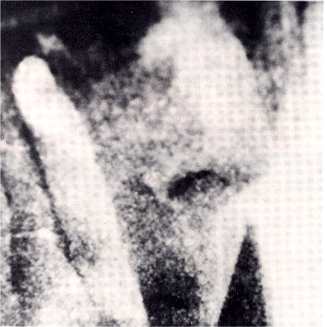
Paul Johns, a Christchurch photographer, exhibited some of the most startling work in the whole show. He makes his SX-70 pictures by photographing 16 mm. movie film that is projected on to a screen. Johns thus gains access to hundreds, if not thousands, of similar moments from which to select those we see. His subjects are removed from our everyday reality: they appear in a self-contained narcissistic world of their own. Because he is re-photographing the original image his pictures are often grainy and muted in their colours. Johns' manner of presentation adds to an already remarkably different approach. His images are mounted on blocks of wood cut to the same dimension as the SX-70 picture unit and approximately two inches thick: the picture unit is secured behind a piece of perspex with a small stud in each corner. Three of the works were single images: two others, The Kiss and The Murder, were constructed in the same way, but consisted of two parts. These were hung one above each other. A sixth image was a larger construction using four picture-units, and assembled in a more obtrusive manner which unfortunately left the viewer with a much more difficult piece to 'read'.
PAUL HEWSON
The Effect of Science Fiction on Edward
Polaroid photograph
Lawrence Shustak, another Christchurch photographer, showed two of his earlier works from 1975. The more stimulating of the two, Infinity Box, showed the use of the picture within a picture technique that he has explored and utilises in some of his other works. Photo-Forum of June/July 1977 contains two good examples. It is a pity that Shustak showed his older work as he is producing new pieces all the time. His work is worth seeing but he seeks little exposure for himself outside of Christchurch.
Bruce Foster, one of Auckland's more mature photographers showed six images. These reflected a highly refined sensitivity to his surroundings. His wife and daughter figured prominently in the works shown, the rapport existing between photographer and subject being strongly evident in the images. Foster's pictures succeeded in embodying all that is desirable, leaving the viewer with a pleasant satisfied feeling: the image Anji (February 1978) being for me the best.
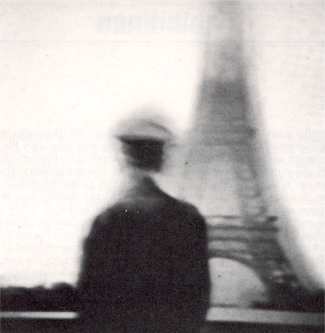
Rod Wills showed a set of six images made from a monochrome television receiver. The images of Hitler, and Jews at Auschwitz were in a way contradictory. Whilst what they were about can only remain abhorrent, the images by themselves could not fully engender such a feeling in the viewer. Those horrors of over three decades ago had been filtered down to merely unpleasant memories - certainly due to their soft blue appearance and lack of scale as SX-70 images. The image used on the poster for the show worked more successfully than the original on the gallery wall.
Gillian Chaplin's work, whilst being a little eclectic, visually remained consistent in the sympathetic warmth evoked between herself and her subjects. Like Foster, Chaplin must be classed as one of the 'heavies' of the Auckland scene. She has had a lot more experience as an expressive photographer than some of the other exhibitors, and this shows clearly in her work.
The madonna-like image of Gwyneth is the best. Looking perhaps more like a painting than a photograph, the image is totally effective compositionally, visually and in the way light and colour are used. It is a shame that such an image could not be seen on a larger scale.
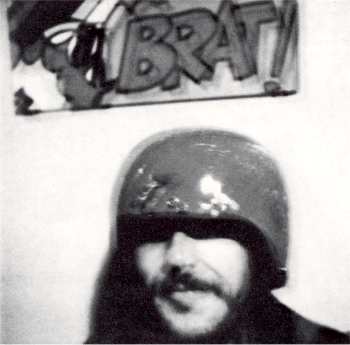
Paul Hewson (possibly the first to show Polaroids in New Zealand) exhibited a series of six satirical portraits. He captioned his work directly on to the lower border of his picture unit, thus allowing no deviance in interpretation by persons viewing the work. In all but one instance this combination of image and words succeeded. I felt that The effect of 25 years in the same job on a 42 year old man really had little or nothing to do with the image of a painter whitewashing a plastered wall. This criticism aside, Hewson's works were humorous and enjoyable.