
Exhibitions Christchurch
T.L. RODNEY WILSON
Philip Trusttum: Recent Paintings & Early Works
It is not often that a painter can produce a sufficiently large body of recent works to sustain two excellent simultaneous exhibitions. That Philip Trusttum has successfully managed this, in twin shows at the C.S.A. and Brooke/Gifford Galleries, is largely attributable to the unswervingly determined professionalism with which he tackles the task of painting. For Trusttum, compromise is not possible: all is subjugated to his work. He works consistently, regularly and extremely hard. From time to time the pace accelerates for periods of white-hot activity leaving him exhausted at the conclusion. The hanging of these two extensive and remarkable shows - accomplished entirely single-handed - was such an event.
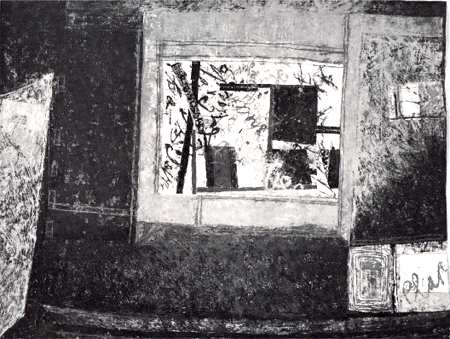
PHILIP TRUSTTUM
North Wall
1825 x 2360 mm.,
mixed media on canvas
(Brooke/Gifford Galleries)
And it was certainly worth it, for seldom does Christchurch have the opportunity to re-experience in this way something of that peculiar excitement which characterized certain exhibitions of the late 'fifties and 'sixties. Amongst them, the big McCahon/Woollaston show at the old Durham Street gallery in the early 'sixties was a milestone. On that occasion one had the impression that something special was happening, that one was a privileged observer of something that was going to be seen as especially significant. The energy, the vitality, the ability to bypass vacuous painterly rhetoric - qualities which have always marked Trusttum's work - and the regained singularity of vision in these new pieces, recalled that exhibition of a decade-and-a-half ago.
Twenty-six large unstretched canvases marched around the walls of the C.S.A.'s cavernous white centre gallery. Suspended in that billowing void, they orchestrated the space in a way that is seldom seen. By contrast a further twenty-four brilliantly-coloured works-on-paper - the most direct and spontaneous jottings from a trip to Provence in 1975 - glowed upon the brown, halogen-lit hessian walls of the print room.
Across the city at the Brooke/Gifford Gallery yet another twenty large works and thirteen smaller ones crowded the available space in a further pageant of colour and paint. Four works at this gallery, executed in thin paint on hardboard and dating from an Australian trip in 1967, gave, when added to the Provence pieces, an ad hoc retrospective touch to shows predominantly concerned with recent work. It was a welcome and enjoyable 'extra'; for those works refreshed one's recollection of the earlier Trusttum and provided, for the hunter of connections, rewarding avenues of investigation.
For instance the nervously energetic calligraphic markings, the embroidery of lines, dots and dashes which we find in the 1967 works are restored in the most recent examples. And the line - reminiscent of Paul Klee's oil paint transfer drawing line - which is so widely employed in the new pieces can be recognised in those works of a decade earlier.
The recent works come as a new and welcome assertion of an individual vision. After a return to the figurative image following his first trip to Europe in 1967, Trusttum appears to have been struggling to digest the gargantuan meal of sensations experienced at the time. That struggle has produced individual works of great merit, but the impression one continually had was that it was a groping and tentative movement out of the woods of eclecticism. The works produced seemed to be exercises - successful enough to be sure, but exercises all the same. These exhibitions reveal him as having clearly regained his own path. The connections back to the opening years of the 'seventies are unmistakable: but equally unmistakable is the break in continuous development. Smallnesses of handling have made way for monumentality, delicacy for a certain brutality, richness of imagery for comparative austerity - indeed in some cases the images are a little too spare and the treatment a little too dry for my taste.
Trusttum, it seems now in retrospect, has used the European experience to enable him to set aside what he must have felt was an uncomfortably, and somewhat conventionally beautiful imagery. In only certain of the recent works has he provided a wholly consummate alternative: but in all he has clearly woven the basis for a tapestry of forms, symbols, scribblings and scrawlings - covert references to the privacy of his own secluded environment - which offer the potential for yet greater richness, complexity and delight.