
Alexander Turnbull's Library:
The Evolution of an Idea 1918-1978
J.E. TRAUE
On the first of March, 1918, Alexander Turnbull signed the papers that bequeathed his library 'to His Majesty the King. . . as and to constitute a Reference Library in the City of Wellington. . . it being my desire that the contents of the Library comprised in this bequest shall be kept together as the nucleus of a New Zealand National Collection the permanent site thereof to be in the City of Wellington.' The history of the library from Turnbull's death on 28 June 1918 has been the working out by the government, its advisers and the Turnbull's librarians, of the full significance of his legacy and the translation of it into appropriate policies.
Alexander Turnbull's concept of a public 'reference library' which should develop into a collection of 'national' significance had admirable precedents in Europe and North America: but it is quite clear from the responses of the government and its advisers in 1918 that for New Zealand it was an idea before its time. Local scholarship ('research', the North American usage, had not yet found favour) was concentrated in the natural sciences and in the study of the aboriginal inhabitants. It would be some time before library-based research in the humanities came of age.
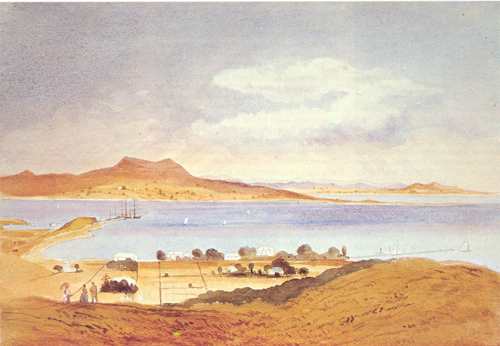
SIR WILLIAM FOX (1812-1893)
Onehunga, Manakau, N.Z., c1849
watercolour, 245 x 350mms.
Among early colonial New Zealand artists, Fox and Heaphy like Earle were outstanding in their response to the new country in their painting. Fortunately there were fifty Heaphys and twenty Foxs, including much of the best early work by both artists, in the one hundred NewZealand Company watercolours Alexander Turnbull purchased in 1916 for £585 from Francis Edwards Ltd. in London. The painting reproduced above is from the Wilkie Collection, purchased for $20,000 from descendants of the artist's god-daughter and including not only one hundred New Zealand views but also many made on Fox's travels around the world: fifty of unique importance having been made in the United States in the eighteen-fifties.
The library was accepted by the government and Turnbull's house on Bowen Street was purchased by the Crown to house the collection. Control was vested in the Parliamentary librarian. In January, 1919, Johannes Carl Andersen was appointed librarian and the Department of Internal Affairs became the administering department, an arrangement which was to last until 1966.
Andersen's requests for money to build a national collection on Turnbull's nucleus received cool responses from the Department. The growth of the collections by purchase was reduced to a trickle. The thinking of the time is reflected in the response Andersen reputedly received from the Under-Secretary for Internal Affairs when he repeated a request for funds for purchases: 'You've got a good library look after it'.
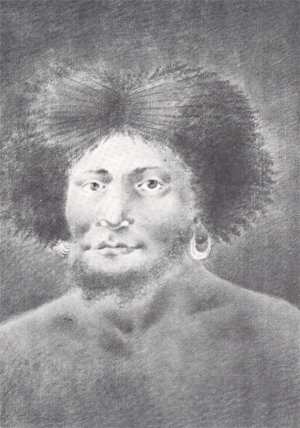
WILLIAM HODGES, R.A. (1744-1787)
Man of Tanna, New Hebrides, 1774, c.1776
red chalk, 550 x 375 mm.
Hodges was the official artist on Cook's Second Voyage. For two years after the voyage he was engaged in working up his sketches at the Admiralty, which still owns a number of the oils he then executed and which were exhibited at the Royal Academy over several years. A preliminary study for this portrait is held by the Public Archives of Canada, Ottawa, in their small collection of red chalk drawings made on the voyage; others are in the Admiral Isaac Smith Collection in the Mitchell Library, Sydney. This item was purchased at auction at Christie's London, for 500 guineas in 1973.
Starved of resources, Andersen could do little except preside over Turnbull's collection behind the closed front door of the library. It had been officially opened to the public in 1920: but the front door was to remain closed for nearly seventeen years.
Turnbull's friends, like Herbert Williams, the Maori scholar, continued to use the library as they had done during the founder's lifetime. Elsdon Best, ethnologist at the Dominion Museum, had moved into a room in the library in the early 1920s. New faces appeared: in 1922 the young John Cawte Beaglehole, studying Captain Hobson and the New Zealand Company for his M.A. thesis; then Thomas Lindsay Buick, housed in an upper room and producing book after book on New Zealand's history; and later H.E. Maude, the internationally known Pacific scholar.
The Library remained very much the preserve of Johannes Andersen and his friends until August 1936, when Clyde Taylor, the new Librarian-designate fresh from his training in the United States, had the front door kept open during library hours. This was the symbol of the transformation of the Library by Taylor (with the strong backing of J.W.A. Heenan, the new Under-Secretary for Internal Affairs) into a public reference library, welcoming all who wished to view or use the collections.
The citizens of Wellington and visitors came to the Library in their thousands to see and handle the books, manuscripts and pictures. It soon became known throughout New Zealand that the Turnbull's reference staff would go to extraordinary lengths to satisfy written requests for information.
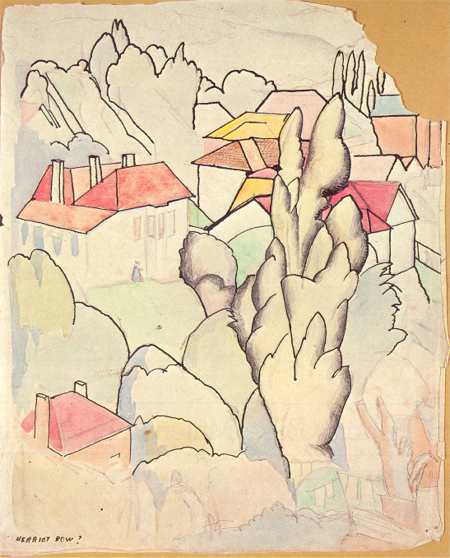
ROBERT NETTLETON FIELD
Herriot Row? (Dunedin) 1937
ink, pencil and watercolour
225 x 205 mm.
In the late 1930s the Government's centennial publications programme had the effect of increasing the small band of scholars using the library (they had hardly expanded since the turn of the century). Beginning in the 1950s and accelerating through the 1960s, the growth of New Zealand's universities and their development as supporters of research in the humanities led to the regular migration of university-based scholars to Wellington during the vacations. They created increased pressure on some materials, made demands on hitherto neglected collections, and required a different kind of response from the staff.
The slow evolution of Alexander Turnbull's library from the private preserve of a few scholars, through a reference library for the public, to its destiny as a national research collection took a leap with the passing of the National library Act in 1965. The Turnbull library was constituted as a part of the new National library in 'separate and: fitting accommodation' its parent was charged by the legislature 'To develop and maintain a national collection of library material, including a comprehensive collection of library material relating to New Zealand and the people of New Zealand'.
The National Library Act gave statutory recognition to an insight that is as old as civilization: that a country's future depends upon its past history, and that it has an obligation to preserve the records of its past and make them available for future generations.