
Exhibitions Christchurch
T.L. RODNEY WILSON
Among the visual arts offering at the 1978 Christchurch Arts Festival, sculpture, drawing and the crafts received predominant attention.
The New Zealand Chapter of the World Crafts Council assembled a heterogeneous collection of objects as diverse as a dog sledge, a renaissance treble viol, weaving and woodcarving, pottery and pancakes (well almost). Not always as fine as it might have been, it was, nonetheless, a stimulating show - testimony to a continuing vitality in the crafts community.
And it was popular, with crowds literally jostling for a vantage point from which to catch a glimpse of the offering. There is no doubt that the crafts appeal to the New Zealand sensibility - at what other exhibition would you encounter such a large turnout, and the buzz of a genuinely excited response? Not the muted murmur of dutiful worship in front of the high altar of a grand master hitherto unseen on these antipodean shores, but a raw gut appreciation all the way from the toes.
Is the stamp of an austere colonial past so indelibly impressed upon us that we can sooner find aesthetic fulfillment in an object of greater or lesser practical application than in such 'useless' objects as painting or sculpture? Or is it that the crafts make fewer demands upon us, pose fewer problems, leave us less perplexed?
There is, as yet, no answer to these questions, since, to the best of my knowledge, no surveys have been made of the requirements, likes and dislikes, of the New Zealand visual arts public. What percentage of our population attend museums and galleries - even for a bonanza craft show? How many of them habitually attend - how many ever return? Are those who do attend satisfied with what they get, or do they crave something quite different? Is the public growing or remaining a static percentage of the population? To what extent is attendance, education and income related: is it the same group who enjoy craft shows as enjoy something like the C.S.A.'s Festival offering - the avant-garde sculpture show Platforms? Is the attendance of a true cross-section of the public an appropriate or realistic goal for an exhibition organiser, or have the arts always been, to some extent, elitist?
If one believes (as I do) that galleries have a responsibility to pursue an exhibition programme as diverse in nature as is consistent with the requirements of standards, there could be little criticism of the Robert McDougall Art Gallery's - or the C.S.A.'s for that matter - offering for the Arts Festival. With the gallery virtually stripped bare of any permanent collection, it housed the crafts show at one end and the ambitious International of Drawings at the other. Organised on behalf of the Festival Committee and the McDougall Gallery by the printmaker Barry Cleavin, it was a highly creditable excursion into the initiation of international events by the McDougall - one that should be allowed to become a regular addition to the sparse international calendar of such shows.
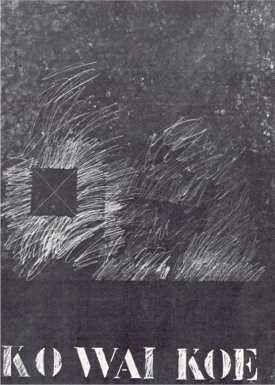
RALPH HOTERE
Ko wai koe
winner of the International of Drawings award
Drawings by 193 artists from 35 countries rubbed shoulders in an exciting global statement of what is current. No less heterogeneous than its neighbouring craft show, it revealed a situation where there are no large persuasive movements, that the common emphasis (if there is one) is on the individual's right to blaze his own independent trail. It was not all good - indeed there was some quite bad drawing. But very much of it was magnificent. What it did reveal by way of clarification of a local attitude, is that few New Zealand artists look upon the medium of drawing as a legitimate end in itself like many of these, their colleagues from abroad. Very many of the drawings were elaborate and beautifully executed pictorial essays, independent of other media or other processes.
A shot in the arm for New Zealand drawing was provided by adjudicator Hamish Keith's choice of Ralph Hotere's Ko wai koe as winner of the single, non-acquisitive, $1000 award. There were many other fine drawings: but there can be no question of national partiality; Hotere's award was richly deserved - a fine sensitive reflection on his ethnic, cultural and physical environment, a marriage of all that is best in the regionalist and internationalist visions.
Platforms at the C.S.A. was the exhibition which confronted the viewer with the greatest number of problems. It was the least popular (so it would seem from attendances) of the three major shows, and yet it was highly professional in its organisation and installation. A wooden tongue and groove platform, either a square, a long rectangle, or cruciform in shape, with an area of nine square feet, was the unifying element. In it, on it, under it, or with it, the sculptor 'made a stand' - or at least so claimed the poster and catalogue. The cavernous space of the C.S.A.'s major gallery, with its austere surfaces, made a perfect environment for this event; and although one felt at times that one was aware of more consummate works by each artist, in all cases worthy pieces were provided and these worked well as a total installation. Especially memorable were Neil Dawson's space expansive tilted cross, apparently defying the forces of gravity, and Greer Twiss' simple cross with a tense implied connection between the walls of the gallery and the piece achieved through eye bolts and short sections of bronze rope at both the cross arms and adjacent walls nodding to each other across empty space.
Three exhibitions about which some smaller, less ambitious shows were grouped; a spread of interest from the mass attraction of the Festival Crafts through the internationalism of the drawings to the esoteric sculpture of Platforms; and a more than usually successful visual arts offering for the 1978 Christchurch Arts Festival.