
Book review
OMAI : PACIFIC ENVOY by E.H. McCormick
published by Auckland University Press, 1977, 364 pages, $21.60
Reviewed by LEONARD BELL
Omai, to quote from the last sentence of this book, chronicles 'the rise and decline of [an] obscure figure who through an accident of history became for a time the most celebrated of all Pacific denizens.' Omai, a Raiatean commoner, was rather randomly taken on board the Adventure at Tahiti on Cook's second voyage, and subsequently transported back to England. There, as the first Polynesian visitor, he enjoyed considerable social success in aristocratic and scientific circles. After two years he returned to Huahine - on Cook's third voyage. His European 'benefactors' set him up on a small estate with an assortment of goods ranging from a musket and a suit of armour to horses and poultry - the cause of some resentment and envy from his fellow Raiateans. He died, apparently of 'natural causes', about thirty months later.
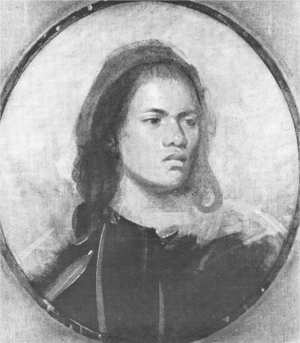
SIR JOSHUA REYNOLDS Omai c1774
oil sketch on canvas,
Yale University Art Gallery
That is the bare bones of the tale. So why a book about it all? The interest, the importance of the events lies in the responses and behaviour of both Europeans and Polynesians - in the ways in which members of different races and cultures, who had just encountered one another, endeavoured to accommodate the other. For instance: to what extent did Omai's English hosts try to make contact with him as a person; or to what extent was he treated as an exotic 'specimen' to be studied and paraded about; or to what extent was he stereotyped or fitted, perhaps unwittingly, to some pre-existing model of how 'savages' behaved or ought to behave As Dr McCormick states in his Preface, Omai was 'a kind of catalyst, provoking discussions on many' issues - moral, philosophical, religious.' For example, the debate between the relative merits and demerits of 'nature' and 'civilisation' - one of the big favourites in the mid-to late-eighteenth century.
Dr McCormick's approach to these problems and the Omai phenomenon is not one of analysis, 'explanation', or abstract interpretation. His method is primarily anecdotal - a narrative approach to history. He tells Omai's story from A to Z, almost day by day, by presenting a vast amount of detailed information about what Omai did, where he went, who he met, how people responded to him - in Polynesia, on the voyages, in England. The narrative is sustained by frequent quotations from contemporary documents - books, journals, etc. - and the range and organisation of these quotations is impressively, awesomely thorough. (One of Dr McCormick's aims was to put on record all the extant material concerning Omai.) The background to Omai's adventures - European exploration of the Pacific in the eighteenth century is also filled in extensively. Indeed in the first four chapters (93 pages) summarising the experiences of men like Wallis, Bourgainville, Cook, and Banks, Omai gets only the briefest mention.
The book is very readable. It could almost be a novel - a novel with pictures since it includes numerous reproductions (4 colour, 71 monochrome) of contemporary paintings, engravings, book illustrations - pictures of Omai and other Polynesians, Pacific scenes, and assorted associated Europeans. The transformations Omai underwent are exemplified by Sir Joshua Reynolds' three renderings of him - a pencil drawing, a small oil sketch of head and shoulders, and a large full-standing formal portrait. Who is depicted? Omai or 'Omai'. Dr McCormick quotes a late eighteenth century German scholar Blumenbach on 'the uncertainty of human testimony'. Blumenbach was not referring to the Omai story, but his comments are applicable. For all the illustrations, for all the detailed documentary information about Omai and Pacific exploration, the 'real' Omai remains elusive, an enigma. European responses to him ranged from very positive to very negative. Reports of his fate among his own people remain inconsistent. For all the activity, for all the energy expended, not much meaningful contact had really been made between Polynesian and European. There had been a series of accidents, contradictions, and misunderstandings, though with some good and useful results. The book raises plenty of questions about European exploration of the Pacific. It is open ended. We are not told what to think. Read it and see what you think.