
Colin McCahon:
A Reflection
TIM GARRITY
McCahon's work does not suffer the objective viewer gladly. Hence the difficulty and perhaps the irrelevance of discussing him in other than broad, brief, extreme and personal terms. The scholarly approach, of keeping one's distance without unseemly displays of enthusiasm, is impossible. The sort of scholarship that McCahon invites is symptomatic more of a culture's weakness than it strength. His work demands that we pass beyond the shallows of visual grammar to the deeper concerns without which art reverts to a sort of parlour game. And in discussing his work one tends to find that the philosophical vocabulary of existence and action is more relevant than that of aesthetics. But English lacks the sort of words whose possession by a people in daily use allows the communal sharing of those deeper concerns. Without adequate words there is no sharing: and no sharing means no commonly possessed culture. It is as simple as that. What is for some cultures the hard currency of the mind, overtly circulating at all levels of that society, remains for us, special, fugitive, suspect, marginal, even non-existent. In short we are apt to remain dumb in the face of the sort of existential situations which fuel McCahon's art, and which has been the stuff of this planet's art for several millennia. Small wonder then that McCahon frequently homes in on that outcrop of ancient knowledge still mysteriously present in every home after 3,000 years, the Bible. Bibles are domestic, like cats, soap, electricity and gas. That people never read their Bibles, however, is something that McCahon can hardly be blamed for.
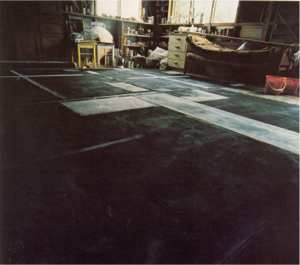
Colin McCahon's Muriwai Studio
(photograph Ian Macdonald)
British aesthetic stiff-upper-lippers like Bell, Fry, Read and Clark have, for their limited purposes, all been able to make do with the sort of words you could buy at Woolworths; long-handled words like 'significant' and 'interesting' which enable one to poke the fires of art without feeling the slightest sensation of warmth. But in Asia and those parts of Europe either historically close to Islam or too poor to industrialize properly, languages track the 'feelings' terrain more closely, so that nothing happens in art without a precedent in the expressiveness of language. In Spanish, for example the word 'duende' has overtones for art which empower it to nail the very qualities in McCahon which remain elusive to us here. Lorca made this word the subject of an essay (included in the Penguin edition of his poems). Duende, and words like it, relate to things outside the compass of our likes and dislikes - the understanding. In New Zealand there is an attitude that one is not expected to understand anything that one does not like. In art duende is something which no amount of training and hard work can fake. McCahon is not tasteful. He appeals solely to the understanding. He must therefore remain something of an anomaly in New Zealand where culture is firmly built on a consensus of taste tempered by an appreciation of cash value. Paradoxically it is this anomalous position that makes McCahon New Zealand's only major painter; a position he is likely to keep for ever if New Zealand society maintains its present course. To sum up, let us mess up Louis Armstrong's proverb by substituting duende for rhythm: 'If you ain't got duende baby, you ain't got nothing'. Between them, Armstrong and Lorca tell all.
By all accounts, if poets can be relied on, or trusted even, New Zealand must have been a pretty dreadful place about the time when McCahon was forging his career. There is indeed something oddly surreal about a people playing the National Anthem on every conceivable occasion and who called England 'home'. The poets tirelessly complained how difficult it was to stand upright in such a beautiful place. Obviously, for some, the isolation was a genuine problem. One's sanity is endangered when ambivalent feelings are entertained about anything as basic as a homeland. But for others, the isolation formed the basis of a perverse attitude, artfully struck for the purpose of galvanizing a dead muse into action. Basically the problem was this: the cultured descendants of English settlers just could not come to terms with the stark existential freedoms which New Zealand thrust at them. Accordingly they shunned the more basic existential freedoms for the secondary one of choosing alternatives to the primary freedoms. One could go abroad, one could stop painting or attempt to teach it, or one could continue painting by jumping on to one of the socially approved stylistic treadmills, and by taking refuge in the clubbish world of art societies, academies, committees and senior common-rooms. But in any event, what usually happened was that, in the Coleridgean sense, the risks involved in using the Imagination were traded for the simpler demands of Fancy. With the exception of McCahon, whose uniqueness lies not only in his ability to keep his imagination, but in his capacity to sustain it, the artists of the period produced not a single image which could not be traced to the pages of the English Studio magazine. They painted the hills, old churches, cow-sheds in various stages of decay, Maoris, cabbage-trees, etc., till they were blue in the face, but the end results were pure London Group, Euston Road, Camden Town, Slade Modern and a dash of Bloomsbury. One or two embraced the Royal Doulton landscape school of Charlton Edgar which alas had neither Imagination nor Fancy. Peter Tomory put it well when he said that the artists of the period 'recognized the visual forms' of New Zealand, but failed to 'read the felt image'. And it remains entirely a mystery and one of the central themes and puzzles of New Zealand painting, that a country so utterly staggering in its visual appeal and existential excitement should have produced just one artist with a vision to cope. Without McCahon, the case for a distinctively New Zealand art history would not stand up. If that history ever gets to be written, McCahon will cast a long and embarrassing shadow over the whole period. But perhaps the days of a distinctively New Zealand art are over. Preferring the cities, painters now are less rurally minded than they were, and a direct appraisal of one's environment is eschewed in favour of a seat in the waiting room of world art where one nervously flicks the pages of international art magazines in search of iconography.
Not surprisingly the first people to understand McCahon's work were not his fellow painters, but a handful of intellectuals and writers; those, presumably, who had enough uncommitted space in their heads to accommodate a set of tough, uncompromising images related to the place they lived in - people who had nothing to lose. A name that springs to mind is the late Arthur Prior, then lecturer in philosophy, and later professor, at Canterbury University College. He had a large 1950s landscape in his room at the University and presumably he took it with him to Magdalene College, Oxford, where he achieved fame as a logician. He was a whimsical man with a brilliant intellect, and it was something of a revelation to us then in 1951 that, while McCahon's reputation among his fellow painters was zero, the landscape should have occupied so dominant a position on the wall of that room.