
Editorial
Landscape, Civilization and New Zealanders
DENYS TRUSSELL
Stand on the farmed contours of the coastal hill country just south of Northland's Waipoua Forest and let your eye take in the rhythm of the slopes and the breaking seas to the west. Then look to the structure of the nearest modern farmhouse. You will have seen the strange contrast of civilization and landscape that is an everyday fact of our lives in this country.
The farmhouse sits four-square on its site, a verandah-less profile emphasising the lack of continuity between the domestic life within and the elemental life outside. The shallow gable in no way points to the depth of the sky, in no way equals the still powerful outline of the hills. Nor does the compound of the farmyard have any feature connecting it with the dark crest of kauri forest lying on the plateau to the immediate north.
This is a division in experience to be felt in any inhabited part of New Zealand.
You are walking at dusk through a maze of streets in a new housing estate of north-west Christchurch. The basic architecture is the same as that of the Northland farmhouse: the suppressed gardens, the fastidious curbing, the bland, sleek automobiles all reinforce one's impression that this is an environment meaning nothing beyond the most banal aspirations of man. An element of insecurity is present: but there is little of exaltation or beauty. Just comfort.
You do not even have to reach the outskirts of the estate to see the Canterbury foothills. They rise out of the horizon and extend in inflexible waves of rock and soil back to the pale ridges of the Main Divide: an image of the immensity of time, the presence of geology itself. The experience they suggest is cosmic, having no reference to the hermetic and vicarious life of the suburbs clustered on the plains fifty miles away.
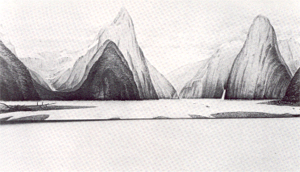
JOHN BUCHANAN,
Milford Sound, Looking North-West from Fresh-Water Basin,
watercolour, 216 x 508 mm.
(collection of the Hocken Library, Dunedin)
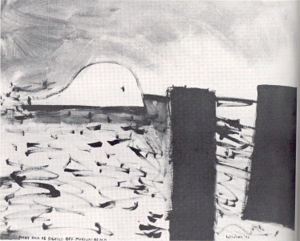
COLIN McCAHON,
Moby Dick is Sighted off Muriwai Beach 1972,
oil on canvas,
(private collection, Auckland)
Now perhaps more than ever before the human environment exists as a statement of mechanical will on the body of the land, suggesting nothing beyond itself: a finite and predictable 'City of Man'. This creates an illusion of being protected from the cataclysms of nature, but it also makes for a kind of isolation: isolation from the creative processes of evolution. Here people are cut off from the physical and spiritual basis of their being in the earth; cut off finally even from one another.
That we need not be insular is shown us by the great progressions of nature. Look out on the ocean and you see the macrocosm, an enormous organism connecting us with all the coasts of the earth. Take in something of that macrocosm, and you have enriched the microcosm of your self. Nature begins in the solitary stones of our beaches and reaches out to include the infinity of us all.
New Zealand, where it lies still in its primordial condition, reveals the naked workings of the elements. To its people it can be something incalculable and beyond themselves, like the future of their own imagination. For while the country has been physically measured by the cartographer, it is still little known as a human inspiration. In this sense it is still the enigma, Terra Australis Incognito, the elusive southern land, and has yet to find its way into our culture through the transfiguring power of the imagination.
This is because the process of osmosis between human intelligence and landscape is slow, and not yet very fruitful here. Many of our activities, particularly in the last thirty years, have no roots in this earth. They are, whether in architecture, engineering, town-planning, forestry or agriculture, based on the cosmopolitan styles of multi-national industry, or on a barren functionalism dragged out of the depths of our puritanism.
Though the white man has never been wholly disconnected from this landscape, the main thrust of his history here has been a vehement quest for security, alienating him from the matrix of the earth and the aboriginal culture that belonged in it. For in Maori culture the nineteenth century European had an example of ecological living: a life-style contained by natural systems. Nature and culture interfused, and the whole vision of creation was a powerful episode in natural symbolism, involving the earth and the sky in a passionate sexual union that resulted in the birth of all other life forms. And it was simple fact that the Maori either lived in harmony with natural systems or he did not live at all: a fact he transfigured by means of his art into a source of awe, terror and exaltation.
The European arrived here, bringing with him, not the dying form of his own 'ecological' culture in the old world, but the seeds of pure materialism. He was industrialising rapidly as he settled here. So from the beginning of colonisation, the mystique of industry affected his relationship with the land. It was the heroic moment of industrialism; the period when human exploitation of nature was least questioned. So the Maori culture, which had deep stylistic roots in landscape and an ecological economy, was not taken seriously. At best it was a dying curiosity, a hindrance to land development. In the 1840s few were in the mood to think about the integrity of the physical environment; fewer still to explore its metaphysical significance by means of art and ideas. The colonists were in a hurry just to get on:
They divided the land,
some for need, and some
for aimless, customary greed
that hardened with the years, grew
taut and knotted like a fist
A.R.D. Fairburn, Dominion, 1934
Colonial art was largely documentary, and too limited to scope to reflect an alternative vision. But a few works and painters began to get beneath the merely visual and start actually interpreting the landscape.
In 1863 John Buchanan, looking out at the mile-high cliffs of Milford Sound, created a powerfully stylised composition of what he saw. His style begins to match the terrific nakedness of rock and ice, and a new land with new dimensions speaks out from this work.
Charles Heaphy, commissioned to record the triumph of the white man in the new landscape, saw at times symmetries in ferns, in kauri forests, in volcanoes and mountain ranges, that had nothing to do with the platitudes of the New Zealand company, or the ethos of settlement.
Alfred Sharpe sometimes saw a strange but significant juxtaposition of the white man in the body of the land. His doughty humans, his colonial buildings sit in some of his works as if they had floated in from another world. And this was of course the literal truth.
James Preston, an amateur who travelled extensively in the Canterbury foothills, left work in which man figures as a naive evidence of alien life in an uncanny wilderness. He painted with an innocence of perception worthy of Gulliver on first approaching Lilliput.
Then, at the end of the Victorian era, Van der Velden came to Canterbury to conduct with paint a scientific exploration into the light and dynamics of matter in the new earth.
Retrospectively, in work such as this, one can find the beginnings of an interpreting vision in the colonial landscape.
The First World War showed that industrial civilization could and did devour its children. The disasters of that war, the failure of the young society to be a heaven on earth, the failure of the materialist philosophy of economic growth: these were common causes of disillusionment here in the first four decades of the twentieth century. Visually this disillusionment was underlined by a continuing failure of civilization to blend with landscape. Farming became more industrialised, more abstract with the growth of new technologies. It was difficult for a truly rural life-style to survive here when circumstances made farming nothing more than a function of the economy.
If anything, the vestiges of style and graceful living that some colonials had tried to establish in the rural landscape were disappearing from the buildings and the tempo of New Zealand life. People were drifting into the sprawling wooden cities, the forests were shrinking, the farms sinking into debt. Nature, even as a dark adversary of the puritan pioneers, was receding in the life of the population.
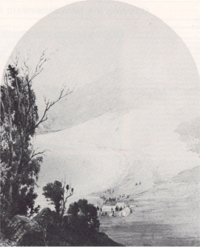
GEORGE O'BRIEN,
The Maori Race-Course, Otago Lower Harbour,
watercolour
(Peter Webb Galleries)
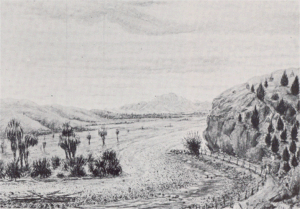
JAMES PRESTON,
Road beside a river,
watercolour
But this drift into modernity had its paradoxes, for it helped in the birth of a new artistic and intellectual honesty about the New Zealand environment. A whole generation of writers and artists among them Rita Angus, Christopher, Perkins, and the poets Curnow, Brasch, Glover and Fairburn, tried to depict, realistically, the often banal world of man against an implacable backdrop of nature:
Beams of day and darkness guardedly break on the savage forests that
from the groins
And armpits of the hills so
fiercely look.
The plains are nameless and the cities cry for meaning.
The unproved heart still seeks a vein in speech
Beside the sprawling rivers,
in the stunted township
By the pine windbreak where the hot wind bleeds
Charles Brasch, The Silent Land
By leaving us a fair description, an interpretation of civilization in a landscape, they gave us the means of criticizing, and perhaps finally changing, the destructive relationship between men and their land.
The Second World War and a steady post-war economic expansion forced us to an environmental crisis point: a deepening isolation of man from landscape. New Zealanders are now almost wholly urbanised. They are surrounded by the televised and neon imagery of multi-national commerce. They are aesthetically confused. Their notions of art are bedevilled by newspaper reports on the impresarios of the avant-garde in New York, and their walls are hung with sentimental nature painting of the worst kind.
Yet it is in these last thirty affluent years that painters have emerged who have an explicit interest in the spirituality of the landscape. McCahon's land paintings seem to identify man's spiritual hopes and fears with the light and darkness of the earth itself; Tony Fomison, a younger painter, also has a symbolic concern with the country's geography, and has shown that this strange wilderness can be transfigured through the insight of an inhabitant into an allegory of man's inward condition here. It is too soon to know whether this is the beginning of a rich and general cultural maturing, or just a flash in the pan before we are all consumed by cosmopolitan imagery and affluence.
But there is now not only an artistic inquiry into the landscape. The science of ecology has emerged to describe the emergency of environmental deterioration. As an image of nature, ecology is of particular interest to the artist. Its underlying metaphysic, that nature is a unity, is common to works of art which forge their own unified microcosm. The awareness that has enabled ecological causes to emerge into politics has long been possessed by artists. Their intuition of a unity in nature is the seed of a more general awareness of landscape here.
Ecology's stress on the unity of nature enables it to avoid, by definition, the arid specialisation of modern science. In politics it cuts across many traditional animosities. Everyone suffers from geographic attrition. Because of this, the ecological 'idea' unconsciously applied by pre-industrial cultures could be the basis of a new social synthesis. The crude industrial exploitation of the biosphere continues, but the scientific and artistic awareness of the meaning of human intervention here is growing.
The two visions, civilization and landscape, are still separate. There is more opportunity than ever to insulate oneself from the land. But there is also more consciousness of the need to be integrated into it. Many are beginning to starve for physical and psychological contact with the earth. The ancient core of their imagination in the macrocosm of nature has not totally withered within them.
Will we succeed in making a new synthesis of human genius and natural forces? Or will we become just the passive drifters of an air-conditioned tourism, moving across the landscape in a coma of affluence? If the latter is our way as a people, then we will be spiritual pygmies, cut off from the forces that created us. And the land will continue to die beneath our feet.