
Exhibitions Wellington
Men's Show Richard Lewer David Cross
REBECCA RICE
The galleryscape has been shifting under Wellington's feet lately. Christopher Moore Gallery is due to close up shop with Bowen galleries expanding to take over its space. Bartley Nees Gallery has vacated its premises on 147 Cuba St, moving to a more high profile commercially oriented spot on Blair St, freeing up 2 spaces that have rapidly been filled by Enjoy and Idiom galleries. So, in a curious move, Enjoy (which is demonstrating remarkable longevity for an artist-run space, having just celebrated its fifth birthday) has become sandwiched between 2 dealer galleries, Peter McLeavey and Idiom.
Idiom's second show in its new, more central spot was a 'Men's Show' featuring the work of 11 of Idiom's male artists. This show attempted to evade the pitfalls of the 'dreaded stock show' by having a male group exhibition that aimed to investigate whether or not there might be a male aesthetic in the visual arts. The hang did not pose any decisive answers to this question, but any interpretation of the works was less ideologically framed than Idiom's next group show of female artists, which is to be titled 'Domesticity'.
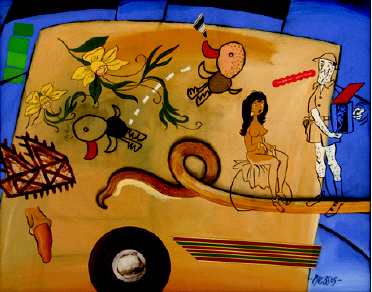
TREVOR PYE (Table-top) Postcolonial depression with sexual references 2005 Acrylic and mixed media on canvas, 800 x 1000 mm.
There were no fake plastic flowers here, and while rugby dominated the external media at the time, it was more a 'blokes in sheds' cliche that pervaded some of the works in the show. Paul Thompson's Technical Expert Series consisted of roughly knocked-up mock wooden cameras, recognisably replicating largely defunct models, such as the 1970s Kodak instamatic and the classic SLR. The lack of finish and words 'Klik' and 'Foto' stencilled onto the unsanded surfaces re-inscribed these models with a playskool mentality. These models acted as signifiers of the 'real' camera, whose presence was referred to in photographic prints that pictured the 'made' objects against a primary background.
Sam Broad's Tiki Robot Jumping Jacks X-series similarly exhibited the product of a tinkering complex. The basic interactive mechanics and luridly decorated surfaces presented a similar pre-occupation with the intersection of folk art and technology. Gordon Crook's digital prints seem to represent some kind of technological competency - maybe they could be the circuitry plans or sophisticated mathematical diagrams of a closet scientist - but they revealed themselves to be more playful than that, whimsically charting the movement of planets with arrows and lines.
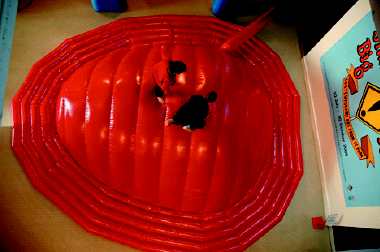
DAVID CROSS Bounce Performance installation at the City Art Gallery 2005
It's true, however, that one's interpretation of works is flavoured by the context of exhibition. Thus, while I found myself searching for telltale signs of a particularly masculine ego, instead, I kept finding indicators of masculine anxiety, particularly manifest in the small, tightly painted wooden surfaces that were the practice of at least three of the exhibiting artists, Roger Key, Bob Kerr and Matt Summers. Roger Key's surreal paintings reflect his 'bewilderment, amusement and disquiet of his [my] understanding of, and part, in the world'. Prevalent motifs suggest that he is less confident with a hammer and chainsaw than Broad and Thompson, or has at least concerns regarding societies' expectations of him in this regard. A woodstump topped with inexpertly hammered bent nails, and a New Zealand flag format with chainsaw replacing the union jack and perfectly sawn logs forming a southern cross attest to these anxieties.
Trevor Pye is perhaps the singular artist in the exhibition who deals directly with more cutting issues of masculinity. In a post-politically correct environment, he begins his paintings with the image of a tabletop, over which a disparate range of imagery floats in an undefined space. Pye overwrites the 'domesticity' of the tabletop with sketchily executed orchids and sexually suggestive shapes as well as blokey drawings of 50s pin-up girls accompanied by dodgy bylines. For example, in (Tabletop) Post-colonial depression with sexual references, 2005, the pasty colonist introduces himself to the exotic lady saying 'Me, white man ... good to friends'.
Richard Lewer, who previously painted directly on formica tabletops, enjoying the unpredictability of the surface, had his inaugural exhibition, 'It used to be so good', with Mark Hutchins Gallery. Here, a lack of control over the painting process was achieved by saturating the canvas with PVA glue, which produced an unstable skin upon which the paint would float, oozing capriciously and delicately across the surface. This technique provided the perfect metaphorical surface for the subject of the paintings, and aptly referenced the faded recall found in both the subjective remembering of childhood and in the supposedly more objective material remnants of the past, the family photographs.
The content registers and reveals scenes of dumped bodies, and a neighbourhood pool in which a drowning has just occurred, suggesting a certain irony is intended in the exhibition's title. All are depicted with the same naive storybook neutrality, an approach that is also apparent in the Venetian blind paintings, where, once again, Lewer finds a perfect pairing of media and subject. Elegantly drawn onto found Venetian blinds, Lewer's cartoonlike scenes of not-so-everyday-life tell stories peered at and guessed at from behind the blinds. Narratives suggest an amalgam of potential sources - crime reporting, small-town gossip, memories and the artist's imagination - depicting episodes from stories as diverse as a possible murder- suicide (or possibly a double suicide) in The couple ... they loved each other, to the pressures of familial expectations on teens in Failure.
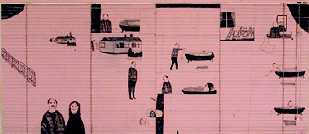
RICHARD LEWER The couple ... they loved each other 2005 Mixed media on Venetian blind, 750 x 1500 mm.
Lewer's charcoal portraits of Sarah, Sheryl, Helen, Janine and Catherine recall the work of Victorian polymath, Francis Galton, who used 'composite portraiture', combining photographs of different subjects to produce a single blended image, to attempt to discover whether particular 'types', ('criminal' or 'sick', for example), could be identified in the process. While Lewer may have drawn on recall or found images of real women, his work presents faces formed by a less objective process. During the process of making the individuality of any 'original' subject seems to have been subsumed by a composite 'type'. In this case, and in the context of Lewer's work, it seems they are perhaps a ,victim' type. A common feature to all five portraits is their luscious long hair, undoubtedly fetishistic, as demonstrated in Lewer's Ponytail bandit, and it is common self-defence knowledge that rapists prefer women with long hair to short, preferring a hairstyle that can be easily grabbed.
While the big guns of the European art historical canon were on show at Te Papa in an exhibition of drawings from the Royal Collection, Holbein to Hockney, the young (or not so young) guns from Te Papa's collection crossed the road to the City Gallery for Small world, big town. One fine Saturday in the middle of this bi-institutional show, a large red bouncy castle in the shape of a head was inflated in the City Gallery foyer. This was the centrepiece of the one-off performance by David Cross, accompanying his exhibition, Closer, in the Michael Hirschfeld Gallery.
Cross's meditation on his own 'imperfect' body, particularly his eyes which weep continually, is central to his art practice and performance. Cross's video work in 'Closer' juxtaposes the male beautiful, represented by models posing at the end of a catwalk, with the apparently grotesque, Cross's own figure, his face reddened and streaming with tears. Tears normally flow in association with emotion or to protect the eyes, but here, their out-of-control nature draws attention to the abject nature of those fluids that transgress the interstitial spaces that are part of every body. Thus they become an 'othering' feature, positing Cross as someone different from the norm-yet Cross admits that his use of the abject as an artistic strategy 'affirms your body as powerfully different'. The repetitive viewing of the supposed 'ideal' versus Cross's 'other' in the video problematises the apparently binary extremes of the beautiful and the grotesque - effectively blurring the lines between the two.
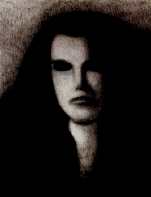
RICHARD LEWER Sarah 2005 Charcoal on archival matt board, 1600 x 1000 mm.
In a series of photographs, Cross's eyes confronted the viewer from behind toyshop horror masks, blown up larger than life. The conjunction of the pretend dress-up horror and the 'real' horror of Cross's weeping eyes acts to question the way that horror functions as a genre. But any horror in this encounter was muted compared with that involved in the performance, 'Bounce'. Shoes off, a running jump, and you found yourself on top of the red inflated face, only to come eye-to-eye with Cross' eyes through cut out holes, much like those of the masks. Cross's performance work often involves an element of endurance, testing the extremes of his body and allowing for a prolonged engagement with the audience. Here, Cross lay prostrate inside the bouncy castle for seven hours, peering out at those who made it to the top, providing an un-nerving encounter for adults, but amusing the school holiday crowds.