
Exhibitions Dunedin
Blue Oyster Gallery Iain Cheesman Ralph Hotere Maddie Leach
PENNIE HUNT
Although the Blue Oyster Gallery's International Art Fair and Cake Stall was more of a fundraiser for the artist-run space than a tightly curated exhibition, the show was no white elephant either. The collation of works donated by 39 artists for an equipment fundraiser also served as a review, surveying the last couple of years of exhibitions at the Blue Oyster.
The gallery itself is not normally in the business of sales and marketing and many of the artist exhibitors take advantage of the opportunity to pitch their ideas on a large scale and to a receptive audience. By nature their exhibits are often experimental and the work on show need not be saleable. Bearing this in mind, some of the artists contributing to the fundraiser subverted the notion of a prepackaged art takeaway, preferring instead to instigate an interaction with their prospective buyer. Some offered to install the work in its new environs, others to continue evolving the work beyond its sale-date.
Bridie Lonie's small, unfinished sketchbook titled Some of My Time contained partial drawings and. drafts, with the implication that these lines mapped minutes, the pages framed hours. Incomplete, the remaining sheets would be filled over the course of a month and the resulting product would represent a visible block of the artist's time. Similarly Ali Bramwell's Sketchbook, handful of unsigned ideas was a collation of conceptual sketches, unsigned and uneditioned, evading signatory authorship. Her laser-printed figurative sketches evoked the creative process, commenting on the way in which ideas are always in transit, shifting from objects to people and back again.
Other artists were more comfortable with providing a souvenir, a saleable work that acted as a memento or directive of their broader practice. Bekah Carlan's Picking flowers in the city at night used the throwaway materials of wire and tin befitting the weed-like status of the dandelion flower, transforming these into a whimsical testimonial to moments of the ordinary and everyday.
A single hand-packaged bar of soap presented by Teresa Andrew was emblematic of issues of purity and pollution at the heart of her practice. The soap was a nominal token from her recent works play-lunch (2003), a tupperware lunchbox offering up plain milk biscuits, milk and soap and an installation and performance dis-grace (wool, fat, soap, milk) held at the Dunedin Public Art Gallery earlier in the year. Andrew deploys these raw white substances to enact and stage rituals of replenishment and cleansing that ultimately comment on the decay (and cellular renewal) of the body. Harbouring restraint and complying with codes of decency, nothing in play-lunch was allowed to publicly spoil or defile. As if mothering her work, Andrew would refresh the cup of milk and would wipe clean the stark white surfaces of her dis-grace installation; cleansing and renewing what time had corrupted.
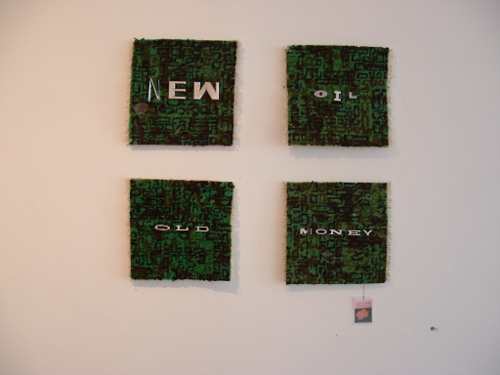
IAIN CHEESMAN Old Oil New Money 2004 Mixed media, 580 x 580 mm.
Couched in the materials of the domestic interior, lain Cheesman's recent works provide a seemingly benign lure. For his contribution to the International Art Fair Cheesman donated Old Oil New Money, a four-panel work on plundered carpet. The carpet, originally from Dunedin's old Century Theatre (and bearing witness to decades of foot traffic), was excised from the floor of the gallery's office and regaled with insignia salvaged from wrecked vintage cars. Each square panel appeared like a chest sporting an array of plundered medals, their arranged sequences spelling out the title emblem.
This was not the only occasion at which the work had been exhibited at the Blue Oyster - it was first shown with its companion piece, a bag entitled Victor/Avenger also made from the same ragged carpet and named for its classic-car precedents, the Vauxhall and the Hillman. The two works travelled in the Blue Oyster's Portable exhibition late last year, sent to other artist-run spaces in Christchurch and Wellington.
Dispatching his carpetbag north, Cheesman played the role of the 'carpetbagger' - a derisive term that hails from the period of the American Civil War when Northerners, carrying only bags made of carpet, travelled South during the Reconstruction. The term is still applied to opportunists who utilise a situation for economic and commercial gain. Though Cheesman's carpetbag was kept firmly closed, its wares undisclosed, there was a sense that the bag foreshadowed the contemporary briefcase, the trademark of the modem deal makers venturing East, as Cheesman suggests, to bag old oil with new money. As bags can import goods, they can also export them. The broader concept of bags and containers evoked by the paired works Victor/Avenger and Old Oil New Money can be expanded to encompass the money and arms that go into the East as well as the casualties and body bags that come out.
Cheesman's point was made more pressingly in a recent solo show Contact, also at the Blue Oyster. Here weapons of destruction were shrouded in padded pink quilting. A target was cut from a floral bedspread and formed the insignia for a large plane wing which was itself smothered in carpet and edged in lace. Making use of video, Cheesman muffled taped frames of war with shots of duvet covers, a reminder that daily news broadcasts saturated with such footage are beamed into homes and received in living rooms and bedrooms. Nearby parachutes made of linen evoked giant doilies, the kind set atop TV sets, veiling scenes of war with the ornamental and the domestic and suggesting the ways in which violence is both manifest and masked in the home.
Not the only local artist to take issue with recent political events, Cheesman provided an interesting counterpoint to the Ralph Hotere show at the Temple Gallery. Hotere's exhibition, simply titled New Work, presented 14 works, six 'litho-drawings' and eight lacquered corrugated iron pieces, most of which prominently bore the word 'Jerusalem' inscribed in blood red. Though the execution was bold, the works themselves were suggestive and undeclared - the significance of the word here ambiguous. Rather Hotere used symbols, to conjure and subvert ideas of the fraught Holy City, evoking a barrage of responses and a disquieting sense of political unease that is perhaps befitting. Following in the style of his Round Midnight iron works and lithographs from 2000, Hotere used the Cross of Lorraine, the heraldic double barred cross used as a symbol of freedom by the French Resistance during the Second World War.
Here the links with his Sangro series are apparent - both are reflections on death, yet in this case not the death of a brother but rather, as the French patriots might have claimed, 'of peace and brotherly understanding'. In other works Hotere used a Star of David, a symbol of Zionism made from shiny Union Jack postcards overlaid with a pun used formerly, the Double Cross, Double Union Jack. Though some of Hotere's earlier meditations on Jerusalem have reflected a local place, a site idealised in the poetic prophesies of James K. Baxter, the dark litho washes and red paint of his most recent works subvert any poetic notion of an ideal Jerusalem. The word itself is here like concrete, casting an uneasy pall.
At the Dunedin Public Art Gallery, Maddie Leach's installation Take Me Down to Your Dance Floor transformed the ground floor BNZ gallery into a cool minimalist space. The dance floor, manufactured to Leach's specifications by her Dunedin based sponsor Wood Solutions, was comprised of a slick wooden surface bisecting the gallery on an angle and cornered by two metal leaning rails. This slightly raised triangular platform framed a company logo routed into the floor, standing in lieu of the artist's signature.
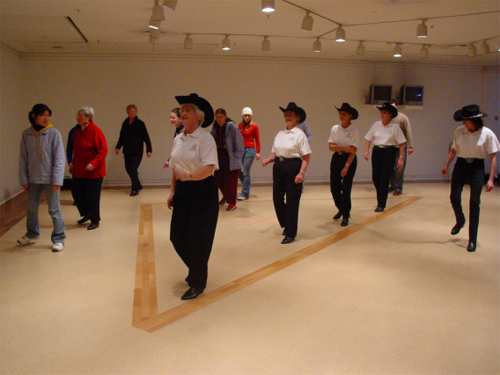
Maddie Leach's Take Me Down to Your Dance Floor at the Dunedin Public Art Gallery
Viewing the exhibition on a weekday generally meant that this symmetry remained uninterrupted. The dance floor, on which activity should be native, instead upheld a monumental emptiness and standing alone on its polished surface seemed an imposition, the idea of dancing alone an absurdity. Coupled television monitors suspended above the dance floor and flanking its edges screened a continuous video loop. The footage showed the horizontal passage of ships at night, their slow shifting lights suggesting movement where there was none and evincing a ghost presence in the gallery for which imagination was called upon to fill the space.
The work's status as both dance floor and an installation remained somewhat at odds during the course of the show. As Leach's ice rink in Hamilton was more of a laneway than a circular promenade, her Dunedin dance floor similarly circumscribed movement, restricting the formation of steps within its pyramidal wedge. Groups of dancers used to more traditional square or rectangular dance floors had to adapt their performance to fit the requirements of the artwork. Another factor creating a discrepancy between form and function was the 'look' of the work when the space was unused. Its clean and carefully crafted aesthetic generated the kind of emptiness often felt by gallery goers in the face of modem art. Yet this lost audience were subsequently recaptured by the dance performances and drawn back into the work as engaging spectators, far more conversant with the situation and activity taking place.
On the weekend, when the orchestrated series of performances and classes by local groups from Rock-'n-Rollers to Hip-Hop dancers imposed upon the floor's architecture and the gallery's quiet, the installation became the backdrop for an event. Whether lured by a call broadcast via the loud speaker, the jangling emissions of the rather tinny sound system filtering out into the atrium or by the open display of bodies glimpsed through the glass fronted gallery, people were gradually drawn in. These clusters of human bodies, dancing and watching, etched their own rhythm on the space, generating an interesting and sometimes odd transaction between the manufactured and the crafted, the professional and the amateur.
The various groups of performers, draped in a menagerie of costumed splendour at times brought an endearing awkwardness to the space Leach had created. Sometimes there was the sense that the dancers were uncomfortable in their surroundings, though others seem to revel in the opportunity to capture a crowd. In opening the gallery up to these sorts of experiences, Leach makes an interesting observation regarding the interaction between people and the public spaces where our social interactions take, or fail to take place. She enables us to engage with, or at least imagine ourselves in the picture rather than just viewing it from a distance, like the ships on the horizon.