
Exhibitions Auckland
JON BYWATER
IKI and thanks for all the IKA Francis Upritchard & Rohan Wealleans Peter Robinson & Seung Yul Oh Tame Iti Jacqueline Fahey Lauren Lysaght Lisa Crowley
Up at Artspace, Tobias Berger's title IKI and thanks for all the IKA substitutes the Lithuanian word for 'so long' and the Maori word for 'fish' into Douglas Adams' '80s British comedy sci-fi book title, for no more serious reason than to acknowledge the unlikeliness of the geographical connection the show makes, being about Pacific practice and conceived for a Lithuanian venue. In its Auckland incarnation, following stints in Vilnius and Rarotonga, it incorporates East European work alongside the self-described 'resident tourist' German curator's take on the Pacific.
The thank you, though, also resonates with the reciprocity in Berger's gesture, sending something back from his new community centred on Auckland to the community in which he lived and worked on the. Baltic Triennale; a personal connection arguably much less arbitrary than that made by the concurrent, vastly more expensive, one-way export package of Paradise Now? Contemporary Art From The Pacific in the entirely likely location of New York City.
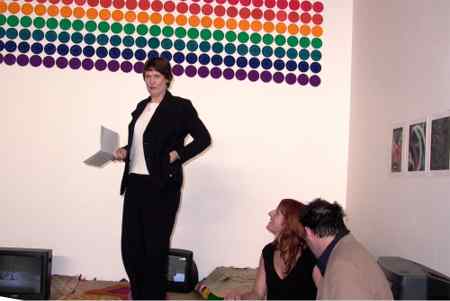
Helen Clark at the opening of Artspace's IKI and thanks for all the IKA
IKI ... IKA captures a colourful, tropical and subtropical, colonisation and tourism-shaped landscape of mangroves, flowers, souvenirs and material underprivilege. Characteristically full and multifaceted, Berger's selection of works goes well beyond usual local self-identifications as Pasifikan, to include several pakeha/palangi contributions. The state housing that is a backdrop for much of Aotearoa's Pacific Island community, for example, shows up in Ava Seymour's work. Francis Upritchard's fantastic, museumistic shrunken heads provoke responses based on a range of investments in colonial history.
New work by Upritchard shows at Ivan Anthony in Albino, a joint exhibition with Rohan Wealleans. Here her distinctive feel for endearingly grotesque glass case specimens produces freakish furry apes. These sit with Wealleans' paint-layered sculptural canvases (here more than ever like paint stalagmites), which incorporate a fascinated but wholly in-my-own-head pastiche of tapa cloth and carving motifs, to create a kind of Tomb Raider 'South Seas' imaginary South Pacific.
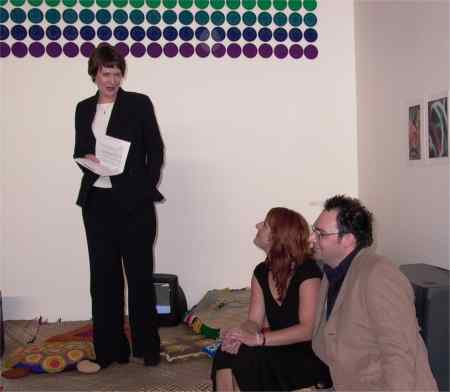
Helen Clark at the opening of Artspace's IKI and thanks for all the IKA
Having previously exhibited a teenage girl's pinboard and giant vulvas, Wealleans' anti-PC flagrancy about displaying imagery that derives more closely from other people's experience comes off better in this version. As with Upritchard's previous 'Maori' artefacts, the palpable risk of toe trampling adds to the fundamental, intriguing oddness of the work, while the sustained and detailed follow through vouches for the mitigating seriousness.
Luridly totemic 'lost tribe art' was an earlier mode of Peter Robinson's. His title Neo Conceptual Primitivism alludes back to this, in his half of another joint show, Asian Caucasian Stein, with Seung Yul Oh at Anna Bibby Gallery. His early 'primitivism' - furry logs, sticks with eyes - coincided with his first public moves towards identifying with his Maori whakapapa, reading as a barbed fulfilment of what might be expected of a non-European artist. Here, labelled as the Caucasian half of the Stein, the primitivism is one of rude sculptural effect. A haze of connotations around smoking, addiction and discomfort hang over the exuberant materiality of Fag Time. Sculptural foam chunders in plumes like ruptured cockroach guts amidst deposits of glossy blacks and matt rubber. Big 3D extrapolations from the figures he has based on Philip Guston's famous painter / smoker / klan figures, some of the unease seems to be about the artist at the mercy of his influences.
Seung Yul Oh also presents big, dumb objects in his half, The Pet Show, Site I, two much larger versions of the concrete-coated elephant figure he showed in Picture at the George Fraser last year. Scaling up from vacuum cleaner to playground proportions does not add much to the understated humour of the feebly flapping ears, bleating sound effects and cute power-cord tails, nor the basic open-ended possible significance of a stylised elephant.
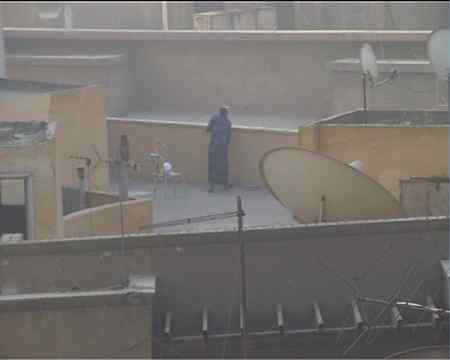
LISA CROWLEY Garden City 2003 video still extract
Ethnic identity is a given rather than something in question in Tame Iti's practice, and the clarity of his position doesn't make him any the less playful. Artspace may have had the Prime Minister to open IKI ... IKA, but it was Iti's The Prick at Gallery Salmonroot that made it onto the front page for his invitation to National Party spokesperson on Maori Affairs, Gerry Brownlee,to open the show. Where Helen Clark could make the positive connection to Lithuania's impending membership of the EU, an important export market, Brownlee had to step up to a challenge on his position on the Foreshore debate.
Compared to the patiently-crafted works Iti showed earlier in the year at the Gully Lounge, The Prick is rapid fire. Full of expressive marks the works fit the most conservative definitions of art; the technical roughness begging to be excused as a mark of urgency. The signature on each piece, 'T.Iti' suggests the word 'Tiriti'. Ambiguous stick figure crowds populate a horizon line in illustrations of contested foreshore ownership. The greetings card size, quickly worked sketches are a vehicle, a focus for discussion, more than ends in themselves. A sense of humour (cartoons of 'trespassers will be eaten' signs) shows that this is not all earnest expressionist protest. Iti's talent for using art as a space for exchange, for the creation of new possibilities, is in the intervention represented by the event of the show more than in its aesthetic invention. As further evidence of his lived creative practice, he presents letters from various agencies that have politely refused to accept paintings as payment for fines (a move amusing in relation to Billy Apple's PAID series, where the artist's bills are transformed into artworks when a patron pays them).
Up front political content is characteristic of Lauren Lysaght's work. Her Whitespace show Certain Circles comments very generally on pretension, privilege and exclusion. In its Newmarket location, where addicted-to-shopping bumperstickers are unselfconscious self-presentation, she amplifies just that kind of joke at others' expense. One of the best examples is an exquisite embroidered gang patch for Men Against Change, with dinosaur rampant. It is a sample of a range where some gags were stronger than others, though. The repetition of the formula across the wall has the visual vigour but not the greater specificity of reference of her best work.
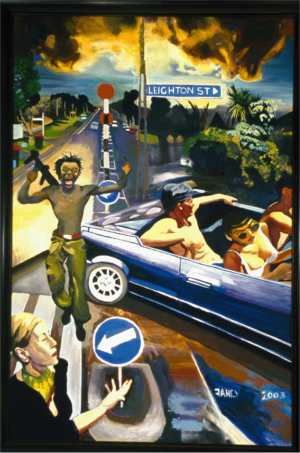
JACQUELINE FAHEY Apparition on Williamson Ave orThe Spirit of 2003 2003 oil on canvas
Jacqueline Fahey's new paintings in Bringing It Home at the Anna Miles Gallery, depict her immediate locality of Williamson Ave in Grey Lynn, but in a way that makes visible her awareness there of other places. News broadcast explosions and gun wielding fighters are shown as features of the local landscape, mingled with assaults, motor accidents and shoppers at the dairy. Her compositions draw on Renaissance narrative conventions, and the colourful paint handling resembles post-impressionist technique; the characters repeated from work to work coloured in a Gauguin-esque glow. These block buster reference points in tradition are marshalled as resources with which to posit the dilemma of the painter in the face of violence and suffering, whether on the doorstep or as newsbite. One title asks simply 'Can Painting Change Anything?' As with Robinson, Philip Guston, currently the subject of a major show at the Royal Academy in London, comes to mind, for his famous angst over the meaning of art in relation to state level politics. (Guston: 'The war, what was happening in America, the brutality of the world. What kind of a man am I; sitting at home, reading magazines, going into a frustrated fury about everything-and then going into my studio to adjust a red to a blue.')
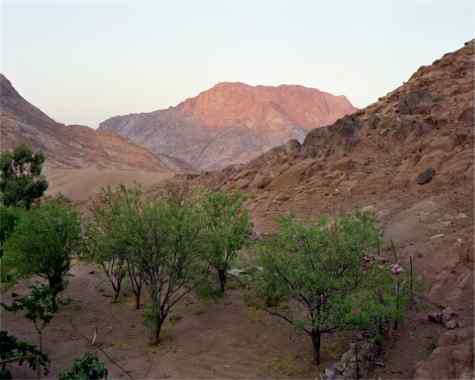
LISA CROWLEY Sinai Desert 2003 C-type photograph
Lisa Crowley's Garden City at the Gus Fisher is also charged by its relationship to media imagery. A main component of her exhibition was a small city of plinths bearing video monitors, each giving a few minutes' view onto roof gardens in Cairo. These views keep the domestic scenes they reveal at a distance, overseen rather than participated in. They skirt the Orientalist tropes of the veil, the screen and the courtyard as emblems of the cultural inaccessibility of the 'east', substituting the discreet remove of the politically sensitive traveller. It is the lack of incident they display that is most striking. Elsewhere large format photographs of Middle Eastern landscapes similarly betray expectations of violent action bred by the kind of televised news Fahey references. We are confronted with someone else's home, exotic to us perhaps but not living up to its pre-exposure as the sets for the terror of the Bush Administration's racist War On Terror.