
Eion Stevens
JOHN DICKSONEion Stevens' retrospective exhibition of paintings from 1976 to 1996, which was held at the Centre of Contemporary Art in Christchurch, was in two parts. In the main exhibition room, there were 28 paintings, most of them from the artist's own collection; and in a smaller and much darker room, there were 20 paintings for sale. These bare facts can be considered as evidence of Stevens' dedication to his chosen art of painting, and of his need to sell works so as to continue painting, not so much for the money, but for the knowledge that people enjoy particular works enough to want to live with them. In a sense, then, Stevens is a professional painter, a craftsman who has worked for 20 years. Of course, there's much more than the bare facts, whatever they are.
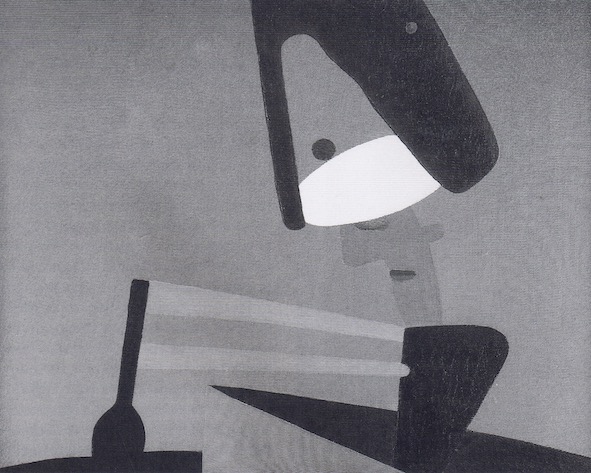
EION STEVENS Journey 1995 Oil on board, 500 x 620 mm.
I have always found it interesting to look at exhibitions based on an artist's own collection, because what you see are not always their 'best' works, but those in which they still see possibilities for new work. Furthermore, you can see how they go about creating their unique mark, particularly in a time when there's a massive proliferation of images, including those of art works. In such a context, a painter will not be working as though nobody else had painted a painting, and thus it becomes a specific challenge to not only assimilate various influences, but make them over into their own work. This is something that Stevens has successfully achieved.
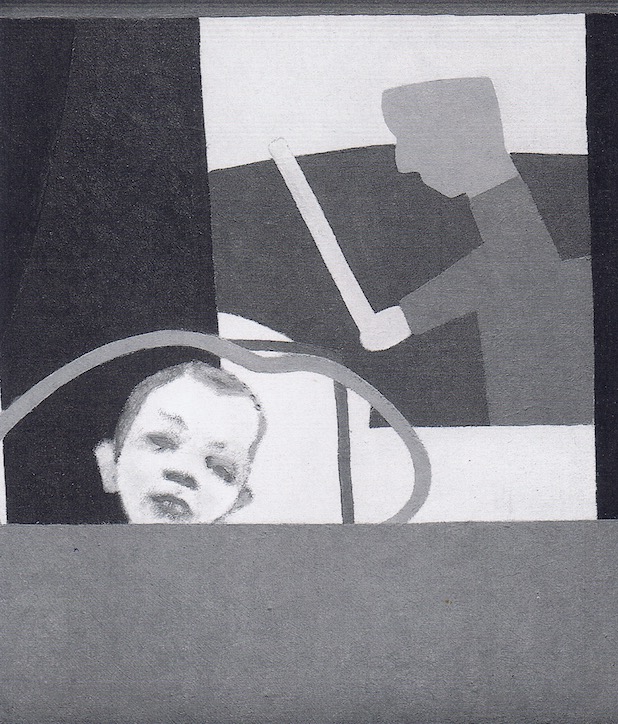
EION STEVENS Sleep, Sleep 1987 Oil on canvas, 560 x 480 mm.
In his work, Stevens not only uses various photographic images such as the head of a dead communard from the Paris Commune, or a Mapplethorpe lily but, more importantly, he also shows that he is prepared to learn from painters he admires. For instance, the earliest work in the exhibition, Untitled (1976), makes use of what the exhibition catalogue calls 'elements gleaned from Italian Renaissance art'; but then, in subsequent paintings, and with growing confidence, he begins to cross the influence of the Italians with the influence of Kitaj, Charles Blackman, and Miro, amongst others. Combine this with his considerable ability as a draughtsman and colourist, and his work develops into an often surprisingly moving simplicity in its exploration of psychological space.
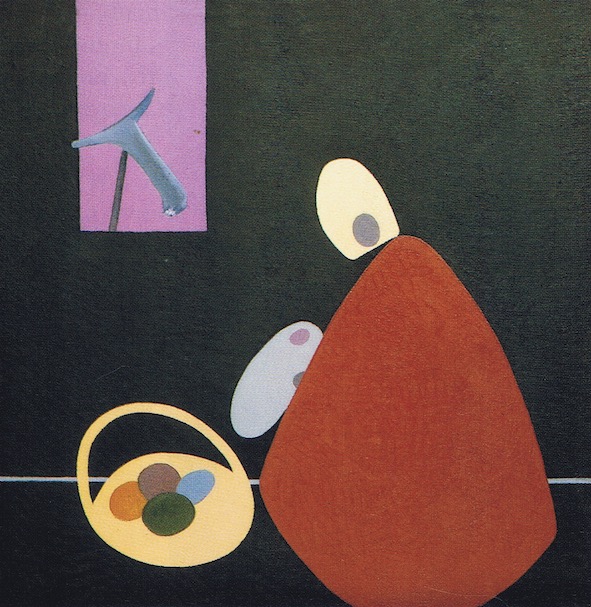
EION STEVENS Adoration of the Child 1995 Oil on board,820 x 820 mm.
Adoration of the Child (1995) is described as 'an improvisation on a painting by Tintoretto in the same manner that Miro briefly explored in the late twenties', but such a description does no justice to Stevens' painting. As Caroline Barnes points out in her essay which was made available at the exhibition, in the original, the mother and child are the most important elements, compositionally and emotionally. In Stevens' painting, the basket of eggs or gifts is larger than the head of the mother and much larger than the figure of the child. And I would add, the importance of the basket is further accentuated by being painted in a rich golden yellow, whereas the mother's head is a lighter yellow, and the child a gray shape which recedes into the surrounding black wall. We can ask, What kind of world is this, when a child is less important than the gifts intended for it?
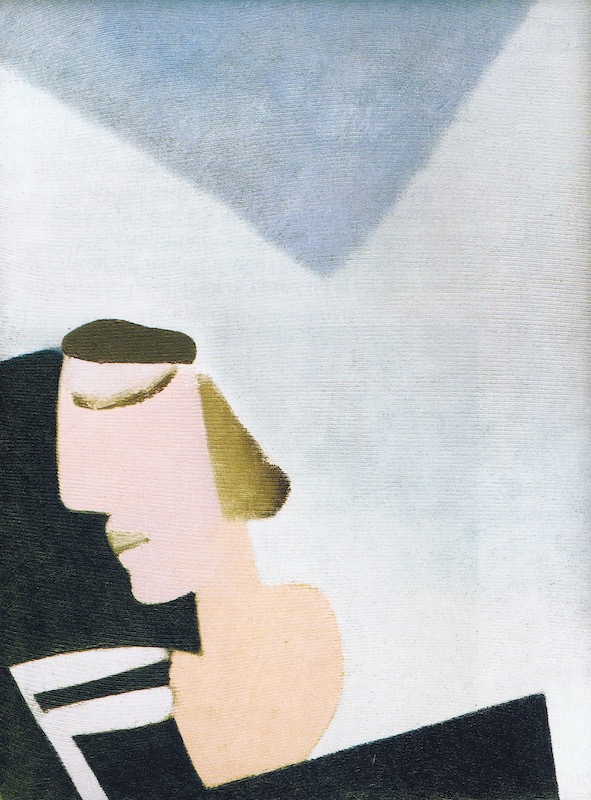
EION STEVENS Rowing to France 1992 Oil on board, 640 x 460 mm.
Perhaps a clue can be found in the recurring imagery specific to Stevens' paintings, particularly in the way he typically renders humans as disembodied heads. One of the more extreme examples of this is Local Knowledge (1992) in which the head of a horse or donkey is talking to the bowed head of a bearded man which is also on a stick. In Bound for Glory (1978-79) the head is completely bandaged. In Sleep, Sleep (1987) Mr Punch is threatening the haloed head of a child with his stick. Such images abound. And often, the paintings display a disjunction between their meaning and their vibrant colours and peaceful composition. This disjunction can invite laughter, but more often than not, it serves to accentuate the sadness of a world in which humans are subject to forces greater than their own. In many ways, the psychological space of these paintings is that of unresolvable conflict, like that of a child venturing the absolute while riding a familiar rocking horse.
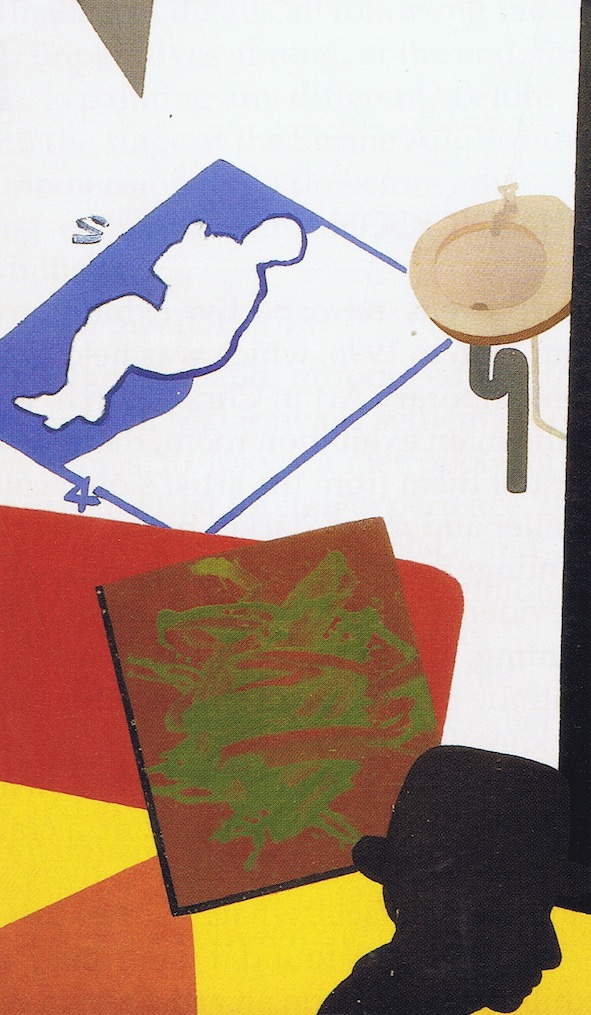
EION STEVENSPrisoner of Conscience 1985 Oil on board, 910 x 560 mm.
My favourite painting in the exhibition is entitled Journey (1995). The painting is not only beautifully composed, it also provides a way into a particular quality of Stevens' work. A figure with a jaunty white cap, punctuated by a red pom pom, is manfully paddling his way to some unknown destination. And all would be well, except he is so wilfully oblivious to everything other than his destination, he doesn't notice that he's about to be swallowed by a whale descending from above. His cap is already disappearing into its gaping jaws. His journey is about to begin in a very unexpected way.
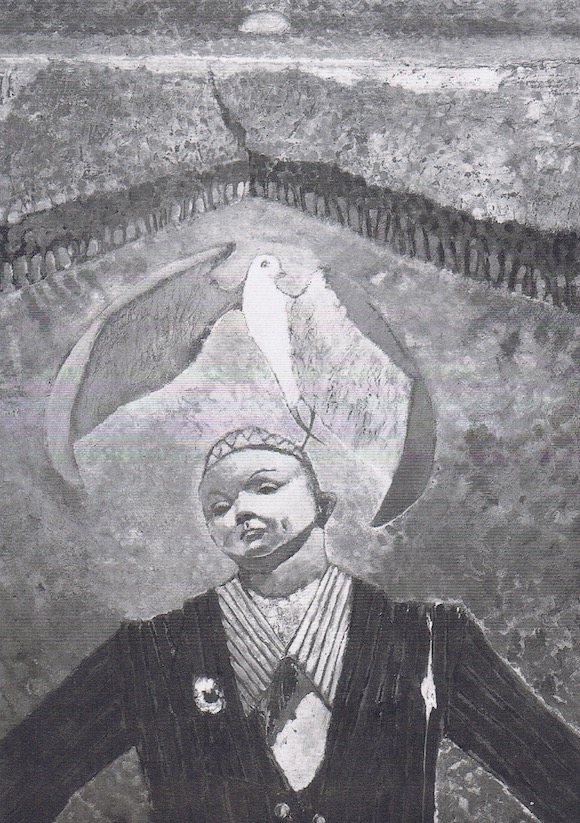
EION STEVENS Untitled 1976 Oil on board, 1100 x 800 mm.
When I viewed this painting on my third visit, while marvelling at the luminous blue of the sky, I thought of Colin McCahon's Moby Dick seen off Muriwai Beach painting. Unlike Journey, McCahon's painting belongs to The Sublime, and in case we miss the point, the caption in the upper left corner tells us that the whale is not just any whale but Moby Dick. And while I'm a fan of McCahon's work, I'm sometimes irritated by the way he often tries to completely settle the meaning for the viewer (although I acknowledge that his paintings also take their particular risk as to interpretation; I think, here, of the Australian senator who unintentionally provided a great mis-seeing of Victory Over Death 2 by describing the I AM as the world's largest painting of a digital clock). Stevens' paintings are different. They allow, if not invite mis-seeing. In the case of Journey, for instance, Eion Stevens said to me that the whale was not intended to be a whale but a muppet hand as serpent, and then he added, but it doesn't matter, it can be a muppet hand as serpent, or a whale. Which goes to highlight the unexpected magic Stevens' paintings bring out in the viewer, because while McCahon's whale is still at sea, the whale I constructed out of Journey, falls out of a luminous blue sky.
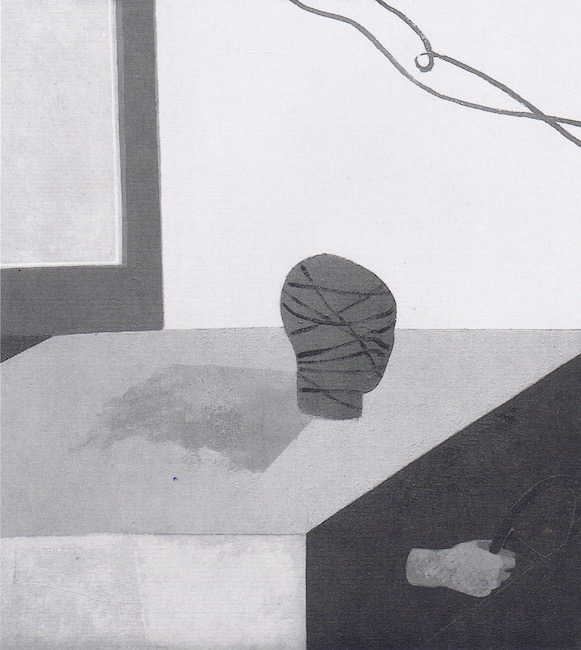
EION STEVENS Bound for Glory 1978-79 Oil on board, 850 x 850 mm.
In conversation, Eion Stevens comments, 'I'm only a painter when I'm painting', which to me is a refreshing attitude, when, on the one hand, the media makes much of the life of an artist, while on the other, art theorists tend to consider art as only a field on which to prove the validity of their theories. And as much as I would like to explicate the meanings of his work, and tell you that it's the work of a man who is influenced by the work of certain European men, and so on, I remind myself that when I finally walked out of the exhibition, I was left with memories of yellows and blues and greens and reds, composed together in images I would love to see again, because what matters to me is the material beauty of his paintings.
PHOTOGRAPHS: BILL NICHOL