
Bryan Dew
Images from the Sixties
D. H. BINNEY In those social gatherings I saw, there seemed to me to be a lot of self-consciousness. People often seemed to be strained, awkward, and unsure of themselves.'(1) Bryan Dew was born in Hastings in 1940, the eldest of three children to relatively young parents. Home life in that fruit and canning centre, where the high point of any weekend might be the beergarden of the Mayfair Hotel, was stable and unpretentious. He was spotted by Norman Haigh, a local columnist, as a young artist (2) to watch. Bryan went to the Elam School of Fine Arts for four years from 1958, to be in receipt of Auckland's presumptions—less than cosmopolitan, yet able to make him feel diffident. As if in answer he drew, with 6B pencil or ballpoint pen on cheap paper in the lineaments of caricature, ponderous business-men and officials and their social antitheses—pimply dance-hall youths, Bathing Beauty competitors, 21st Birthday recipients and just-marrieds.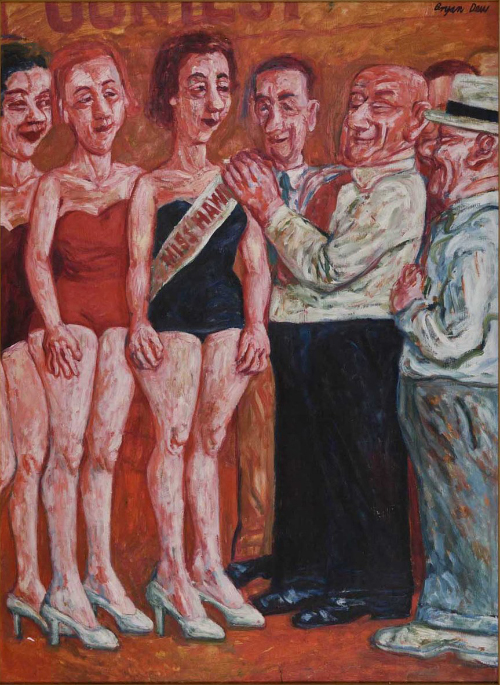
BRYAN DEW Beauty Contest c.1960 Oil on board, 1120 x 815 mm.
These he learned to paint well in oil, although on self-deprecatingly humble surfaces. 'Gallery size' painting was, just then, establishing its scale; Michael Nicholson, Robert Ellis and Don Driver were beginning to emphasise professional practice; but 20 years would pass before any art students would start worrying about the archival qualities of their work. With import restrictions a reality and rationing a recent memory, over-expenditure might look effete. Anyway, Bryan was apt to watch his every jump. In Auckland he was open to the teaching of Nicholson and Ellis; he also got to know McCahon. Graham Percy, a talented Graphic Design student, was of considerable influence then, and later as a friend and fellow-expatriate. (Thirty years ago, Elam students Dew, Percy, Thorburn, Perry, Carter-Hansen and myself were majoring in Design: Painting was still reeling from the death of Augustus John.) Bryan's design work adapted upon typeface layouts; his drawing style and content put him in demand as an illustrator for university and literary journals. Hence, he had workshop contact with Bob Lowry of the Wakefield Press—a robust personality who became as close a friend as any outside the artist's peer group. The wider aspects of New Zealand art Bryan regarded with informed reserve, his master exemplars being Soutine and Ensor. New York and its artists were a major interest. Not a few Ben Shahn postures, gestures and eye-line references find resonance in Bryan Dew's work. For reasons now clear, Jack Levine was important—in Dew, as in Levine, there is a tendency to condense slightly adult body-length of depicted figures for enhanced compositional concentricity. Evergood was important, George Grosz identified; add Alfred Leslie, Larry Rivers, mid-career Guston and those turn-of-the-sixties sound-alikes from Saul Bass to Mort Sahl. He identified particularly with the gentle-awkward anti-heroes of John Cassevetes' Shadows who talked, disengaged, about 'normal-type guys'. (Thoroughly aware of the Beat Generation, he reserved a special scorn for some of its local imitators.) He appreciated early Bing Crosby and corn-black-bread-and-molasses blues. He read Esquire, Look, occasional Mad comics. Britain seemed to figure less, though there he would first go, for Royal College qualifications; he was aware of Jack Smith, Bratby, the 'Kitchen-Sinkers' and the 'angry' b&w social-realist cinema of those days. In hindsight, Dew's work of the early '60s can be seen to be moving against ascendent local ideals. Ellis, Bracey, Illingworth, Smither and I were seeking personal, or national metaphors within the land mystique of Pacific Light, of located places hallowed by the rites of depiction. But Dew's imagery was largely interior, tungsten or flash-bulb lit; densely, if awkwardly, inhabited. By this view he was to remind a nascent mainstream of a base-culture which, despite purportive idealisms, it was possibly running away from. Himself intimate with that ethos, he perceived its frailties and insecurities which he knew the better by his bonding, his roots within. Florid pink, ochre, cobalt blues and grey are the colours, and little tonality—darkness of pigment just announced itself with every inevitable national ensign or serge suit. Such is the nature of the paint. The eye, the hand, is that of the native son. The man who talks to the masters of Pig Island About the love they dread Plaits ropes of sand, yet I was born among them, And will lie some day with their dead.(3) In the New Zealand of Nash and Holyoake, too many Chairmen, Mayors and MPs spoke in hard, rebuking monotones between dour jowls, under horn-rimmed bifocals; belligerent metaphors were many, repressively featureless suits sporting the RSA badge; rituals of civic circumcision they performed, upon yards of tight ribbon. To view such figures as other than correct was to risk disparagement for being Bodgie, Beatnik, or Red. Insufficiently radicalised to be any of those, Bryan formulated his own panorama of social uneasiness, somehow extending from the Napier Earthquake to the Cuban Missile Crisis. His painting took place, quite precisely, in the Kennedy years—his later studies at Elam, then 'post-grad' training in Auckland and teaching in Hawke's Bay 1963 before leaving for Britain that year. To see Dew's work now is to view preconditions to important issues of the 'sixties, and ones to follow: matrimony, piquant as pre-sliced bread; acrimonious old soldiers recommending more Asian war to their young; women in party or beach costumes, when 'chick', 'dolly', 'bird' (not to mention 'sheila') were endemic nouns; civic celebration, so bleakly short of Celebration. He differed with social propagandists, though: power and pomp he saw in its blind folly, but short of outright tyranny; and his plebs and proles are no enslaved, pure watchfuls to some Red Dawn but awkward youth like his own, struggling to be free from acne, inadequacy or ill-becoming trappings status or epoch.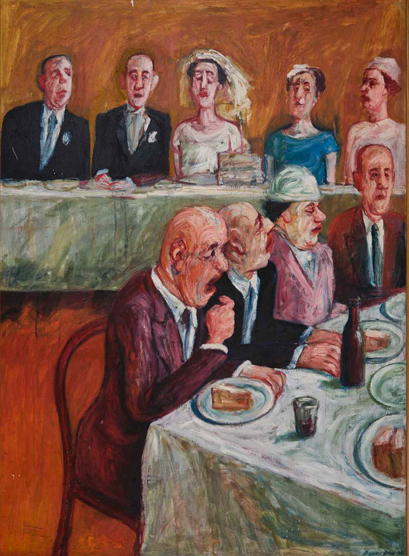
BRYAN DEW Wedding Breakfast 1961 Oil on board, 1100 x 800 mm.
Take his Wedding series, on Whakatane Board: demure Bride, shy Groom, Best Man, all focus to a hall of bug-eyed men and po-faced ladies; each table beer hymenally joined with every soda pop in a paper then napkin embrace. Or a Bride, teeth oddly a-jut (by then he had seen reproductions of de Kooning's women) knifing a tiered cake as if in blood sacrifice. Men in Dew's paintings do grin, seldom smile; females mostly grimace. Their collective biology—craggy jawed genes from Loch Neague or Strathclyde, cellulite, false teeth and varicose ulcers—navigates an environment of lounge suits, rust carpet, taffets, faceted-plastic salad bowls, keg beer and sponge cake. Dew would go to an Anzac parade for its subject matter but be repelled by archaic-accented chauvinism. If there was any malice in his imagery, then he was drinking at its spring, alongside each depicted Alderman, or Showgrounds Rube. His view was before, beside—but not from above.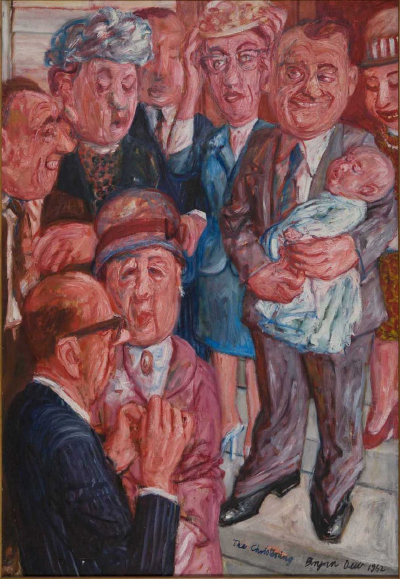
BRYAN DEW The Christening 1962 Oil on board, 1125 x 775 mm.
I discovered Thomas Wolfe's books before this phase of Bryans's painting here ended; I couldn't persuade him to read them. Though pining for his own regional birthplace, Wolfe needed to see the awkwardness, the caricature of Mountain kinsfolk. Higher studies meant alienation and creative stirrings—themselves pointing not Homeward but to New York. More insular, Dew also left his Hastings/Ashville for an Elam/Chapel Hill; to eventually a Manhattan/ Time and the River. At any rate, nearing fifty, he has well outlived that debatable comparison. He returned to Auckland in 1987, after 20 years as a graphic illustrator in New York. Essentially the same: rancour mellowed, perceptions predictably acute.(4) He brought with him a middle-length documentary film, created on his own initiative (and budget—running to colour) about Munro Veach, one of the old-time Cowboy saddle-makers and folk raconteurs.(5) Here an elder, of sorts, is scrutinised by the middle-aged artist. Instead of earlier ingredients—skewed crustiness, suburban impotence—another's wisdom is analysed per empathy, loving-care replacing Pig Island 'love they dread'. Wholeness and respectfulness, requisite for the dying '80s as more wry views were at the '60s beginning, is evident, in a different medium. The hand is as steady as ever, the eye as sharp. 1. The artist, in correspondence with Roy Dunningham, 1989. 2. Other Hawke's Bay incipients then included Barry Lett and Dick Frizzell. 3. Pig Island Letters 1963, 1966; Collected Poems: James K. Baxter , edited J. E. Weir, Oxford University Press, Auckland 1979, p.278 4. 'When I went back to NZ in '87 I couldn't believe the way people in the art world in Auckland attacked each other all the time, not only on the basis of opposing art ideologies, but on a personal level as well. There was so much contempt, disapproval . .. for such a small place among people who had once been friends, and whom you would think had a common purpose' (the artist, to Roy Dunningham). 5. A $ Horse and a $40 Saddle (1987), a 58 minute documentary essay/portrait for Public Television, directed and produced by Bryan Dew. An exhibition, Bryan Dew: 1960-1963 , curated by Margaret Cranwell and Roy Dunningham, was held at the Hawke's Bay Art Gallery and Museum, in December 1989.