
Ken Robinson
Beyond Duality
PETER GILDERDALE
In a year of round figure anniversaries, Ken Robinson did not, when I talked to him, draw attention to one of his own. At fifty, Robinson is too young for the ‘elder statesman’ tag and too old for the ‘up-and-coming’ market. Nevertheless, his half-century provides an overdue opportunity to sum up the almost 30 years of single-minded effort which he has devoted to his art.
The story of Robinson’s introduction to painting seems tailor-made for journalists. ‘Sporting Career Tragically Ended’ the headline might read—’Grammar Champ’s Unlucky Break’. This being a sober article, however, it suffices to note that a broken leg gave Robinson his first chance to study art: part-time at Elam. Subsequently on OE in England, he took more part-time classes and after a year was accepted for the full-time course at St Martin’s School of Art, London.
St Martin’s at the beginning of the 1960s was the ideal place for someone whose interests ranged from Ginsberg poetry to Zen Buddhism. Rigorous intellectual stimulation from lecturers like Caro, King, Latham and Auerbach ensured that students explored the nature of art and their motivation for doing it. In Robinson’s case external factors affected his choices. Having been refused Arts Council support (he has since made applying for Arts Council grants into a mildly masochistic ritual akin to Cézanne’s submissions to the Salon) he could not afford to pursue sculpture. So he concentrated his efforts on abstract painting. Rather than imitating any fashionable abstractionist, however, Robinson spent six months in the Life Room. Working large, he gradually reduced the figure to the point of complete abstraction with an intense jerky hatching that seemed to loosen and liberate the form and anticipate the ‘gesture’ which is so characteristic of his recent paintings.
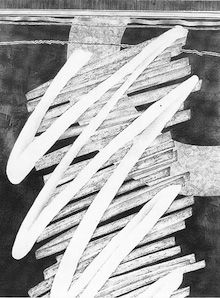
KEN ROBINSON Gestural Sign 1989 Pencil on paper, 1050 x 750 mm.
Robinson’s later student work fits loosely into the category of Op Art, where all areas of the picture surface are activated to create an optical ‘event’ through vivid use of line and colour. The idea that the work of art and the actions involved in making it are ‘events’ was one of the major contributions which St Martin’s made to Robinson’s thinking, as was the idea that the size of a painting, sculpture or building has a relationship to the size of the person making or viewing it. Whilst not demonstrable in reproduction, scale remains for Robinson a prime concern.
After a post-graduate year at St Martin’s, Robinson went directly to a teaching position at Middlesborough College of Art. He exhibited widely and was represented in the 1966 Eight New Zealand Artists show in New Zealand House, London. Then, in 1968, after extensive travel in Europe, he moved to Canada for two years, working in advertising, design and window display. He also travelled to the States which he disliked. For all its optimism he found the art scene there rife with self-promotion. Finally, in 1970, after ten years abroad, he returned to New Zealand.
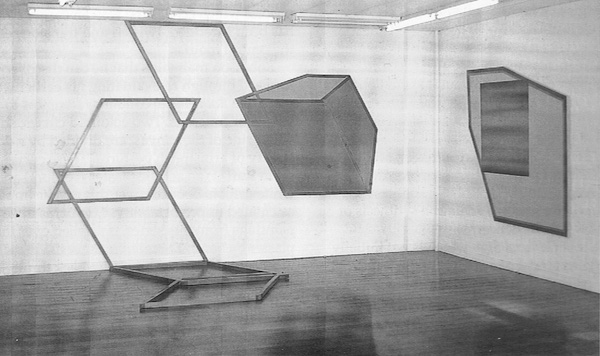
KEN ROBINSON Installation at the Petar/James Gallery, Auckland 1985
Whilst overseas Robinson had experimented with an overtly New Zealand style but had found that, despite striking results, it did not suit him. His concerns were and are universal and, as such, out of tune with the nationalism of the local scene (1) which turned the British experience of artists like Robinson and Edward Bullmore (2) into a liability. Lacking ‘New Zealandness’ (and with work that was essentially a personal development unrelated to fashion) the ‘returning-artist-brings-nothing-new-to-local-scene’ type of review which greeted his first show was, in retrospect, predictable. Robinson largely withdrew, for a time, from the one-man public arena, preferring instead to consolidate in his studio the lessons of his 1960s work.
In 1971 Robinson took up his present position at the Auckland Institute of Technology’s School of Art and Design and in 1975 he began his Dribble series as reaction against what he felt to be an over-pretty (and thus commercially successful) tendency in his latest works. He had long admired Morris Louis’ idea of the painting as a stage where colours enter, do their thing and exit, and Louis’ approach seemed the perfect antidote to overworking. Initially, Robinson renounced all control of the way the paint behaved. Control was exercised instead in the choice of colours and sometimes through a sprayed background. Sway(3) is perhaps the major work of this period. Colours waft and sway in effortless harmony and insistently imply a continued existence outside the frame. Whilst the dribble effects here are totally random, Robinson soon found that he could introduce a level of predictability to their behaviour. Using different thicknesses of paint caused the dribbles to travel at different speeds (thus bringing in the hidden dimension of time) and to move in characteristically different ways. Then, pushing the idea further, he began to stop the flow of colour before it reached the bottom edge of the canvas, so that the wide vertical lines of floated colour were transformed into round-tipped masses. This was the start of his Drop series.
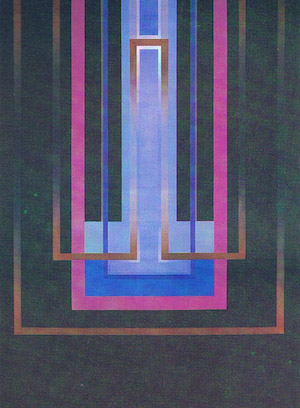
KEN ROBINSON Drop 1982 Arylic on canvas, 2230 x 1800 mm.
The creation of such works is clearly an ‘event’ but the end product seems to have become for Robinson a sign or indicator of that event which could then be re-created on a symbolic level using other media. In Drop(1980) a series of coloured lines plunge down the unprimed canvas in a manner reminiscent of earlier paintings from the series, but the web of inverted semi-circles with which they terminate announces hand-painting. Behind these lines three overlapping frame-like rectangles hang from the top edge like an inverted step pyramid. Subtle tonal changes in their outlines here and in Drop (1982) give an undeniable spatial dimension to configurations that initially appear flat.(4)
Robinson has an aversion to easy solutions, and initially avoided dualities. Ultimately, however, he found that they were a necessary part of the road to wholeness. On a technical level they appear in his works as contrasts of rough and smooth, cool and warm, recession and flatness, shine and matt, whilst on the philosophical level the Yin and Yang are reflected in the partnership of intellect and intuition. The basic structure of his works is intellectual, but the paintings themselves—even ones which, like Drop (1982), appear totally pre-planned—are in fact the result of intuitive subconscious decisions made as the work developed. As such, Robinson’s works initially communicate non-verbally after which they open themselves to rational analysis.
Another of Robinson’s concerns has been the dividing line between the painterly and the sculptural. In Installation (1985)—one of a particularly witty series—a number of rhomboid wooden frames romp impudently out of their vertical domain and squat three-dimensionally, flat on the floor in sculpture’s traditional domain. Linked to the frames, a six-sided turquoise painting containing trompe l’oeil wooden frames creates an illusory third dimension which complements the real space occupied by the frames.
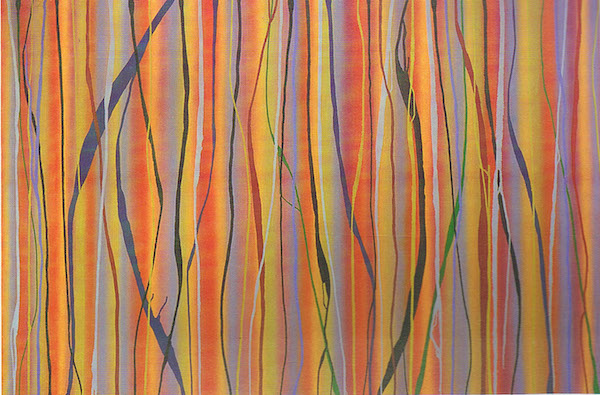
KEN ROBINSON Sway 1979 Acrylic on canvas, 1600 x 2400 mm.
Although this series, for Robinson, represents a crucial step out into the room from the safety of the wall, it remains largely unexhibited, as is much of his enormous output. He has nonetheless shown his work regularly, at first arranging his own spaces, then latterly at Auckland’s Petar/James Gallery, the WSA Gallery in Hamilton, the CSA in Christchurch and with Louise Beale in Wellington. He has also been a finalist in the Benson and Hedges (twice), Team McMillan Ford, Tokoroa Art Award (twice), Wanganui Art Award (twice), Goodman Suter Biennial (twice) and an International Miniature Art Show in Toronto.
Robinson’s most recent exhibited work has developed out of his interest in the diagonal zig-zag ‘gesture’. Originally Japanese-inspired, it began as a contrasting element within the geometric Drop format but, in the course of a 1982 print cycle, it burst free of its rectangular enclosure. The gesture was initially a calligraphic event, but to Robinson it again became a sign, and in recent works like Gestural Sign it is recreated in a detailed almost trompe l’oeil pencil technique that seems highly appropriate for a work which re-presents the idea of an ‘event’. At first sight this seems close to Lichtenstein but, whilst the American’s reconstituted gestures are deliberately depersonalised,(5) Robinson’s achieve a synthesis of personal and symbolic concerns.
An element of Gestural Sign which is not initially obvious is the fragment of a circle. Circles have periodically appeared in his work since student days, but recently the symbolic content has begun to provide a kind of holistic focus to Robinson’s complex ensemble of gestural rhythms. A musical analogy here is justifiable. Married to composer Eve de Castro-Robinson and a keen musician himself, Robinson’s musical interests show up overtly in the background of another pencil work, Drop Out. The lines of the stave are, however, not quite lines. They are actually done with painstaking diagonal hatching, a fracturing process which echoes the way an earlier Drop image has been shredded, twisted and transformed to form the central motif.
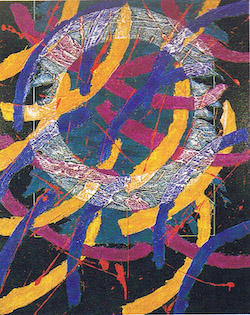
KEN ROBINSON Night Dance 1988 Acryic on board, 1200 x 1500 mm.
Robinson maintains that he can discover ways forward through re-evaluating his earlier works and a piece like Both Halves contains references to several of his major concerns. Two coloured circles, sliced at either side of the canvas, are divided by a dense tracery of arm-stretch gestures. These curves are built up in Ruff-it (an acrylic plaster medium) and the white dribble bounces over this acrylic impasto with calculated unpredictability. Colour, as in all the paintings from this series, is applied over the white plaster by hand. This allows the artist in many works like Night Dance to sand circles back through the colour to the white, with ethereal and spatially ambiguous results. Night Dance also contains an almost eclipsed Drop rectangle which subtly helps to reconcile the order/disorder duality which these works evoke and then transcend.
Ken Robinson’s art does not compromise. Although it can be read on many levels, it demands the full participation (‘communion’ is Robinson’s term) of the viewer and a total commitment from the artist. A product of inner necessity, the works make no attempt to woo the fashion-conscious, yet Robinson surely represents a valid part of the artistic spectrum. It is to be hoped that as we begin to see these parts as interdependent rather than mutually exclusive and learn to celebrate, rather than stifle, our diversity, Robinson’s work will be appreciated for its intelligence, integrity and energy. Meanwhile, Robinson continues to develop along his chosen path (which currently involves working on a series of monoprints). ‘I have never seen Art as a quick process’, he says. ‘There’s no great hurry.’
1. See the introduction to Francis Pound’s Forty Modern New Zealand Paintings, Penguin Books, Auckland 1987. Jackson Pollock summed up the abstractionist’s case when, in 1944, he claimed that an isolated national art made as much sense as an isolated national mathematics—quoted in Herschel B. Chipp, Theories of Modern Art, University of California Press, Los Angeles 1968, p. 546. 2. Brenda Tennant, ‘Edward Bullmore’ in Art New Zealand 50, p. 68. 3. The title is a recent addition. Most of Robinson’s works were originally untitled. 4. A useful comparison can be made with Robyn Denny’s door-like colour structures. Whilst structurally similar, Robinson’s philosophical framework and treatment of space is quite distinct. See David Thompson, Robyn Denny, Penguin Books, Harmondsworth 1971. 5. Ellen H. Johnson, Modern Art and the Object, Thames and Hudson, London 1976, p. 195.