
Kohia ko Taikaka Anake at the National Art Gallery
ROD BURKE
Kohia ko Taikaka Anake at the National Art Gallery is presented in a three-tiered structure. Six senior artists are given large gallery spaces for individual installations, ten mid-career artists contribute examples of their work in a group exhibition environment, and ten iwi or regional groups exhibit in rotation in the remaining four galleries. This is the largest showing of contemporary Maori art ever assembled, displaying the work of over one hundred artists and craftspeople, but for all its size it is not a comprehensive survey of Maori art. Its subtitle is 'Artists construct new directions' and the exhibition is restricted to developments since the late 1950s or early '60s when what could be called the contemporary movement in Maori art was pioneered by the six senior artists, Arnold Wilson, Para Matchitt, Fred Graham, Selwyn Muru, Sandy Adsett and John Bevan Ford (together with Cliff Whiting and Ralph Hotere).
A complementary exhibition Taonga Maori is presented downstairs at the National Museum. Taonga Maori is restricted to traditional Maori art. Together, the two exhibitions do survey a wide range of Maori art, while exemplifying some of the problems this country has in exhibiting such art.
It may not be realised by many that the National Art Gallery has a Maori name. The distinction in the English titles between the Art Gallery (for fine arts) and the Museum, where an anthropological or ethnological approach has traditionally dominated, reflects European distinctions between fine arts on the one side, and artifacts or craft on the other, and between the 'high' European culture and items of 'ethnological' or folk interest. The distinction is simply not present in the Maori title, which is the same for both the Art Gallery and the Museum: Te Whare Taonga o Aotearoa.
The gallery exhibition is a fundamentally European concept and environment, taking place, so to speak, on the Pakeha marae. The quintessential activity in Maori visual art is surely the construction of a great meeting house (wharenui) or whare whakairo in which many different aspects of the culture are expressed in a range of traditional techniques and materials. The production of such a wharenui is a community activity, the major expression of Maori visual art, and the traditional way a Maori artist makes a reputation in the Maori world. However, the individual reputation is always subordinate to the mana of the group or community, and the fine meeting house and other arts of the iwi are principally means of enhancing the mana of the iwi rather than that of the individual. Even this mana-enhancing function is subordinate to the spiritual function of the wharenui expressed through its artistic references to the tribal ancestors and the spiritual traditions.
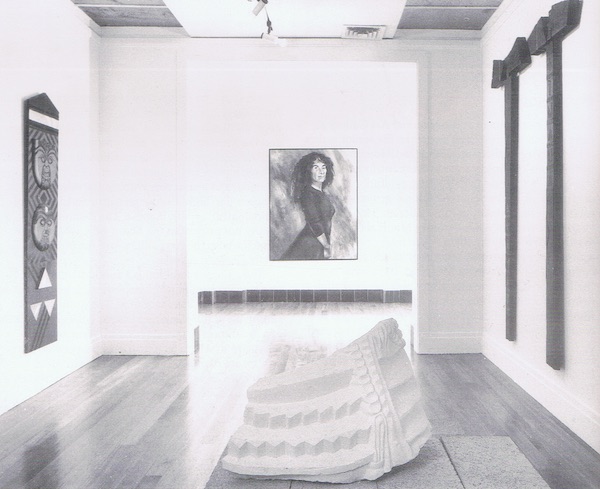
Installation at the National Art Gallery's Kohia ko Taikaka Anake showing (left to right) Clive Arlidge's Te Hokinga Mai (1990), John Walsh's Portrait of Anita Smith (1990) and Bob Jahnke's Te Atakau (1990), with Matt Pine's Fragment for a Lost Culture (1990) in the foreground
To a large degree, art galleries isolate and alienate art from its true context and function. They work to compartmentalise and label examples of what should be integrated parts of the living culture. This problem is not restricted to Kohia ko Taikaka Anake. It is also found in the presentation of traditional Maori art in ethnological collections. There is a real Wharenui in the National Museum, but we are given little idea of its original physical placement in the village or its social context.
It is practically impossible for curators to overcome these problems altogether, but at least some progress has been made recently in the presentation of Maori art. The great Te Maori exhibition was the watershed, enabling us Pakeha ever since to respond to the mana and artistic power of Taonga Maori instead of seeing them as ethnological curiosities. Progress has also been evident elsewhere when galleries have been handed over to Maori organisers. The Sarjeant Gallery's Whatu Aho Rua and Te Ao Maori and the Wellington City Art Gallery's Mana Tiriti were good examples. The recent Te Koanga Spring Festival of Maori arts in Auckland included performing arts as well as the visual and did take the visual arts out of the gallery. This event was produced by the Nga Puna Waihanga (New Zealand Maori Artists and Writers). Kohia ko Taikaka Anake originated with the offer by the National Art Gallery of its space, money, staff time and expertise to Te Waka Toi (Maori and Pacific Arts Council) and Nga Puna Waihanga. No non-Maori artists were included, and some leading Maori artists declined or were unable to take part because of their other commitments. These included Cliff Whiting, Ralph Hotere, Robyn Kahukiwa, Haeata Maori Women's Art Collective and others. Hotere speaks little about his work, but he is reported as saying in 1973, 'I am Maori by birth and upbringing. As far as my works are concerned this is coincidental'. The question arises as to the definition of a Maori artist. It could be limiting to be categorised in this way. And what about those Pakeha artists who freely use Maori motifs in their work? New Zealand culture is a continuum with extremes and a meeting and mixing point some distance from the centre. In a series of articles on Maori art which form an excellent introduction to the subject, Frank Davis in 1976 proposed the following working definition: 'Maori art [is] the art work produced by people who (a) believe that they are Maori; (b) are thought of as Maori by other people; (c) believe that their art work has some connection with their being Maori.(1)
On the whole this seems to fit the art in Kohia ko Taikaka Anake. The exhibition, like Maori art itself, is strongest in wood-carving, which in the contemporary movement is often executed in a broad technique using heavy powertools. The wood is usually combined with other materials. Para Matchitt combines wood with corrugated and wrought iron, Selwyn Muru with found objects, and Arnold Wilson has often painted the surfaces of his carved wooden sculptures. In his major piece in the exhibition Wilson presents an installation where plain timber posts represent the native forests and large quantities of wood-chips represent their misuse. Above the 'forest', a net catches and destroys bird life like a driftnet wasting marine life. The title is He Moumou.
As with many of the titles in the exhibition no translation is given. However guides (Maori people) were available to explain the exhibits. Another difficulty is the lack of a catalogue, or even a rudimentary list of exhibits. I was told a catalogue is to be produced at the end of the exhibition so that all the exhibits from the iwi groups can be included. While appreciating the practical difficulties, I'm sure most visitors would have appreciated a list and an introductory essay, with the full listing available later as a supplement. 'He Moumou' means something like 'A catching, taking' or perhaps 'A wasting', referring presumably to the natural resources of Aotearoa.
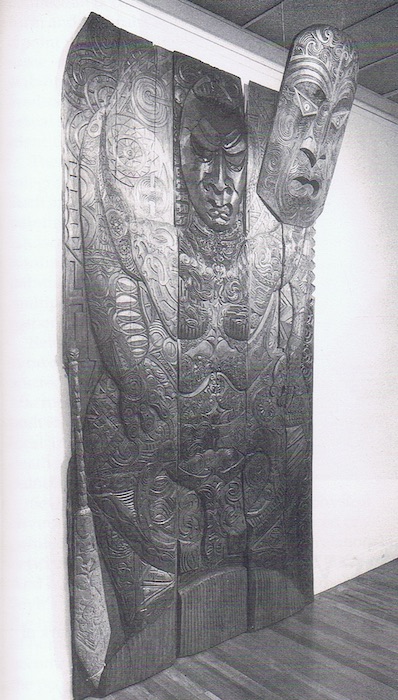
MATAHI WHAKATAKA-BRIGHTWELL Maui, Te Mana o Ngati Porou (1981-90) Totara, 3250 x 2000 mm.
This kind of political comment is found in much of the work in the exhibition, with the strongest feeling in Emare Karaka's Waitangi Wailing Wall. The most effective message is in Selwyn Muru's installation, which fills the large front gallery and is a powerful exhibition within an exhibition, consisting of large paintings, sculpture and other work. His Whakapapa refers to Colin McCahon's influence in format (a series of fourteen unstretched canvases) and style. Muru freely borrows McCahon's technique of painted handwriting, but as a disciple and follower, not as a postmodernist appropriator. McCahon was deeply sensitive to Maori culture and used the language in some of his work. In Whakapapa, Muru paints his texts in Maori, English and Japanese, so not every visitor will understand them all. Some of the English ones are clear enough though, and hit home hard. For instance: 'Are we tangata whenua or are we Maori refugees in our own land?' and 'They ripped our land off, now they're flogging it off to foreigners to pay for their debts'.
Of all the artists in this exhibition Muru communicates the most directly. He is quite at home in combining the two cultures of Aotearoa, and even goes beyond this to speak universally in his huge sculpture Whatever we do the Gods are constant.
Para Matchitt's installation shows his complete mastery of materials and form. His subject matter, centred on a flag of Te Kooti, referred to both as visual object and repository of Maori meaning and aspiration, is less readily accessible than Muru's. Matchitt requires his audience to work a little harder at their studies in Maoritanga. Finer points of meaning aside, his work is readily appreciated for its scale of conception, workmanship and visual impact.
Fred Graham's carving is also of wood, combined with metal or other materials in a highly finished style. Closer to Maori carving in traditional styles, its subject matter is beyond decipherment by most Pakeha, but written explanations are provided. The finish and formality of Graham's work make it seem less contemporary and more conventional than Muru's or Matchitt's, but its genuine quality should prove lasting.
People familiar with John Bevan Ford's lightly-drawn works on paper should be impressed with his handling of massive forms in his well-conceived installation Te Manawatu o Hau which refers to the legend of the naming of the Manawatu river which was so breath-taking that it made the heart of Haunui stand still, hence Manawa-tu.
The remaining 'senior artist' Sandy Adsett presents only two large works, both titled Tuhi series. 'Tuhi' means 'to delineate, draw, adorn a surface by pattern, colour or painting' (as in rafter painting). These painted reliefs embody a restrained and mature synthesis of European materials and Maori ideas.
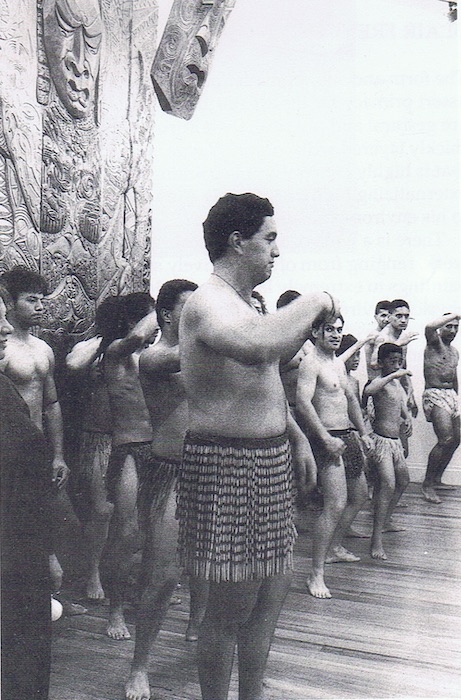
Members of the Te Atiawa haka group performing at the opening of the National Art Gallery's Kohia ko Taikaka Anake
Of the many excellent mid-career artists represented, Bob Jahnke is particularly successful in finding a third way between the exuberant powertool- worked style of Matchitt and Muru and the fine craftsmanlike finish of Fred Graham. In his works Ata, Te Atakau and Mana Whenua, Jahnke combines original thought with tradition and has the ability physically to realise his ideas to a very high technical standard. His forms are original, if a little obscure in their symbolism. His use of reversals of the same form seems to relate to the relationship between the material and the spiritual, or between the physical world and the realm of values, expressed through paired material forms.
Matt Pine shows a thorough knowledge of contemporary European art while expressing ideas of Maori and bicultural significance. His recent Fragments for a Lost Culture (seven limestone sculptures-tableworks) bridge anthropological, Maori and European postmodernist classicising themes in an extraordinarily stimulating way. They are also interesting purely as forms, and strike me as Pine's finest work to date.
The nearest Kohia ko Taikaka Anake comes to indicating the community nature of Maori art is in the method of presentation of the iwi groups. However, the content of those groups I have seen does not reflect community activities very strongly, being something in the nature of miscellaneous collections of carving, painting and traditional and contemporary crafts. A great deal of individual talent and excellent work is displayed, bringing many names to our attention who obviously deserve to be better known. I was particularly interested in the Kaihanga-Uku National Maori Potters Group's work in the Taitokerau display, and in the very competent young fine art talents of Brett Graham, Peter Robinson and Shane Cotton. I wish I could mention all the fine contributors to this long overdue exhibition. It should open the eyes of Pakeha and Maori alike to the great reserves of Maori artists' accomplishment which we have been slow to recognise: He toi whakairo he mana tangata.(2)
1. Frank Davis, 'Maori Art and Artists', in Education Vol.25, n. I-X. Department of Education, 1976. 2. 'Where there is artistic excellence there is human dignity'.