
A Conversation with Helen Hitchings
ROSS FRASER
I talked to Helen Hitchings at Prospect Terrace in Auckland recently. After Marti Friedlander had taken some photographs, I recorded an informal conversation that touched on only a few of the preoccupations of a long and varied career.
ROSS FRASER: Your name is associated in the minds of many New Zealanders interested in the arts with the first exhibiting and selling of this country's own painters, sculptors, print-makers, ceramicists . . . But few perhaps really know any of the details of all this. Could you tell us how it came about?
HELEN HITCHINGS: It was in the late-forties, early-fifties . . . when I ran The Gallery of Helen Hitchings. At 39 Bond Street, Wellington. It was a beautiful street in those days. But they pulled down my old building last year, the last of the old landmarks. I don't even have a photograph of it!
R.F.: What was it like?
H.H.: You stood at the Majestic Cinema in Willis Street and you looked down to it. Across the side of the Victorian brick building was a huge sign that read, The Gallery of Helen Hitchings, Textile House, 39 Bond Street. I remember telling Doris Lusk how much it had cost me to get the signwriters to do it, and her saying: 'Oh, if I'd only known I would have done it for you!'
R.F.: What led up.to your decision to start the Gallery?
H.H.: I was born in Thorndon, Wellington. Our family on both sides have been associated with Thorndon since the last century. I wanted to study medicine originally, but there was not enough finance. (People kept suggesting nursing—as though that were an equivalent!) After boarding-school I worked as a kind of Girl-Friday in an advertising agency—Catts-Patterson. I met Russell Clark there and he dragged me along as a model to the art society. Later for a while I worked as an unpaid land-girl on the family farm of a student friend and then went herd-testing after a pressure-cooker course at Massey College. But I became gravely ill, and had to spend a number of years in hospital. (I well understand the feelings revealed in the writing of Katherine Mansfield . . . the heightened consciousness brought about by the condition of tuberculosis . . . how every puddle on the side of the road became magnified and illuminated . . . suddenly all your pores and senses are opened! It's inside me even now, an indelible part of me!)
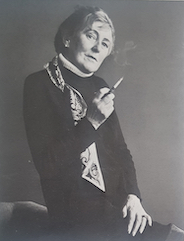
Helen Hitchings 1983
(photograph by Marti Friedlander)
It was actually during the latter part of the hospital years that the idea of the Gallery began to take shape in my mind. I didn't quite know how to do it at first. I had never seen or heard of a gallery of the kind I wanted. But I felt there must be artists throughout New Zealand doing work that ought to be known about. I had my twenty-first birthday in hospital. The bomb over Hiroshima was dropped during that time—a traumatic event! Somehow everything seemed to come together to turn my mind to the necessity for creative aspects of life.
R.F.: So you found premises for the Gallery?
H.H.: I eventually found the premises for the Gallery in this marvellously central little Bond Street, where the old customs building still existed with its shingled roof (it had been right on the waterfront in the old days). Textile House was a big brick warehouse in which the Gallery occupied two-thousand square feet. The light was marvellous. I hired scaffolding, and members of Unity Theatre came down to help me paint the walls. We painted the place with some of the kind of materials used in the theatre. (I was accustomed to designing for the theatre.)
It was basically a huge room of bare brick, with enormously high ceilings. As you came in the door from the top of the stairs looking south there was a long wall of sash-windows. I calcimined the brick white; painted pale grey trim around the windows; painted the ceiling a beautiful shade of yellow. I left the wooden beams of the ceiling bare, and got a carpenter in to make a kind of deep pelmet at the far end that brought it down to help make the hdge space a bit more intimate.
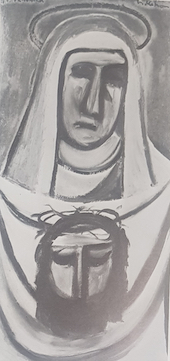
Colin McCahon
St. Veronica 1949
oil on cardboard, 763 x 392 mm.
(Collection of the
Auckland City Art Gallery)
I had a sander work on the wooden floor, oiled it and threw down mats specially sent from Samoa: got Ernst Plischke to design furniture in Southland beech and heart-rimu utilising black-and-white tweed and sulphur-green linen and wonderful leathers—the first time, I think, that New Zealanders had ever seen anything quite like it! There were large, round, low coffee-tables with hand-turned legs and lips on which I showed ceramics. My idea was to make a kind of welcoming space-to-be-lived-in, with a happy marriage of all these things.
To break up this vast space and make a hidden workshop-room, I had a carpenter build partitions, frames which I covered with hessian and painted in areas of midnight-blue, delicate rose and salmon and grey. There was an old lift-well where I put in a floor and shelves and displayed hand-woven and hand-printed fabrics. All this seemed to
help the acoustics. Strangely, the acoustics in the building turned out to be quite pleasant by the time all these things were done! We were able to have concerts by the contemporary music society which where broadcast over the National Net-work from the Gallery.
The first lunchtime concerts started with me . . . the first poetry-readings . . . madrigal singing. Maria Dronke gave evening poetry-readings, for one of which Douglas Lilburn composed music for a Rilke poem. Charles Brasch would always come up from Dunedin for any special occasion ... and many people would come from Christchurch and the Wairarapa and Palmerston North and even down from Auckland.
R.F.: What was your first exhibition—when you opened the Gallery?
H.H.: Well at first there was something of a hanging back. There was much interest in and enthusiasm for the idea, but just that slight doubt among artists . . . that-'waiting to see'. After all they hadn't seen a gallery like this either. So my first show was a general mixture of not especially exciting work on the whole. It was really just to mark the opening of the Gallery—a necessary way of getting things moving, getting the atmosphere and the policy working.
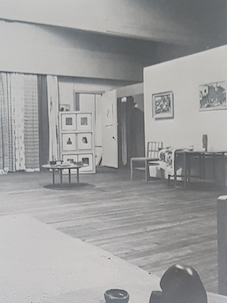
A corner in The
Gallery of Helen Hitchings
showing printed textiles
by May Smith and
furniture by Ernst Plischke
From then on it really did take off and it is impossible to convey the intensity of activity and interest. It became a magnet for students too (which was marvellous). While it was stimulating and rewarding, it was also incredibly hard work . . . because it was starting from a kind of total vacuum (such as people today could not conceive) and it reached out to all New Zealand.
R.F.: What about the individual painters?
H.H.: There was Douglas MacDiarmid—who was doing some quite fervent and lyrical work at that time—McCahon of course, and Woollaston. I had that tremendous McCahon and Woollaston exhibition. It seems a curious combination perhaps: but the Gallery was so big that I could use half to put up McCahon and the other half to hang Woollaston... and they set each other off. This show caused a real furor! The impact of these two painters was tremendous—and particularly together! Nothing like it had been seen!
R.F.: What was the reaction from the press?
H.H.: Eric Ramsden, the political reporter for the Evening Post who also wrote on art, was very conservative—and I have to say that he damned every single thing I ever showed. But, on the other hand, manners were very nice in those days, even when informal (as I was always). Eric would telephone and say: I know Miss Hitchings that you are not going to like what I have written: but I will read it through to you, and if there is some specific thing that I have got wrong . But of course it was always so awful that there was no use my suggesting anything. However I appreciated that courtesy at least . . .
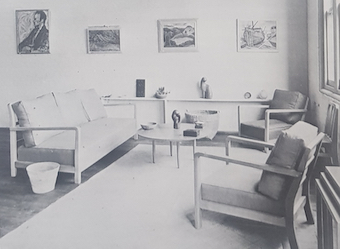
Opening exhibition at
The Gallery of Helen Hitchings
showing two early wood-carvings
by Molly Macalister
Fassett Burnett got a job with The Dominion at that time, and he begged them to let him do art reviews. He was very enthusiastic and he would come in and out and do what he could. Louis Johnson, the poet, was also writing for the Southern Cross then and I remember he did a big column under the pseudonym 'Palette' where he described himself standing, staring, awestruck in the Gallery as he encountered the McCahon and Woollaston exhibition.
I showed the Christchurch 'Group' . with Rita Angus, Colin McCahon, Olivia Spencer-Bower, Doris Lusk, Douglas MacDiarmid, W. A. Sutton and others. The Thornhill group exhibited with me. There were Louise Henderson, John and Charles Tole, T. A. McCormack, John Weeks exhibiting with them. I had a one-man show for Eric Lee-Johnson. There was May Smith—paintings as well as textiles.
Most of the significant painters of the time appeared on the Gallery walls. And while I never managed a solo Rita Angus exhibition (I certainly tried to) I always had her latest works and others by her in the Gallery.
Harry Tombs printed my catalogues (you know, he published your predecessor, Art in New Zealand). I had to give up Bob Lowrie who had printed the first ones in Auckland. Bob did the most beautiful printing, but he became too unreliable. Juliet Peter and Roy Cowan were very good about helping me with catalogues. They were illustrating School Publications then. Juliet did a delightful set of greetings-cards—which nobody else had thought to do at the time. There were also one by E. Melvyn Taylor. And I always stocked the literary magazines Landfall, Arachne and Arena.
I was never able to show Gordon Walters's work. In fact I never saw Gordon's work just then. He seemed to be very retiring in those days. Theo Schoon would come into the Gallery when he was in Wellington, and I saw his cave-drawings which engaged him then: but I didn't show his painting. He was very much occupied with photography about that time I think. Gordon McAuslan is someone I've completely lost track of, and who I thought had a splendid talent. There was also John Drawbridge; and Keith Patterson, among others.
R.F.: What about sculpture?
H.H.: Sculpture was rather overlooked in those days. I had to look hard for it. I had the ceramic sculpture of R N. Field; Lorna Ellis. I had Margaret Garland—bronzes. Molly Macalister—then working mainly in wood. Bill Allen also used wood.
R.F.: You were saying something to me the other day . . . about The Gallery of Helen Hitchings being not so much a ‘dealer gallery’ as it might be known today, but more a kind of centre for many creative activities.
H.H.: Well it was a dealer gallery in the sense that its purpose was to confront people with all this activity that was going on in the arts, and then to encourage them to buy works for their own homes and offices. I needed to convince them that art was something they shouldn't he frightened of, you see. My attitude was that art must be lived with. You must let it come to you and speak to you! I would suggest that they just sit down in one of those chairs for a while, and just look, in quiet stillness, and not fret about it all.
R.F.: What you were doing was creating, really for the first time, an environment in which people could start to value contemporary New Zealand art.
H.H.: Well I don't suppose I did that consciously. I was just caught-up in this thing; and I was careful not to knock anyone hack.
Work had to be sold of course. Because many of the artists were really on the breadline. There were several classic cases of that. Colin McCahon suffered greatly. Toss Woollaston was struggling too, working as a salesman for Rawleighs. Paintings were sold at five guineas, seven guineas. Ten guineas was a colossal price to pay—or so the public thought! My commission was usually ten per cent. Frequently I didn't take any commission at all.
R.F.: You took an exhibition of contemporary New Zealand painting to London in 1952 didn't you?
H.H.: Yes. I hung the show myself, at the Irving Galleries in Leicester Square. I wrote a short introduction for the catalogue explaining that this didn't pretend to be fully representative of New Zealand painting—it was just some New Zealand painters.
New Zealand House in London kindly printed the invitation and the catalogue without consulting me—and the results were pretty horrible! F. W. Doidge got up at the opening and spoke fervently—about New Zealand butter!
The critics were interested . . . but they couldn't understand the McCahons, for instance. The. Listener got Maurice Collis to do a review (he was a well-known English critic then) and I must say he picked up on Rita Angus and interpreted Rutu in a way that no-one else really has . . . the essential way that Rita meant it!
R.F.: Can we talk a little now about your friendship with Rita Angus? And about the portrait which she painted of you, but which remains unfinished.
H.H.: Rita always let me select what paintings I wanted for the Gallery—when she had work available. We kept discussing a solo show, which she said she very much wanted to have with me. But she never could get enough work together—or she said she couldn't. She was seldom satisfied that she had ever finished a painting. So it never came to fruition.
In all the material that's recently been written about Rita Angus there is no mention of the fact that The Gallery of Helen Hitchings Exhibition of New Zealand Painters shown in London contained works by Rita Angus—including the most important single work she had painted to that date—Rutu.
I saw that work when it had just been finished. Rita lent it to me and it lived with me for a long time. Douglas Lilburn, I think, borrowed it for a bit. Then I eventually took it to London.
In connection with the recent Rita Angus exhibition, I noticed an idea expressed regarding the iconography of Rutu, suggesting it was some sort of mangled Polynesian form of the name Rita. This is not so. I asked Rita at the time about it . . . about the title. She said: 'It's Rutu, Maori for Ruth . . . Ruth in the biblical sense.' So I remembered The Song of Ruth in the Old Testament .. . have you got it there? [The New English Bible, Oxford University Press]: Where you go, I will go, and where. you stay, I will stay. Your people shall be any people and your God my God. Where you die, I will die, and there I will be buried.
Rita didn't actually quote any of that to me. She simply said it was Ruth, the biblical Ruth. But I would like you to understand that there were many of us in-those days—Rita included— who visualised an idealistic state in New Zealand where the two races would inevitably intermingle — and we would all end up somehow half Pakeha and half Polynesian . . . there would be no divisions between the races! And while the painting Rutu expresses many things of course, it very strongly calls up that idealised vision of an integrated New Zealand society.
R.F.: And Rita Angus's portrait of you?
H.H.: Rita always wanted to paint a portrait of me. She often used to say: I want to paint you one day.' She would say: 'It is to be a portrait for you—my gift to you: I was to have the painting—and then when I died it was understood between us that it was to go into the collection of the National Gallery, Wellington. She considered it would be an important piece in her oeuvre.
Rita came to stay with me in Thorndon—it was just before she took the Thorndon cottage. We talked painting—as we always did a lot—techniques and things. It was very noisy in the flat with traffic changing gear on the hill outside (and that wasn't Rita at all). She was unhappy and depressed at the time, and very hard-up. I remember one afternoon we were talking and we got on to the subject of painting in egg tempera. I'm interested in it and so was she. She said: 'Egg tempera would be a good medium for you Helen!' She said: 'I think I’ll start your portrait in it now!' I said: 'Well there are some eggs in the safe—but I'm not sure they're quite as fresh as they should be for egg tempera.'
Anyway she got me to sit in this mustard yellow chair. She said: 'That's where I want you. The light's just right: After some quick charcoal sketches she took a prepared board and started laying on paint mixed with egg-yolk.
Then she said: 'It needs some blue!' I knew exactly what she meant. I went outside and got this little blue daisy—a powdery blue just right to balance all the rest. Rita said: 'That's perfect—the daisy is your flower—that's you!' I sat there with the daisy in my hand while Rita worked at the painting. Then the light went and I left to get us something to eat.
I didn't see any more of that painting. Almost immediately Rita's Thorndon cottage cropped up. We went to see it. There was a tremendous amount to be done . . . but I thought it was probably right for her. I helped Rita, as did other friends, when she moved in, to clean the place and so on.
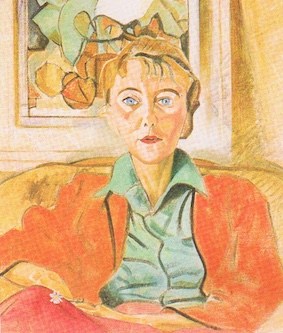
Rita Angus
Portrait of Helen Hitchings 1954-55
oil on camas. 640 x 590 mm.
(Rita Angus Loan Collection,
National Art Gallery
Wellington)
She said to me: ‘I'll get to work on your portrait now, when I've done a few things . . .’
When Rita died, the portrait of me was found unfinished among other works at her studio. I encountered it when I was asked to look through some of her paintings at the National Gallery. I identified it for them. It was an enormous surprise for me. Because this wasn't the portrait of me that Rita had started at Hill Street! It was a huge thing—not done in egg tempera but in oils. The pose, the background, everything about it was exactly as it had been when I posed for her and she had started it. But she had transferred it to a much bigger canvas.
There's an amusing little tailpiece to that whole story of the portrait . . .
When Rita had begun the painting I was just wearing old clothes—frightful old garments, ready for the rubbish-tin. Rita said: 'You mustn't throw those clothes away. You must keep them for me—because I may need them later on . .
After my mother's death (Rita had already died by then) I found among her things the orange jacket and trousers and the shirt rolled up, with a note pinned to them reading: ‘Don't throw away. Rita Angus wants these to finish Helen's portrait.’