
Peter Hannken
Construction with all Tenses
RONALD BROWNSON
Peter Hannken exhibited 17 Ektacolor photographs at Real Pictures Gallery from 8 August to 16 September, 1983. It was his third one-person show in five years. On this occasion he arranged his photographs in a clockwise sequence and gave them the generic title Construction. All the prints were made this year; the negatives having been exposed between January and October 1981.
The photographer's subject is something secret to those whose life is spent building homes that they will not inhabit. Arcane facts about the construction process are revealed: from the clay-earth footing marked out and surveyed, to the completed doorway revealing an enclosed space, ready for habitation by persons needing urban rental accommodation. Hannken's photographs show a progress inside-a-building theme as a preparatory counter-weight to socialised medium-density quarters.
The place was not identified—so I'll tell you it was Freemans Bay: one of Auckland's first suburban housing areas for the working woman and man, whose history as an egalitarian area has always been a mythic notion. During the 1850s tauiwi relations arrived in numbers to live there, settle and take up work in the neighbouring factories and offices. By the 1940s, whatever housing had been constructed in the past was being altered by the increasingly mobile nature of the suburb's population. Housing conditions had decayed to such an extent by 1955 that many residents were making vocal demands for an upgrading and renewal of the area. Whina Cooper was one such person who lobbied fora radical change in the nature of available Freemans Bay accommodation. What Hannken photographs is, to a remarkable degree, the present response to an historical request for minimum standards in public housing, two kilometres from central Auckland.
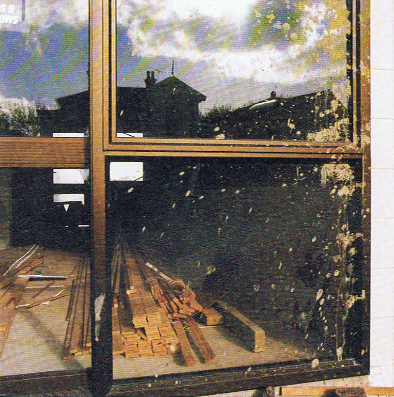
Peter Hannken
Untitled photograph 1981,
from Construction series,
cibachrome print
Hannken chose the dark night as his rostered time of record and only three pictures have employed daylight illumination. He used a hand-held flash-unit, with a multiplied series of exposures to `wash-in' walls and floors, wires and joists, with an immediate understanding as to the relationship between light and the sensitivity of photographic emulsions. The flash-unit was unmodified and acted as a neutral source that captured the texture and degree of colour in its most natural relationship under a standard grey scale. His current method was that of a plate-camera photographer using well the tradition of black and white zone exposure; which gets translated into colour work. By requiring such technical expertise of his coloured images, Hannken had deliberately selected a pliant subject, which allowed for shadow recessions in plane and a complex amalgam of an inviolate focal length. To keep a uniformity of tone under such conditions is extremely demanding and almost impossible with a controlled subject situation.
In the photographs that he included with the National Art Gallery's Views and Exposures exhibition, Hannken revealed something in the varietal nature of his photographic style. There, one gained an impression of subjective dispersal and oppositions in arrangement. Construction has a great single coherence. The images here appeared cool and analytic without being objective. They resided together as a uniform group concerned with spatially progressive change. Their regularity acted as a consequence of changes from a determined development within each unit. They were at the same stage in a physically sustained presence throughout construction. Hannken avoided symbols of personality as he allowed opportunities for metaphor and visual tricks to override an individuated point of view. At no time were the human actions involved in a building confused with documentation containing present humans. Each photograph's spectator became, by proxy, that view's inhabitant.
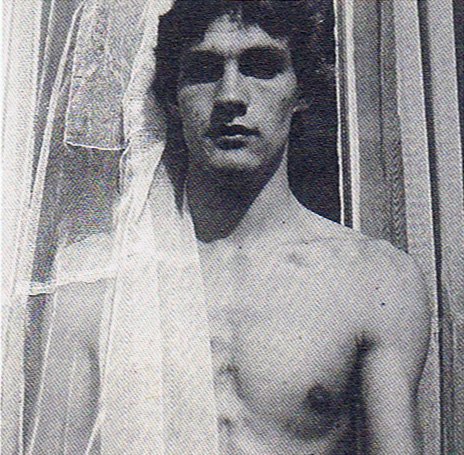
Peter Hannken,
Self-Portrait 1978-79,
gelatin silver print
Construction while being a substantial step forward for the photographer, should not be taken as the technical limits of his potential. By concentrating on the resolution of those technical problems Hannken made himself a solid ground, which should be fertile and productive for future work. In his solo exhibition, A Selfportrait, of 24 July– 11 August 1979 (Photoforum Gallery, Wellington), he indicated that his talent for documentary self-portraiture was both powerful and idiosyncratic. Construction consciously avoided such an overt politicisation of the photographer's view point. As he quietly remarked, the spirit-level was on the camera.