
Theo Schoon
Photographs of the Thermal Regions
MICHAEL DUNN
Among the varied achievements of Theo Schoon the artist, his photographs of the thermal areas of the central North Island stand out in quality and importance. That these photographs have not been seen by the general public is in itself remarkable. That they have been ignored by the art establishment for so long is a reflection of the lowly status given to photography in New Zealand. Only in very recent times have art galleries in Rotorua and Auckland accorded some recognition to Schoon's photographs by acquiring examples for their collections.
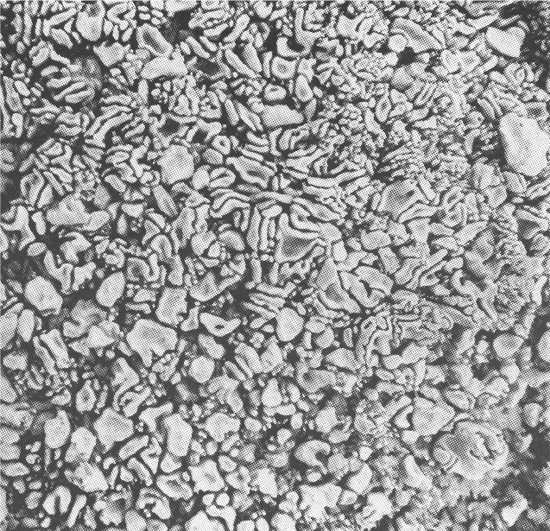
THEO SCHOON Coral-like formation in a spring of boiling water c.1968 colour photograph
Theo Schoon began his photography in and around Rotorua about 1960. His study of the thermal formations continued in the mid-1960s when he returned to live near Rotorua. For the next few years his main concern was photographing the endless variations of formations made by the steam and heat of the thermal pools, geysers, and lakes of boiling mud. To his studies of well-known tourist attractions Schoon brought not the eye of the casual visitor looking for the obvious display of natural forces at Whakarewarewa and Ohinemutu; instead he came with a thorough knowledge of contemporary abstract painting and design. He came with an obsessive purpose - to reach past the trite and commercial to the unique, the magical, the true beauty of these areas.
Paradoxically, Schoon was directing his attention to indigenous New Zealand subject-matter as the basis for his photographs: this in spite of the fact that he had been criticised and rejected in some circles for ignoring such source material in his pursuit of abstraction. Time will reveal that Schoon was among the most determined seekers after a genuine New Zealand style, a subject-matter unique to this country, of any artist working in the 1950s and 1960s. But what he discovered was sufficiently radical to appear alien to tastes formed on traditions of provincial realism.
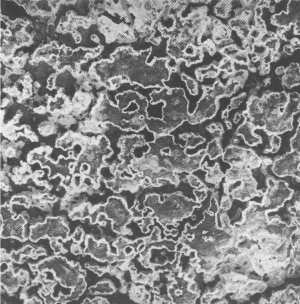
THEO SCHOON Chemical separations in dried volcanicmud c.1968 colour photograph
Theo Schoon's first thermal photographs were taken in black-and-white. He took them with 21/4 square twin-lens reflex cameras - an Ikoftex and then a Yashicaflex. Many of his shots were taken with the camera hand-held, even in the case of exposures down to a thirtieth of a second or slower. Only after his return to Rotorua in the mid-60s did he move on to colour photography. At that period he began to use a single lens reflex camera as well - an early model Canon that needed a close-up lens for the detailed shots he often wanted. The later photographs include some of his most remarkable images, in which colour becomes a crucial element in its own right, adding to or supplanting the tonal and structural basis of the earlier works.
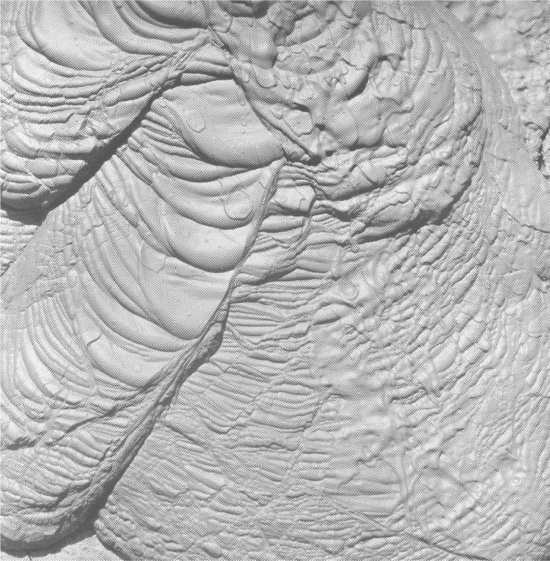
THEO SCHOON Boiling Mud from a Miniature Volcano, Waiotapu c.1968 colour photograph
From the start Schoon applied himself to the task of photographing the thermals that went beyond the commonplace. He camped out on sites, watching for changes of lighting and for how they affected his motifs. Like a hunter waiting for his prey and ready to fire at the critical moment, Schoon would lie in wait by the mudpools for that special formation to take shape, for the momentary burst of activity which would provide a new and special image. He searched the environs of the hot pools for colours in the rock made by algae, fungi, traces of sulphur and other minerals. Gradually he began to discover a personal vision of his subject-matter. The broader views with landscape backgrounds became subservient to the close-up. By focusing on the small areas around the larger, more obvious structures he isolated a whole series of individual images.
His long months, and ultimately years exploring the thermal areas brought him special insights. For example, there were seasonal changes; some effects of steam, some fierce eruptions of boiling mud would occur only in the winter. Frost around the dried and cracked mud could provide novel textural effects as well as subtle tonal qualities. Colours, too, changed with the seasons. Some intensification of red or yellow might occur only for a few weeks in the spring, then be gone. Once Schoon realised the ephemeral nature of such effects he made sure he was there ready for that special shot he knew no other casual visitor could obtain.
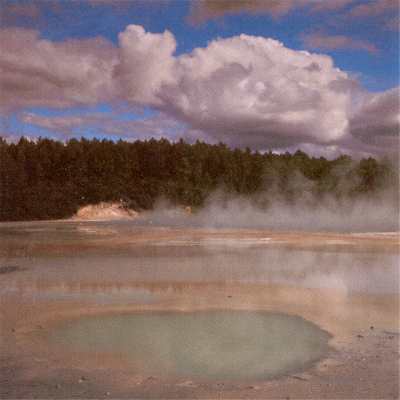
THEO SCHOON Waiotapu c.1968 colour photograph
For this reason, Theo Schoon's thermal photographs are unique and cannot be repeated. It is doubtful if anyone will ever again devote the time and prolonged concentration to the subject. Even if they did, much of what Schoon photographed has gone forever. Recent geothermal developments have destroyed whole areas that he knew intimately. As much as a third or more of the less well - known thermal areas have been buried under forestry projects, roading works and land development. Much of the natural thermal beauty that Schoon knew and photographed no longer exists.
In addition, Schoon took risks in pursuit of his photographs. Not for him the safe pathways in the tourist areas: he dared to work perilously close to the boiling water and mud. The heat, the sandflies, the lack of food were nothing compared to the agonies of a foot breaking through a surface crust into boiling mud below. His photographs were bought at a high price.
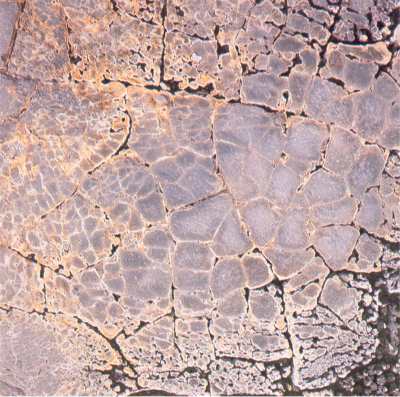
THEO SCHOON Chemical separations in dried volcanic mud c.1968 colour photograph
In his early series of black-and-white photographs Schoon chose to work at a large mud-lake at Waiotapu. Located some thirty kilometres from Taupo, this area of thermal activity is much less known than the major tourist spots. Here Schoon could work without distractions through until dark. The extensive surface of the boiling mud lake provided him with a constantly changing and varied range of thermal activity. In addition to his shots of static formations, Schoon also captured the momentary eruptions of the mud as it projected small boiling lumps into the air. In the flow of mud down the sides of miniature volcanic formations Schoon found some of his richest material. He was one of the first to visualize the thermal 'wonders' in terms of the extreme close-up and with the focus on formal values - tone, pattern, texture and shape. That these photographs are of specifically New Zealand motifs is not what gives them validity. It is the quality of the image that counts. And for Schoon that was the central concern. The regional aspects were always a secondary consideration.
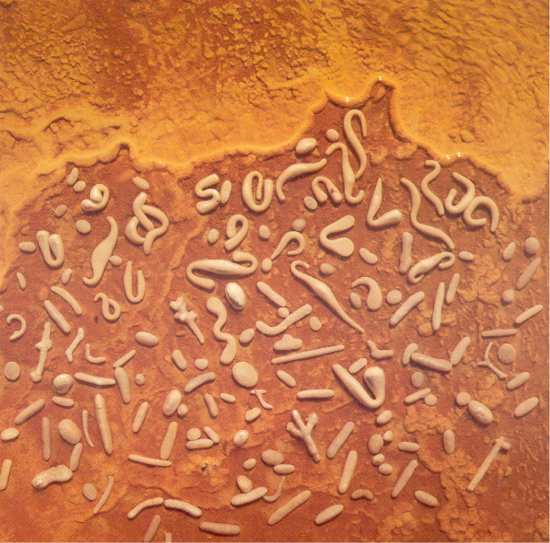
THEO SCHOONSilica-coated and fossilised debris, Waiotapu c.1968 colour photograph
Light plays an important part in these works. Highlights on boiling mud can galvanize a photograph into life. In the best images, there is a sparkle and a tonal radiance that is special and dazzling. From a compositional viewpoint, Schoon varies his approach: but he favours a view looking down over the subject so that the imagery flattens out and reveals its design qualities. In this way modular aspects such as cracks in mud that repeat one another, yet also vary slightly in shape, are made into clear two-dimensional designs. They can recall European abstract paintings by artists like Paul Klee. Schoon did not, however, allow formulas to creep into his work. Part of the strength of the series is the deliberate questioning of process and the search for new angles of approach.
Colour provided Schoon with a special bonus. After the black-and-white series he had his eye in for tonal effects: colour allowed him to widen his range. It also shifted his emphasis from the mud and its formations to the pools of water nearby, to the algae and organic growths near the steam vents. There he was to find colour effects of powerful intensity. The rich red of iron-oxide appears free from any dilution, as does the sulphur yellow. Also, there were translucencies and juxtapositions of colour and shape hard for any artist to imagine or create. For Schoon, the thermal areas became like a natural art gallery full of surprising and unique masterpieces.
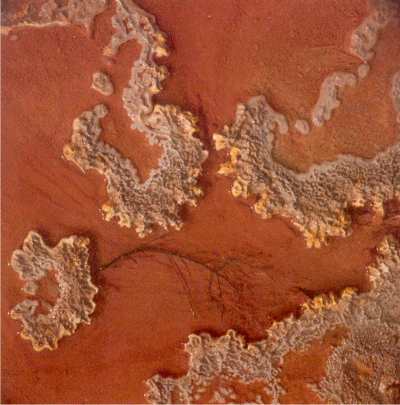
THEO SCHOON Coral-like formation from the fringes of the Champagne Pool,Waiotapu c.1968 colour photograph
Seen singly, each of Schoon's thermal photographs is valid. Taken together, though, the impression is more substantial. Each work, as in a painter's oeuvre, comments on the others. The thermal photographs were seen and taken in groups, not singly. For Schoon did not use a small amount of film; his long days in the field were used to the full, and, despite his care in selection of each frame, the number of shots taken is extensive. In this very real sense Schoon's thermal photographs are serial in character.
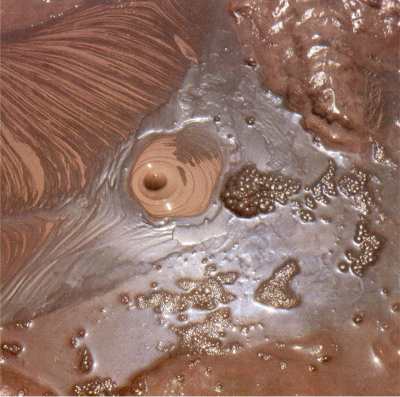
THEO SCHOON Black mud pool with an iridescent oily substance,Waiotapu c.1968 colour photograph
Without doubt Theo Schoon's thermal photographs rank among the most important and brilliant images taken of the New Zealand landscape. They extend the tradition of photographs of thermal subjects, which goes back to the nineteenth century into the present. They deserve to be better known.