
Exhibitions Christchurch
EVAN WEBB
Christchurch Festival Paperchase
The Christchurch Festival opened the 1984 cultural year with a diverse array of visual and performing arts. The Brooke/Gifford Gallery showed the works of two local craftspeople, Robin Royds and Noel Gregg, with a series of photographs entitled Seaview, by Bruce Foster. The Canterbury Society of Arts offered two painters, Philip Trusttum and George Baloghy; two artists working on paper, Gordon Walters and Mervyn Williams; and two local sculptors, Evan Webb and John Tullett. But the most comprehensive exhibition was at the Robert McDougall Art Gallery.
As its title suggests, Paperchase was an exhibition of works on or with paper. The title offered little restriction, however, to those artists represented and the exhibition encompassed a wide variety of draughting, printing and painting styles as well as paper-craft. Contrasted against the traditional yet masterful drawings of eighteenth century artist Henry Fuseli were the enigmatic etchings of David Hockney's Blue Guitar series. The Jabberwock hand-paper-mill in Hobart exhibited some interesting paper-craft, while over thirty prominent American artists utilised the printing resources of three of the State s leading print workshops (Crown Point Press, the Ernest F. de Soto Workshop and the Tamarind Institute) to produce an extensive exhibition of printmaking, entitled Print U.S.A. Within these parameters, twelve local artists were well represented.
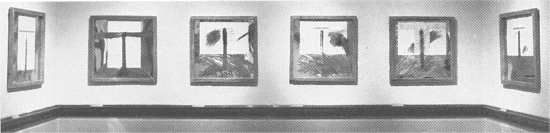
Ralph Hotere at Paperchase
Some of the works by Don Peebles were, as their titles suggested, Drawings Towards larger paintings and gallery installations. Others, such as Drawing No. 12 and Drawing untitled No. 2 were reminiscent of earlier work completed about 1979. In these works a loosely drawn, all-over mess of horizontal and vertical lines produced a spatial ambiguity by both reaffirming the surface of the picture plane and creating the illusion of depth. In Drawing untitled No. 2, a figural element floats uneasily within this space, perceptually teasing us as we attempt to locate it spatially.
Michael Reed's pencil and pastel works also created ambiguous pictorial spaces, but in a different manner. By visually floating deltoid forms in a plane distinct from that of the background, an incongruity is established between the figures and the ground. In some works this effect was extenuated by actual constructed recesses that projected back into the picture plane. Not only were these works animated by vibrant colours, but they also altered with the changing angle of view.
Where Reed's forms were hard edged and angular, Alan Pearson's paintings, entitled Variations on the Theatre were baroque in manner and highly decorative. Although Pearson has studied and worked in Canterbury, the fifteen drawings and paintings shown were all completed in London, where he now lives, during 1982/83. All his works depicted some aspect of the theatre or the opera, such as chorus lines, dance troupes and individual performers. Pearson's rapid, gestural and accomplished style portrayed these characters in a humorous, bizarre and even grotesque way. For example, Diva in Top C shows a straining tenor with maddened eyes. Yet, in spite of their competent, if somewhat mannerised style, these works belong more to the bygone days of vaudeville and to the burlesque than they do to the nineteen-eighties.
The political content in the work of some of the American printmakers was obvious if not blatant. Three Flags for One Space and Six Regions by Vito Acconi was a large, six-part photo-etching which combined the motifs of the major powers into one impressive ensign. The Californian artist, Chris Burden, renowned for his death-defying performances which illustrated the actual violence within society, presented a large etching and watercolour work which commented on the ultimate violent act. Atomic Alphabet was laid out with all the innocence of a child's alphabet book but its portent and meaning were far from innocuous; like 'm' is for mutant.
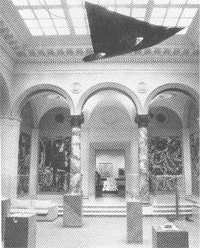
Paperchase - centre Court installation
The theme of imminent nuclear destruction was also paramount in Ralph Hotere's work. His twelve panels entitled 1984 combined the prophetic title of George Orwell's novel with the ominous image of the Polaris missile. Paper stuck down to stainless steel sheets provided a ground through which the phallic missile literally 'ground' its way upwards. This material dissimilarity - paper on steel, soft on hard - provided one of the many metaphors employed by Hotere. Reflectivity and reversible writing further illustrated the contemplative, here-and-now qualities which we have come to associate with this artist's images. In spite of these qualities they remain fine visual works of art, because what they impart politically does not evoke the feelings of urgency and the magnitude of the nuclear threat.
Ominous, too, was Neil Dawson's installation, but in quite a different sense. High above the central court area he suspended a large sheet of paper, which, in his inimitable fashion, he transformed into a black void out of which hurtled three meteorites. All three were an illusion created from the simplest of means: crumpled paper sprayed obliquely with black paint and back-lit from the skylights to give a sense of form and mass. The title of this work, Paper, scissors, rock, suggested that this type of sculpture is child's play - but only if you have Dawson's impeccable sense of scale and placement.
Beneath these heavenly projectiles Terry Stringer's rather frail relief works sought refuge under the gallery display cases.