
Exhibitions Wellington
AVENAL McKINNON
Warren Viscoe Jacqueline Fraser Wellington Wash Rob Taylor
Warren Viscoe's New Works at the Peter McLeavey Gallery were imaginative, even evocative. His sculpture is primarily an art of compartments, shelves and secret places. Like giant Cornell boxes, his works are assemblages of objects arranged for contemplation. Tree fragments, blocks of wood, a glass of water, coins and fishing weights are selected, mounted and boxed to produce highly satisfying compositions. Conscious of the organic vitality of his materials, Viscoe has a sensitive eye for the marvellous textural possibilities of wood which has been notched, split, hand-sawn, weathered and charred by time and volcanic rock worn to an elemental smoothness. The rough-hewn tree is meticulously crafted with the bushman's instinctive sympathy for his materials. As images his assemblages are endowed with a vital force which gives room for metaphysical speculation beyond their purely visual qualities. Environmental in intention, these works demonstrated man's interaction with and transformation of the natural world. Nature is as it were 'reshaped'. Even the tree (a hint of Eden) in Nature and the State of Innocence, cut and stripped of all leaves and fruit, is boxed and crated. Vulnerability in the marks of human use and neglect is evident in the rusting nail-holes and the pale blotches of lichen on greyish bark, in the coarse counter-graining created by the saw and the thin markings of the builder's pencil. Yet there is a sense of awe in the formal arrangement of the Bushman's Tableau.
In Puketi, gnarled tree fragments from this fast diminishing native forest are laid out like anatomical pieces. Branches and sawn tree limbs are displayed with all the reverence accorded a saint's bones in a rough open box that is at once a raft, coffin and reliquary.
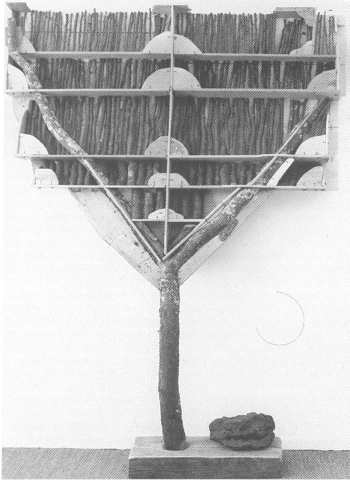
WARREN VISCOE Vegetable Kingdoms 1984 wood, wire, stone and vinyl 2090 x 1620 x 450 mm.
The inevitability of the natural order of things is positively reaffirmed in Vegetable Kingdoms. Here a patriachical tree, reassembled in a tiered, strictly compartmentalised growth pattern becomes a physical realisation of the family tree metaphor, embodying the whole principle of generation and fecundity.
In contrast, Jacqueline Fraser's installation at the same gallery was a thin, frieze-like screen. Suspended from corner to corner, it completely divided the gallery space in half, emphasising the light source on one side, the shadows on the other. Fraser's materials are unconventional: scraps of cloth cut from old clothes, cheap bamboo mats and rafia at 12 cents a metre. All are woven together in an art-form which closely approximates a three-dimensional drawing in space. Highly linear, even airy with its web-like interconnections of wire, string and thread, her installation formed a delicate open tracery which echoed the patterns thrown into the room by its leaded glass windows. Concentrating upon the symmetrical distancing and balancing of her elements, she presented an ingenious system of weights and swinging measures - a recreation of the aesthetic order and control of trapeze artists. Scrolls of velvet and silk, pieces of coloured tulle and silken bags endowed the work with a softness and flexibility that links her with Feminist sculptors. Yet the real vitality of the work became apparent when it was touched. To move from one side to the other involved a contact which animated the whole assemblage into a springing, swinging motion. The suspended weights immediately assumed the form of crude pois suggested by the title Taku Poi Poi and the whole work became a playful, ingenious pattern of movement-invested with the rhythmic motion of a Maori poi dance.
During the week-long installation session to mark the end of the City Art Gallery's Wellington Regional Art Exhibitions, Noeline Black and Val Griffith-Jones (members of the Fabric Art Co.) assembled Wellington Wash. A refreshingly creative scrutiny of domestic life with an inherent social comment, the installation consisted of nine washing-lines hung with plaster-dipped clothes, each one an individual statement but forming a chronology which could be read as an inventory of suburban life. Beginning with the static forms of white wedding clothes (arranged in curious simulation of a photograph), the lines became multicoloured with 'his' and 'hers' ensembles, then changed to the random disorder of huge family washes routinely thrown up. it continued with a wet summer wash where flimsy sun-suits, towels and swimming togs drooped forlornly together and ended with a final line of old people's garments. Many of the striking postures assumed by the gradually solidifying clothes were spontaneous, determined by chance, the weird juxtapositions the result of a humble crowding together of garments. Though clearly still very much an experiment with ideas, it was an unselfconscious installation, a silent tableau of the aftermath of human passions which was not without a gentle humour - as represented by an entire line of odd socks.
Rob Taylor's most recent works, exhibited at the Louise Beale Gallery, continued the experiment with collage that has preoccupied him in recent years. From 1981 until 1983 Taylor's collages were strongly palpable and coarsely textured. Like an essay in raw organic abstraction the artist used egg cartons, cardboard and rope in an ostensible fabricating of surface, applying a film of paint over a wrinkled skin of tissue paper. His Collage Screen with its packed surface of hollows and protuberances became a tangible structural object, a masonry of supports and interlocking structures, strongly assertive in its massive plasticity.
With the beginning of 1984 his scale changes. The main elements of his collage are formalised into a concentrated, more coherent order, his sometimes strident colour subdued to a sombre chiaroscuro. In Specimen Drawer (Jan-Feb '84) Taylor achieves a gathering intensity where the tips of tubes of paint set within the collage break through their sombre setting as brilliant points of colour.