
Exhibitions Christchurch
EVAN WEBB
Class of '79 Three Christchurch Painters
Two recent exhibitions at the Canterbury Society of Arts Gallery are confirmation of the continuing painterly and formalist tradition in Christchurch.
The Class of '79, as its name suggests, was a show of artists who were Stage III painting students at the Canterbury School of Fine Arts in 1979. Catherine Brough, one of the organisers of the exhibition, commented `A prediction was made by one of the tutors that no good paintings would be produced that year, perhaps a comment on the rawness and clean sterility of the new environment.' With one or two exceptions, five years free of the `clean sterility' has not produced any significant painting from the ten artists of this group, and at best their work is only mediocre.
The formal considerations of surface, texture, colour and composition are the main features of the exhibition and although these were, on occasions, handled competently, alone they remain hackneyed and outdated concerns of painting.
Catherine Brough's partial abstraction of urban scenes is sound and consistent painting: so too is David De La Mare's landscape abstraction which, although more gestural, becomes too slick and seductive in its colour use. Of a more hard-edged nature, Nicola Everitt's vertical panels with horizontal stripes tentatively explore the effect of optical shifts but ultimately remain on a mere compositional level.
Only two or three artists in this exhibition consciously attempt to deal with content which is outside the concerns of painting as painting. Pat Unger's Wall Berlin and her other works in this show continue her preoccupation with `wall' with its underlying political and sociological connotations. Unfortunately the scale of these works, their painterly quality and their presentations as 'painting' renders these works ineffective. They simply don't generate feelings of oppression or isolation or any of the other emotions we might associate with walls—especially the Berlin Wall. The content is stifled by the form.
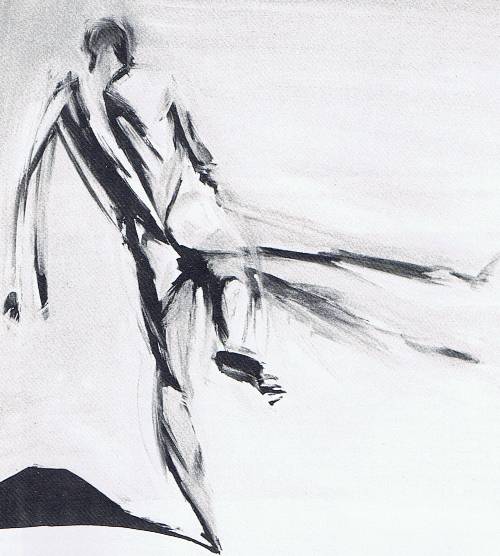
EUAN MACLEOD Balance 1984 acrylic on paper, 700 x 610 mm.
Four works which did possess an immediacy and potency were by Euan MacLeod, now resident in Sydney. MacLeod's paintings depicted two close-ups of a man smiling and two images of a figure exercising. The scale, tone and colour of Head Smiling (both works have the same title) projected the quality of a television image—loud, intrusive, interrogating, 'now'. The exercising figures worked alone, seemingly trapped in the space they articulated. These unsettling images demand an acknowledgement from the viewer and, as such, put MacLeod in a class of his own.
Running concurrently with Class of '79 at the same venue was another exhibition of painting with the title Three Christchurch Painters. Vivien Bishop, Grant Banbury and Bianca van Rangelrooy share nothing in common as far as painting is concerned but this curatorial anomaly did not detract from the show. Of the three, Bishop has been painting the longest, yet her work remains the least innovative. Her Winter Series of five works entitled City 1, City 2, etc., continue her technique of staining into raw canvas a nebulous ground of paint against which figurative elements are finely drawn. In this case the elements resembled mythical city-scapes imparting a fictional or fairy-tale quality to the works.
Grant Banbury has an almost obsessive interest in applying acrylic paint to paper. The six works presented in this exhibition, each entitled Vertical Sequence, are a development of previous series in which worm-like squeezings of paint are carefully laid down in neatly ordered rows and columns. Fine silver thread is then stitched through the paper in regular patterns sometimes slicing the raw pigment. All this occurs against a ground of paper mottled by paint flecks, roller-marks and other print-making techniques. Such meticulous craft and careful modulation of colour is a characteristic of Banbury's work.
The Vertical Sequence paintings depart from previous works of this type in size, format and a less ordered composition. Each work utilised three sheets of paper, loosely mounted, one above the other. On each sheet the elements of paint and thread varied in arrangement, giving some animation to the previously classical forms.
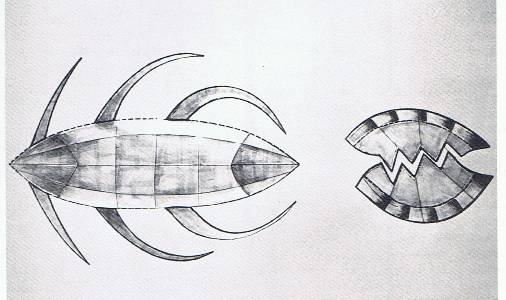
BIANCA VAN RANGELROOY Pincers and Husk 1984 tissue, wire and acrylic, 2000 x 750 mm.
Like Bishop and Banbury, van Rangelrooy is also a graduate of the Canterbury School of Fine Arts. Although her work in this exhibition lacks consistency, her exploration involves greater (aesthetic) risks and hence engenders more excitement than the work of her colleagues. Van Rangelrooy's contribution to the exhibition included five drawings, some in ink and some in ink and acrylic, and eight painted constructions. In the latter, brass wire frames provided a shape and structure over which tissue paper was pasted and later painted and detailed with acrylic and ink. The constructions hung as discreet objects against the gallery wall with the wire structure imparting an interesting relief to each. Like Killeen's recent work, these objects formed a curious mixture of the representational (almost) through to the obscure.
As its title suggests, Pincers and Husk resembles a very large beetle trailing its spent shell. Shield also conjures up images of insects as well as primitive artefacts. Indeed, some of the drawings seem to draw on Polynesian design. Other forms were less referential, less literal and more whimsical. Their brighter colours and zig-zag patterns gave them a carnival vitality much like Debra Bustin's zany installations.