
John Holmwood
Thirty Years of his Painting
ALEXA M. JOHNSTON
John Holmwood spent most of his working life as a commercial artist. His career began in 1924 when he joined the New Zealand Railways Advertising Studios in Wellington at the age of fourteen. Family circumstances dictated that he should earn a living: but his mother and brother always encouraged him to paint, and at eight he attended Saturday morning drawing lessons with H.Linley Richardson.
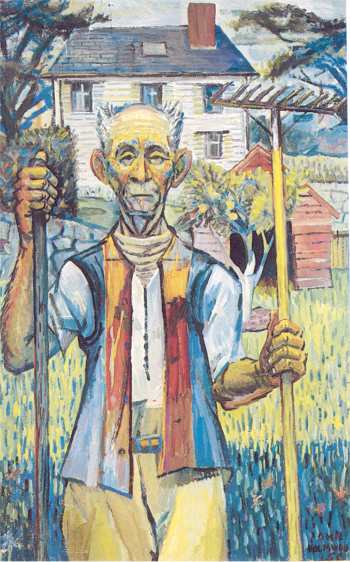
JOHN HOLMWOOD The Gardener 1958 oil on board, 1210 x 750 mm.
Holmwood sees similarities between his years at the Railways Studios and the sorts of apprenticeships served by young artists in the studios of great painters.
Here I was to learn a lot about pigments at close quarters; mixing great drums of white lead, zinc-white, red-lead, lamp-black, and grinding pounds of various colours; cleaning palettes and brushes for the pictorial artists, setting out their palettes and squaring up great areas from small designs created in the designing room. These were the days when lithography was very seldom used in outdoor advertising, and the hoardings were painted with oil paints. Tests were carried out to determine the most enduring colours and admixtures for various conditions, such as the thermal districts, salt-laden sea air and fume-laden city air. Carpenters, glaziers, printers and bill-stickers were employed with designers, pictorial artists and signwriters. I was to become acquainted in a practical way with all these departments and activities. Eventually after many years I was to design posters and hoardings, but it was a hard apprenticeship.(1)

JOHN HOLMWOOD St Mary's Bay 1946 oil, 550 x 680mm.
The chief artists at the Railways Studios were Don Grey, Gordon Tovey and F. V. Ellis AR.C.A. Ellis later became head of the Art Department at the Wellington Technical School and asked Holmwood to teach drawing there part time. Holmwood had attended the school's evening classes in drawing, etching, anatomical studies and life classes over a number of years.
During the Depression, work was scarce in the Studios. Holmwood was reduced to half-pay and sent around the South island to make reports on the condition of the Railways' billboards and hoardings, which were often used for target practice by local farmers.
I often travelled in the guards van or in the cabs of locomotives; then I would borrow a railway jigger, and taking note of the times of trains to avoid a collision, I would set off whizzing through the countryside on this self-propelled rail trolley. Great freedom! I allude to these experiences because I was meeting people in many walks of life. I had responsibility and I was seeing great tracts of our country in a most unusual manner. I was kept pretty short of money as I sent money home each week. However I was fortunate to get full board and lodgings for £1 a week. I enjoyed a happy life.(2)
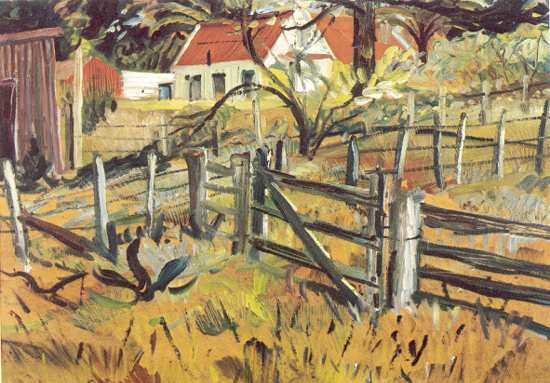
JOHN HOLMWOOD Taranaki Farmhouse 1952 oil on board, 530 x 750 mm.
This experience of the landscape emerges in paintings like View from a Railway Bridge (1949) which show Holmwood's appreciation of the untidy backyards of New Zealand. Similar vistas filled with coils of wire, empty oil-drums and old tyres can still be seen from railway carriages.
Back in Wellington Holmwood met many artists throughout the nineteen thirties. He mentions Nugent Welch, Constance Bolton, E. Mervyn Tavlor, Christopher Perkins and Russell Clark. Although he was doing some painting for himself, he did not exhibit any work. In 1938 he left the Railways and went to work for an advertising agency, taking over from Russell Clark who had gone to teach at the Canterbury College of Art. Holmwood disliked agency work and when war began he enlisted. He was accepted into the Camouflage Unit and served in the Pacific.
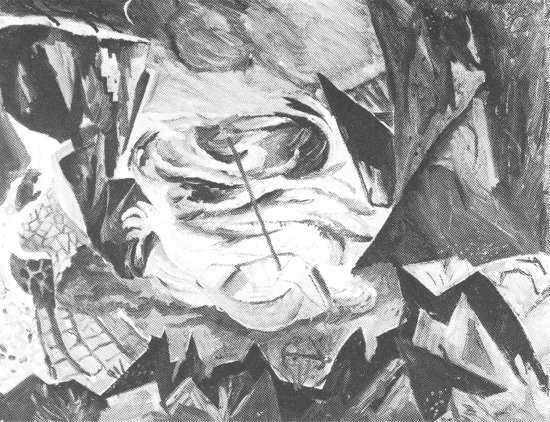
JOHN HOLMWOOD Haven 1950 oil on board, 550 x 700mm.
On leave in Wellington during the war he married Nola Findlay whom he had met when she joined the Railways design staff. They worked together on a 120-foot mural for the Railway Court in the 1940 Centennial Exhibition, depicting the history of railways in New Zealand. John Holmwood credits his wife with encouraging him to paint for himself and he showed for the first time in the exhibition Artists in Uniform which toured the country in 1944.
While John was in the Pacific, Nola Holmwood set up a design studio in Auckland. When her husband returned he joined her and they built up the business together. The move to Auckland marked the beginning of a time of intense activity for them both: their studio was very busy and John Holmwood was becoming involved in Ns own painting and in the Auckland art world.

JOHN HOLMWOOD The Quick and the Dead 1953 oil on board, 750 x 550 mm.
So now I found time to paint. It did not matter how good or bad - I can only say that I began to enjoy the world in a new way. I had to paint at night usually, sometimes until 3.00 am - then five hours sleep and then an excursion to the easel to be flattened, or maybe to find a surprise. I would come home after work and perhaps carry out some alterations, but usually I painted in one go. Sawmill(3) for instance was painted in about seven hours, from a small pencil note made when on a trip passing through Raetihi county.
At this time Erick Westbrook was Gallery Director and I was called upon to join discussions on panels at the City Art Gallery, and join radio talks on topics concerning the local art scene. I also conducted theatre design workshops. Two evenings and Saturday mornings I was Art Appreciation tutor for Adult Education. I became involved with the Auckland Festival and Laird Thomson had us do work for ballet over several years. I designed and painted huge backdrops as well as stage sets and costumes for the Community Arts Service. Nola helped me considerably with this work and kept the business going. Vernon Brown asked me to talk at the Auckland University of Architecture on the practical aspects of dealing with clients. A thorny problem!(4)

JOHN HOLMWOOD Near Raetihi 1956 oil on canvas, 740 x 1070mm.
In 1957, Holmwood had a solo exhibition at the Architectural Centre Gallery. in Wellington and in 1958 his painting The Gardener was included in an exhibition of New Zealand painting which toured the USSR. This work is clearly influenced by Grant Wood's 1930 painting American Gothic. John Holmwood is well aware of his tendency to adopt a variety of painting styles and always stresses that he painted for his own enjoyment. He had no ambition to be considered among the avant-garde, but greatly admires the work of Colin McCahon and others who pursued a personal vision with dedication and commitment.
Holmwood's work was regularly included in the Auckland City Art Gallery's exhibitions of contemporary New Zealand painting in the early nineteen sixties. He also kept in close contact with the Auckland Society of Arts.
In 1969 the Holmwoods sold their business and set off on two years of world travel to Asia, Europe and South America; and on their return John was elected President of the Auckland Society of Arts. In an address to the Society, he said:
I have every intention of fostering the policy of inviting notable New Zealand painters and sculptors from outside the Society to exhibit their work in our Gallery. We need such a measure to stimulate our working members to more adventurous efforts and to prevent ourselves from becoming too easily satisfied.(5)

JOHN HOLMWOOD Beresford Street Jive 1956 oil on canvas, 500 x 61omm. (Collection of the Auckland City Art Gallery)
John Holmwood's involvement with the Society was a happy one: however, when Nola Holmwood died, he resigned his Presidency and went to live in Britain. He painted for a few more years but was forced to stop in 1976 when his eyesight suddenly deteriorated.
John Holmwood returned to New Zealand for the retrospective exhibition of his work organized by the Auckland Society of Arts in April of this year. The exhibition included works from 1946 to 1976 and showed a wide range of his paintings, landscapes, portraits and genre studies. Several of Holmwood's landscapes from the nineteen-fifties include the white stumps of dead trees, a subject used by several other artists. Holmwood remembers the rage he felt at the destruction of the bush, as well as his enjoyment of the sculptural forms of the skeletal trees.
The pioneers began the slaughter of the bush and it still goes on. You can't get it back.(6)'
John Holmwood's observation of people is acute and many of his genre works are witty and direct. Holmwood enjoyed the spontaneous laughter aroused by his painting The Quick and the Dead when it was shown in an Auckland Society of Arts exhibition. Another painting Beresford Street Jive elicited the following comment from a reviewer:
Holmwood's bouncy, 'boppy' painting of Teddy boys and girls at a dance is the only exhibit which seems to spring from a direct understanding of the vibrant life led by a measurable proportion of city youth.(7)
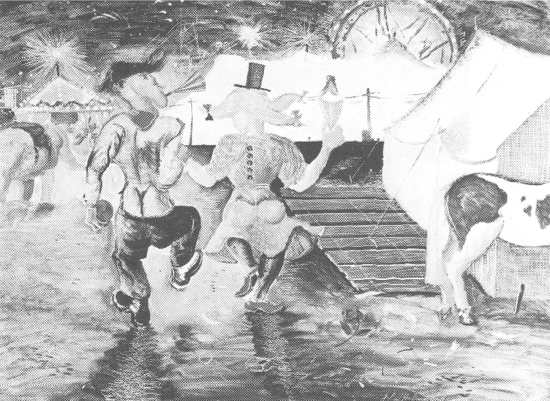
JOHN HOLMWOOD Circus Ground 1952 oil on board, 730 x 990mm.
Holmwood sees his tendency to paint in a variety of styles, a result of his work in commercial art, as a drawback in his painting. Yet in a number of his works, using strong colour and vigorously applied paint, he communicates his sharp observation and his honest response to people and the landscape.
In the best of his works the vision is undeniably his own; and, whether humorous or poignant, they are always memorable.
1. Letter to the writer, 17 May 1982 2. Letter to the writer, 17 May 1982 3. Landscape with a Sawmill 1952, oil on millboard (collection of the Auckland City Art Gallery) 4. Letter to the writer, 17 May 1982 5. Artist and Connoisseur, 1 February, 1972 6. Conversation with the writer, April 1984 7. E.H.R., Auckland Star, 30 September 1952; review of the AS.A. Annual Exhibition
Photographs by Julian Bowron