
Art In Dunedin
Installations and Performances by Artists from the South
LOUISE WILTON
In May of this year Dunedin played host to a fortnight-long project showing the works of younger and lesser-known artists in what may broadly be termed the sculptural field. Art in Dunedin was brought about through a combining of resources by the Arts Council and the Dunedin City Council. A ten thousand dollar grant from the Arts Council covered the travel costs of fifty artists and a further twenty musicians, participating in the concurrent New Music Festival. To run the project the Dunedin City Council created jobs for five PEP workers, who were incidentally younger and lesser-known artists themselves. Also the city fathers made the old Municipal Chambers Building in the Octagon available for the event. In return for this unusual burst of cultural philanthrophy, it was decreed that the city of Dunedin be advertised in some way by the project, hence the somewhat bland Art in Dunedin emerged as title to a varied project comprising installations, sculpture, performance works and artists' slide-talks and discussions.
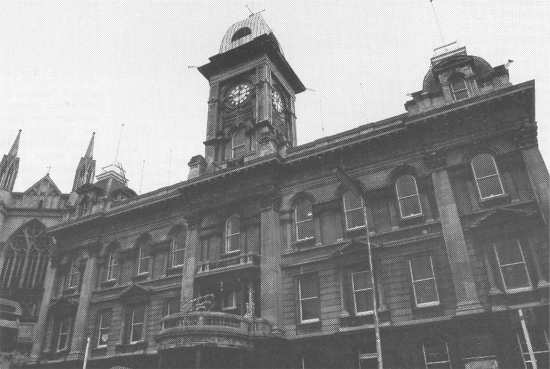
The Municipal Chambersin the Octagon, Dunedin (an installation by Jurgen Waibel on the balcony)
It is ironic that five PEP workers, should be left in sole charge of 'a major event on the NZ Art Calendar.' Inevitably, the project strongly reflected their abilities, areas of interest and areas of the lack of it. Glaringly apparent was the inattention to the curatorship of the exhibition spaces. Works and installations were not identified, nor was a catalogue available. What was possible, was to collect xeroxed information sheets from various window-sills and, from a floor-plan amongst them, to deduce artists' names. Large gatherings of artists and their works are known to tend towards the atmosphere of the fairground. The scene which greeted the visitor inside the old Municipal Chambers Building resembled an abandoned railway station. Spacious facades tended to dwarf exhibits and installations, which were dotted casually throughout the large maze of rooms. It was a great surprise to see how few artists had actually cointemplated their spaces: a number of works looked as if they had merely been dumped on an allocated spot. In every case works beyond the reach of these remarks were those where an artist had somehow delineated a space and filled it. For his - presumably - Untitled Installation, Russell Moses, a Dunedin artist, required a small, rectangular room, some 18 feet in length. A sizeable lifeboat was constructed in the room, its outlandish pod shape fitting diagonally across it. Propped up on one side from an up-turned position the boat revealed a pebble bed of smoothed fragments of crockery, adorned in the centre by a bunch of spiky young roses made of plaster. All, inclusive of walls and floor, was an immaculate, ghostly white, invoking in the one instant the chic that whiteness bequeaths to things and its association with the remains of dead things.
The Erewhon space in Moray Place posed lighting problems. A dozen single bulbs blazing from the ceiling did little to enliven the huge, ex-factory space, which to boot was covered in an aged, light-absorbent, dark green paint. It was therefore a special surprise to find works that rely on light, simply in order to be seen for what they are, displayed in Erewhon. Pauline Rhodes's installation Extensum/Extensor and Michael Armstrong's Inflatables fairly faded into obscurity under these conditions.
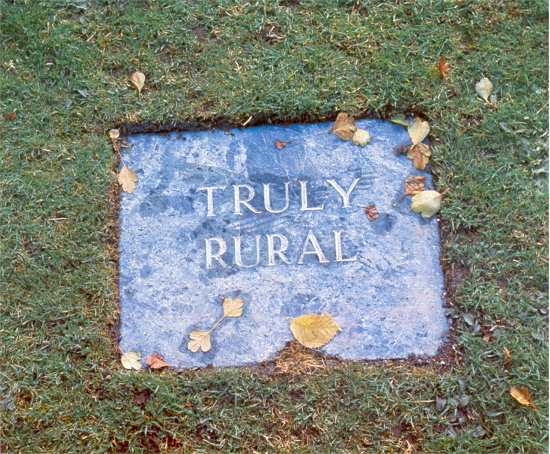
MARY LOUISE BROWN Truly Rural 1984 installation in the grounds of First Church, Dunedin
In the far reaches of Erewhon, Jacqueline Fraser had found a closet-like room, some six feet by six feet, with two small windows in the wall opposite the door. These she scrubbed until light could pass through them. The room then received a paint job in transparent magenta overlaid in parts by bright, wavy patterns in purple, pink and white. A smattering of glitter and a web of beads and other light-catching objects completed a one-off installation, Omeka, which sparkled whenever the sun shone through the windows. Light as light, Omeka exemplified the playful, magical mind that is the mark of Fraser works. Probably the worst consequence arising out of the problems with the exhibition spaces is that the public tended to visit the spaces first, and hence perhaps, be put off Art in Dunedin. The less public side of the project - including performances (at 6p.m. on the first frosty evening of winter), and artists forums and discussions - suffered no such defects.
Colleen Anstey's performance, Rain From the Moon, was concerned with the search for the collective experience of being a woman, although Anstey sees herself as working outside of ideological feminism or any other -ism. The performance was constructed in response to interviews with a number of older women.
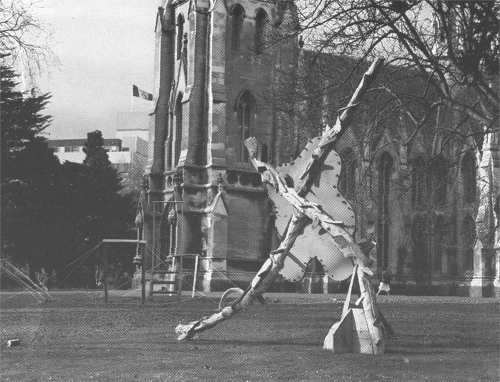
Sculptures by Warren Viscoe (foreground) and Morgan Jones (background) in the grounds of First Church, Dunedin
For Rain From the Moon, Anstey dresses in a yellow cotton overall, a strip of kanuka bearing a ball-shaped 'bulb' at its upper extremity, strapped diagonally across her back. The performance is held in a large gallery where she positions herself at one end facing the wall. Proceeding to take slow, deliberate steps backwards, she pulls a tape through a deck situated directly in front of her original position. Simultaneously a film, which is looped, of Anstey's hands dicing onions, flickers on the wall above the deck. As Anstey works her way further down the gallery the garbled speech from the tape-deck clarifies into three phrases, repeated intermittentIv: "I want to but I can't' . . . 'Here's a dollar' 'he could never really show love'. For several moments the audience can reckon film sequence against reverberating phrase or against Anstey's progress from her starting point. Then, reaching a lamp at the other end of the gallery, the kanuka and 'bulb' is unstrapped and the tape methodically fed into the 'bulb', the last of it signalling the end of the performance.
The near-unanimous response to Rain From the Moon was that although elegant, it was obscure in intention. Accomplished indeed in the neat dovetailing of the various media used, inclusive of performer's actions, it is the case that the promptings of the work are not evident within it. When the theme of Rain From The Moon is known however, its elements fall into place. Perhaps the only way out of this impasse is some slight change, possibly in its seemingly unrelated title. No matter what, this is a work that should be performed again before other audiences and critics.
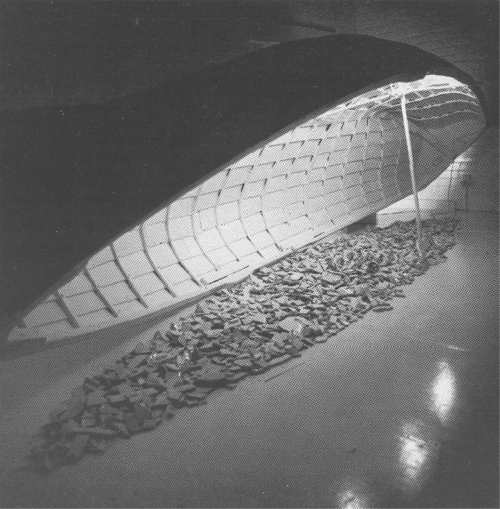
Russell Moses installation at the Municipal Chambers
On the Thursday of the performance week, at the entrance to the Hocken Gallery, black words on white board announced, 'this work contains diuresis and male nudity'. Within, Membrane, a performance by John Cousins, lasted for seven hours. The atmosphere of Membrane is foetal; it is best performed in a chamber which can be kept very warm and in which semi-darkness is broken by filtrated light. To one side of the chamber's centre Cousins is reclined on a bench, connected' via one perspex hose into which he exhales and another attached to his penis, to a many-tiered chandelier-cum-waterfall arrangement, suspended over some 20 feet from the roof to the floor of the chamber. Via a small foot-operated pump, Cousins periodically sends urine from a holding vessel at his side to another at the apex of the chandelier. Both air and fluid create sound at various levels of the chandelier, the fluid through the punctuated but random descent of droplets from top to bottom. The pattern of sound continually rises and decreases depending on the amount of fluid being conducted through the system.
Though it may seem technically complex in description, Membrane is simple, in the sense of seminal, in experience and idea. Cousins himself emphasises that the human air and urine systems and the man - made waterfall system are interlocking and complementary, creating a total environment. The work derives its name from the membranes that function at the critical interfaces of each system: in the filter action of the kidneys and in the pressure on the latex membrane in determining at what rate droplets descend on to the pipes in the waterfall.
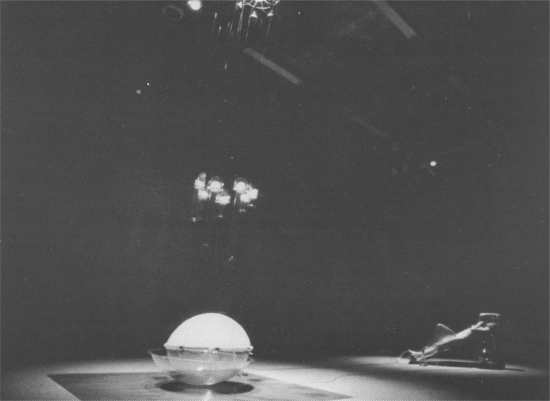
JOHN COUSINS Membrane 1984 performance work
But Membrane is a total environment in a more general (dare I say it) cosmic, sense. It is an analogy with the experience of the foetus in vitro, or with Major Tom, who for some unknown suicidal reason guides his spacecraft into deep space: it is the rush of the breath and the fluid, the uncomposed music, that is first heard on coming into consciousness and last heard going out of it.
In his review of the last ANZART conference in Art New Zealand 28, John Hurrell reported that much of the Australian work 'was by inexperienced and recent graduates from art colleges, and tended to be brash and shoddily prepared.' Hurrell further hoped that, for the next ANZART a curatorial policy be carefully worked out in advance and evident in the resulting programme. It is worrying that another version of just those areas of difficulty was encountered at Art In Dunedin. Obviously, experienced administration and scrupulous curatorship is vital if this tricky area of large-scale, fringe-oriented events is to come into its own. What is desperately not needed is a third version at ANZART in 1985.