
Book review
The Art of Fotis and Lydia Sarris
RODERICK FINLAYSON
Fotis and Lydia Sarris have been active artists in Athens (or some three decades, and with their respective visions, have achieved a considerable reputation. This year after the recent publication by each of a volume of colour reproductions of examples of their work, their achievement is available to a far wider public at home and abroad.Each book includes, in Greek and in English translation, a summary of their lives, their aims and their views of art in general.Even a brief survey shows that Fotis Sarris works in dark and sombre colours, blacks and greys with just sometimes a note of red or orange, fire or fiery sun, truly the night of mankind with only, on the dim horizon, a white streak - dawn light or symbol of hope. Otherwise his mood is pessimistic, mankind oppressed but defiant.As the critic Vaso Katrake wrote:'The painting of Fotis Sarris springs from the dark night even as the howlings of the beast are not yet silent. He marches in the midst of this night like an abandoned and frightened child ... all alone carrying in his heart a burning star. . . '
Lydia Sarri's works include painting, painted sculpture, mosaics, bronzes and terracottas. Her colours, by way of contrast, are warm and bright, ochres, orange and red predominating: but in the case of her mosaics and painted statues, all the bright colours of the rainbow. Generally her mood is gayer, optimistic even, as seen in the series of Winged Victories which preluded the defeat of the colonels of the dictatorship. And a recurring theme is a woman with the rising sun - herald of a New Day?
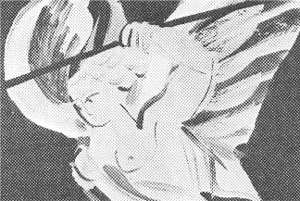
LYDIA SARRI Winged Victory
But some mosaics and terracottas wear the face of woe. Her motifs reflect peasant themes, myths both Christian and ancient Greek, and, especially in the mosaics, Byzantium. She was brought up in country places and islands, a world of classic myth and traditional occupations, surrounded by century-old churches and their multitudinous ikons.' and when she grew older, the wondrous underwater world of the diver, whose gardens and fishes enliven so many of her creations.In her childhood she was somewhat sheltered from the tragedies of the civil war and the dictatorship with which horrors, executions and tortures Fotis Sarris had lived ever since, as a child, he had often to flee from bullets sprayed from English planes. But Lydia's life in Athens with Fotis came at the worst of the terror of the dictatorship from which only their island retreat and the gardens of the sea were a refuge of some sanity.
About that time Lydia Sarri painted her poignant series of Annunciations, her joyful message of hope for what is to come, 'child or hope, life and love.' And later, during the risings against the colonels, she painted her Winged Victories, working to the music of the triumphal Spiritual March, the poem of Sikelianos set to music by Theodorakis. These gave strength to the people against the tanks, the tortures and the killings of the dictatorship.The work of both these artists springs from the soil and soul of Greece with little influence from the West. Indeed it is not surprising that to most Greeks all beyond the Adriatic Sea is barbarian, particularly modern Western materialism and decadence.Early in his career Fotis Sarris summarised his aims thus: 'I try as much as I can to give the artistic extension of a reality which is necessary to the modern human being - a human being who is crucified, a Prometheus, a warrior standing or dead, drowned in blood, a saint, astronaut or bandit, with his hands wounded but attacking ... If hope is the best merit in a world that dies and creates, art as an authentic creation is what enables man in his fight for the best. Thus artistic achievement ceases to be a commercial subject and becomes civilisation.'
It is in this regard that I would compare New Zealand arts, so much of which, painting, sculpture, poetry, music, is so heavily influenced by the American and by replays of worn-out European themes. Lydia Sarri turned her back on all that. In a letter written in 1972 she wrote: 'I turn to the world of imagination again. These last years there is a movement among painters (which began in America) to go back to naturalism. They paint objects of everyday life and they copy photographs of violence or brutal sex and they claim that this is life and this is the way to show it."'I am against this "Pop art" as they call it because I know very well from where it starts. I mean the ideological base of its creators (pessimists in the deepest and most inhuman and fascist way). I am positively against their realism. I do not believe that to paint a soup can of Campbell's or a brand new car adds anything to Art, to Spirit, to Humanity.'
How much of New Zealand art arises from the soil and soul of the land? How much does not even acknowledge this aim? For how long can the New Zealand artist shun his inheritance, the myth, tradition and history of his native land? Or is he forever to remain a stubbornly insensitive stranger to the ethos of this land? As with the Sarris' life and works in Greece, should it need civil war, oppression and revolt to awaken the spirit to the reality of life in one's native land?Whatever the means of our awakening there is a deep-seated malaise to be overcome: the preponderance of the abstract in our lives and thought. In 1936 the New Zealand poet D'Arcy Cresswell wrote: 'We see that savages have more in common with civilized peoples than we have since we are neither cultured nor civilized, that is, using our faculties in harmony, one with another, and all in harmony with surrounding Nature.'And in a letter written just before his death in 1960 he wrote this: In respect of Abstract and Cubist 'art', the result of the former is merely to isolate the abstract extreme, while the result of the latter is merely to isolate the concrete extreme. Now we know that, in nature, as in human nature, abstract and concrete are contraries; but we also know that they are not isolated and irreconcilable contraries, since a thing which is concrete evokes associations which are abstract, and a memory which is abstract recognises a thing which is concrete. Always the one phenomenon evokes the other. it is by means of such associations that the arts of painting, poetry and music unite all these contraries to be harmony. But in the case of abstract and cubist 'art' as with all other aberrations known as Anti-art the contraries are not only unreconciled, they are finally and totally estranged. in most cases the 'picture' or 'poem' or piece of 'music' explodes, so to speak, in one's face! I am not here concerned to judge between Art and Anti-art. But if one be good and beautiful then the other must be evil and ugly. If the one be admirable and sincere then the other must be contemptible and fraudulent. Let us decide which is which, and cherish the one and show a proper aversion for the other. Let us not keep confusing them. If we can't do this, then indeed we deserve that a world so misguided should likewise explode in our faces.
Such artistic decadence is a whole world away from that of Fotis and Lydia Sarris. In this age whose disease is due to its idolatry of the abstract over the concrete, the gigantic error of believing the reason to be superior to the correction of the senses, and Nature a resource to be mined and ravaged by ungoverned technology, the only cure for mankind's health is for poets and artists to present chiefly the concrete, the domain of Nature as perceived by the senses and rejoiced in by a now humbled reason, so that eventually the harmony of concrete and abstract be restored, as for a time it was in ancient Greece.The works of Fotis and Lyclia Sarris complement each other and show us one way to confound the pessimistic, refute the false abstractions and reinstate Man and Woman on our Earth, the one with his crucified but defiant Man continuing to confront the oppressors in the dark night of humanity; the other with her Annunciations of hope, and with Woman of the risen Sun, nourisher and nurturer, raising up and sheltering the poor and the afraid.Some such rebirth only a creator can conceive, perhaps only the Maori expect.(Fotis Sarris, The March of Painting, 1956 - 1983; Lydia Saffi, The Marine Garden - privately published)
Roderick Finlayson, the distinguished New Zealand writer, was born in 1904 and studied painting in his youth. His many books include Brown Man's Burden, Tidal Creek, The Schooner Came to Atia, Other Lovers, and a study of his friend the poet D'Arcy Cresswell.