
Book review
The Pre-Raphaelites: Catalogue for the exhibition of 7 March to 28 May, 1984 Published by Tate Gallery/Allen Lane, London, 1984
Pre-Raphaelite Papers Edited by L. Parris Published by Tate Gallery/Allen Lane, London, 1984
Reviewed by LAURENCE SIMMONS
It seems curiously fitting that, after a year of lavish European Quincentennial celebrations of the art of Raphael, the Tate Gallery should see fit to mount the largest and certainly the most comprehensive exhibition of Pre-Raphaelite painting ever seen—over 250 works with virtually all the masterpieces from the first period of the movement (note-able exceptions are Holman Hunt's The Scapegoat and Dante Gabriel Rossetti's Found). The experience of works so strong and vivid as those in this exhibition, even if only obtained through the catalogue illustrations, is certain to again influence the fluctuating critical fortunes of the painters of the Pre-Raphaelite Brotherhood which have passed from initial ridicule and revile to adoption and celebration and then into lengthy obscurity only recently to be revived once more. Unfortunately, however, the substantial catalogue to this exhibition and its accompanying volume of papers will do little to seriously circumscribe or advance such critical response.
The catalogue is ordered, as the exhibition was, in a strict chronological fashion and, although this is effective for the study of stylistic development, it places serious restrictions on the enterprise as a whole. The terminal date chosen of Rossetti's death in 1882 seems arbitrary given his lack of production in the last decade of his life and the fact that it severs the work of an important member of movement, Burne-Jones, in mid-career. It is through focusing on the works themselves and a lack of historical ideological contextualisation that the importance and relevance of Pre-Raphaelitism in the entire context of nineteenth century culture is not broached. An examination of the origins and development of the Pre-Raphaelite Brotherhood as a response to art historical t such as the German Nazarene style), social, political and economic determinants would have helped test the very concept and coherence of the movement itself.
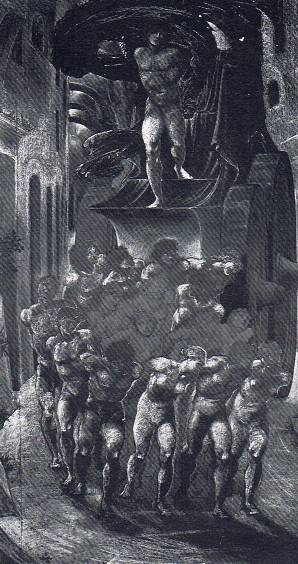
EDWARD BURNE-JONES Study for the Car of Love chalk on paper (Collection of the Auckland City Art Gallery)
One might have expected the amelioration of these defects and faults with 'the publication of a separate companion volume of more general essays to supplement the exhibition catalogue. But the essays in this collection are either quirky in their orientation—for example. Stephanie Grilli on phrenology and PreRaphaelitism!—or merely add to the vast volume of personal reminiscences. We learn that Diana Holman-Hunt, the only direct descendant, has only half a dozen items left from her grandfather's original collection and she has kindly given them to her son. Jeremy Mass informs us, too, that he had the good fortune to meet the author of The Pre-Raphaelite Dream as well as most of the descendants of the members of the Pre-Raphaelite Brotherhood, read English at Oxford, met his wife at the Ruskin School of Art, and that Wenda Parkinson was a strikingly beautiful visitor to his first exhibition of Pre-Raphaelite paintings and drawings, etc. etc... Hardly riveting or relevant material! A more serious and disturbing defect of both catalogue and companion volume, however, is the patriarchal nature of discourse that they share. Both volumes perpetrate the misrepresentation of the active role played by women in the development of Pre-Raphaelite painting and present woman as the static object of art, the model and/or the object of the male artist's attentions. Alan Bowness describes the developments of 1851 as follows: `Girls had now entered the Pre-Raphaelite circle, and the close group of young men was breaking up. Throughout 1851 Rossetti was falling in love with Lizzie Siddal, with a growing passion that identified her as the Beatrice to his Dante'. Elizabeth Siddall, to get her full name and spelling correct (the `Siddal' tag was an invention of Rossetti), at this time a young woman of 22, was in fact to produce a significant body of unacknowledged work before her early death—over 100 watercolours and oil paintings by her are recorded (but only two small watercolours and one drawing are included in this exhibition!) and a substantial volume of her poetry has recently been edited and published. The presentation of Elizabeth Siddall in these volumes as virginal, beautiful, terminally ill and ultimately insignificant, builds upon rather than unmasks the feminine stereotypes that obscure the true significance of women in art history. This tendency to use a familiarised and fantasized biography, to read off from the paintings aspects of life relationships falsifies both biography and painting and says more about the ideological practices of the history of art than it contributes fruitful analysis. In these hands textual commentary is shaped by a consideration of the Pre-Raphaelite painters' sexual habits, and libertarian sexuality is the key to and explanation of developments in their art. The meanings of each painting are donated by the artist's sexuality, be it loss of male virginity (Bowness on Holman Hunt: The Hireling Shepherd records sexual temptation for Hunt personally; perhaps even his own seduction by (or of) the girl, and his loss of sexual virginity.'); or liberated masculine sexuality (Bowness on Rossetti: 'There is a sudden change around 1856 when the mood of innocence and simplicity and virginity that surrounds the first rapture of his love for Elizabeth Siddall gives way to a very different manner—lush, rich, ornate, sensual and highly particularised. Lizzie [sic!] now seems to stand for something threatening to Rossetti, morbid perhaps, even frigid... Rossetti had meanwhile discovered the pleasures of the company of a different kind of woman...').
Here women function as both objects of the male painter's desire in a hierarchy of power in which man is the owner of the gaze and has possession of the feminine object, and as a sign of his liberated masculine sexuality. The point has been made strongly elsewhere and deserves to be repeated: `It is a particular way of seeing and interpreting in which the beliefs and assumptions for art historians, unconsciously reproducing the ideologies of our society, shape and limit the very picture of the history of art presented to us by art history'. (Rozsika Parker and Griselda Pollock, Old Mistresses. Women, Art and Ideology).