
John Guise Mitford
A topographical painter of the 1840s
ROGER BLACKLEY
The first biographical compilation on the obscure figure of Mitford appeared in 1980, in Una Platts's Nineteenth Century New Zealand Artists:
JOHN GUISE MITFORD 1822-1854
Son of Bertram Mitford LLD Clontarf, Dublin; came to New Zealand with his brother G.M.S. Mitford and at first (by April 1841) settled in Auckland. Worked as minor customs official, then appointed 1843 Sub-Collector of Customs in the Bay of Islands.
Painted in Auckland and in the Waikato 1842-44, later perhaps in the Hot lakes district, Rotorua. Was in Auckland by 1845 and by 1852 was the Port Boarding Officer. His watercolours are skilful and some have great artistic value. Represented: Turnbull.
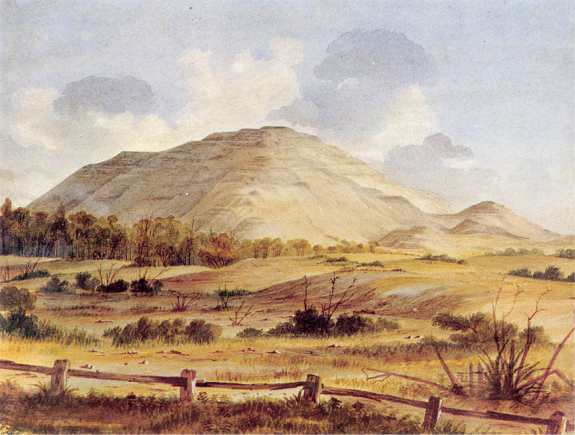
J. G. MITFORD
Mount Eden,
near Auckland 1843
pencil and watercolour,
178 x 237 mm.
Like many of our earliest artists, J. Guise Mitford was an amateur - in the distinct and non-pejorative sense of the word. Over several years (his early twenties) he produced a series of topographical watercolours and wash drawings, for no other apparent reason than his desire to do so. And the inspiration may have ceased quite abruptly, for none of his known works needs to be dated later than 1845.
The concern of this essay is to establish a firm body of work; to approach Mitford's activity through his paintings. After all, these constitute our primary texts, the raw material of art history. Future attributions to Mitford's oeuvre - as much as subsequent biographical footnotes - will only be generated by interest in, and knowledge of, the painted statements themselves.
Mitford's rediscovery begins with Sotheby's sale in 1974 of thirteen watercolours and drawings, one of which is signed on the picture 'Guise Mitford'.1 The Turnbull Library eventually acquired six of these, and the remainder are now in private hands in New Zealand. The arrival of these works has opened the means for attribution to Mitford's hand of a number of unsigned works already in public collections, but classified as 'artist unknown'. So far, one can point to six of these.
Mrs Hobson's album in the Turnbull Library is an album of miscellaneous pictures and texts that was either presented to the widowed Eliza Hobson on her departure from Auckland in June 1843, or dispatched to her shortly afterwards. Two of the watercolours in this album are Mitford's work, as are three sepia wash drawings clearly by the same hand.(2) A larger view of Grafton Gully in the Auckland City Art Gallery collection, with Government House prominent in the middle distance, is closely related to one of the watercolours in the Hobson album.
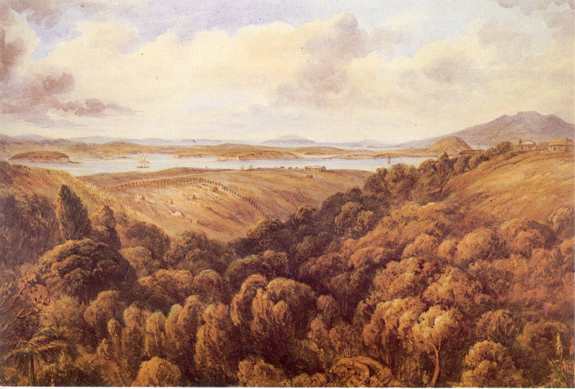
J. G. MITFORD
The Grafton Gully
c.1842/43
penciI, watercoIour
and gum arabic,
327 x 477 mm
(Collection of the
Auckland City Art Gallery)
Geographically, the available work ranges over the Bay of Islands, Auckland and its environs, the Waikato, and the central lakes: Rotorua, Tarawera, Rotomahana and Taupo. The title Near Wellington given by Sotheby's appears to refer to the view of Lake Taupo and Mount Tauhara (private collection).
While none of Mitford's images is dated on the picture, there is evidence to support a sequence from 1842 to 1845. First comes the Auckland work. Watercolour and sepia wash copies of twelve of Mitford's Auckland and Waikato views, signed by 'K. Staples Alexander' and now in t he Auckland Public Library collection, give two Auckland works a date of 1842 - as well as recording the dates of copying all of them (from December 1845 to March 1846). One of Alexander's pencil and sepia wash drawings - Mount Eden an extinct Volcano near Auckland - is a translation of the Mitford watercolour, which is dated 1843 on the mount.(3) And whether or not Mrs Hobson received the album before her departure in June 1843, the four Auckland images by Mitford must have been made before his removal to the Bay of Islands in April of that year.
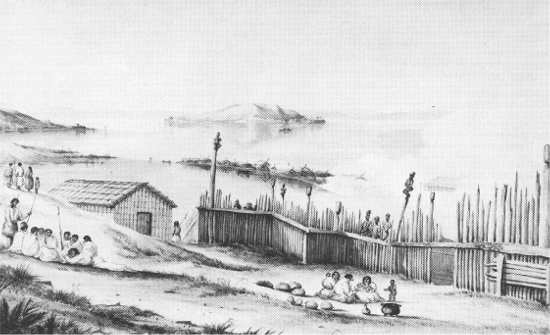
J. G. MITFORD
Mokoia from Ohmemutu,
Lake Rotorua 1845
pencil and watercolour,
276 x 454 mm. (sight)
Mitford probably began with the Waitemata views - pictures such as those in the Hobson album and Auckland City Art Gallery, which stand among the best images of the infant capital. He also moved into the adjacent countryside, using the volcanic cones (terraced by earlier pa dwellers) as central focuses in a series of pictures: Mount Albert, Mount Eden and Mount St. John.
So far the only visual record we have from Mitford's one-and-a-half-year sojourn in the Bay of Islands is Russell from Paihia Wai Keri River (Hobson album). In the official correspondence Mitford groans under the load of customs, post office and treasury duties. Not only does he need to work on the Sabbath to keep the books up to date, but as 'merely a lodger with one of the residents outside the town' he feels constantly insecure in the possession of plunderable government funds.(4) A more lurid picture of the official lifestyle is painted in the 1844 diary of sin-obsessed John B. Williams, the American consul at the Bay, who seems to have taken particular exception to Mitford:
Her Majesties (Queen Victoria) Officers at the Bay have their hours for business, 10AM to 2PM, in this small place of about 205 inhabitants. The intervening time is to(o) much taken up with lewd Maurie women more especially the Sub-Collector J. Guise Mitford, living licentiously with lewd Mauries, and a seducer of innocent young native girls ... (5)
All told, it seems he had little time for painting.
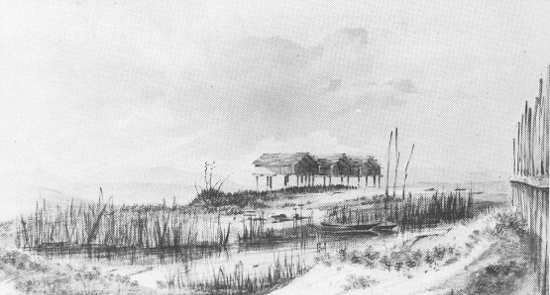
J. G. MITFORD
Provision houses at
Whangape, River Waikato
1844
pencil, sepia wash and
chinese white, 147 x 255 mm.
(Collection of the
Alexander Turnbull Library)
Mitford returned to Auckland in October 1844, after the abolition of customs duty made him suddenly redundant. On October 29 he was negotiating full payment (£50) for the interrupted final quarter.(6) Despite authorisation, this was not uplifted for some months, for in a letter of March 3, 1845, arranging payment, the Collector of Customs writes 'Mr Mitford had been absent from Auckland since the date of those letters until now.(7) We have reason to be grateful for the reign of Free Trade in New Zealand over the summer of 1844/45, for without this new-found leisure Mitford might never have undertaken his journey into the interior.
With whom he travelled, for how long, by which precise route - these and other important questions remain unanswered. Mitford seems not to have contributed an account of his trip to the local press, although many travellers of the 1840s did so. However, when he sent his works back 'home' in 1845, they must have been accompanied by a verbal commentary. This would explain the extended topographical labels and occasional dates on the Alexander copies, which Platts argues were done in Ireland.(8)
Alexander dates several of the Waikato works to December 1844, and a title such as River Waikato at the crossing place from Auckland suggests that Mitford was moving southwards. His landscape interests are varied, as are the media he employs. Whangape Lake, River Waikato (Turnbull) is one of his most atmospheric watercolours, demonstrating an extraordinarily effective handling of broad, loose washes of colour. And yet, by contributing sepia drawings from the same area, he shows how with light washes, brushmarks and pencil drawing he can produce sensitive atmospheric effects by purely tonal means - Provision Houses at Whangape, River Waikato, moreover, introduces the concern for recording aspects of Maori life and architecture that informs three of the major works resulting from this trip: the views of Ohinemutu, Rotomahana and Tarawera.
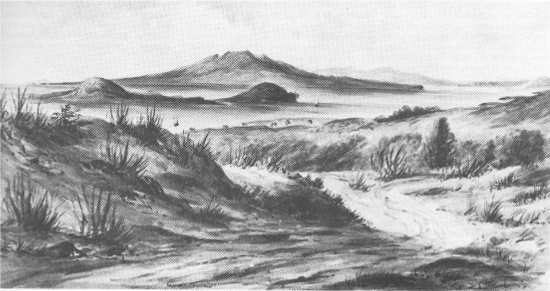
J. G. MITFORD
Rangitoto,
Mount Victoria and the
North Head, from the
Government Domain,
Auckland c. 1843
pencil and watercolour,
162 x 311 mm.
(Collection of the
Alexander Turnbull Library,
Mrs Hobson's Album, p. 35)
As with his series of Auckland volcanoes, there are few precedents for this work. Although he travelled only months before Mitford, George French Angus's Savage Life and Scenes in Australia and New Zealand reveals that he did not visit the Hot Lakes, and the Ohinemutu plate in New Zealanders Illustrated appears to have been plagiarised from work by Joseph Jenner Merrett. Merrett's mannered, sometimes inspired landscape drawings of the interior make up a sizeable proportion of the Hobson album, and these or similar works by Merrett would have been familiar to Mitford.
In Mokoia from Ohinemutu, Lake Rotorua Mitford provides an image of considerable historical importance. Whereas Merrett recorded the pa from the lake,(9) Mitford locates his foreground before the upper palisades, and beyond the steamy settlement he maps out the mirrored surface of the lake.
At Rotomahana, where again Merrett seems to have made the earliest visual records,(10) Mitford establishes a foreground of lakeside foliage, three Maori figures, and a possible self-portrait. Against this 'frame' he establishes a middle-distance exploration of the architecture on Puai Island, and of the already famous pink terraces of Otukapuarangi across the lake. This is the first major picture of Rotomahana, by one of the earliest tourists.
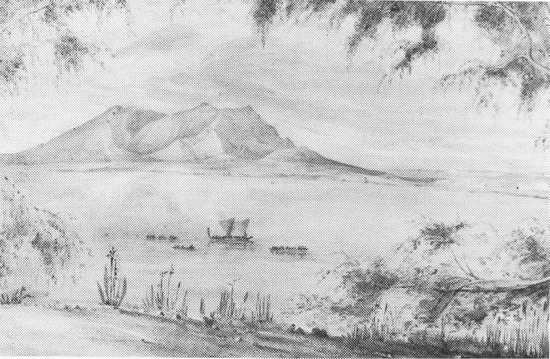
J. G. MITFORD
Mount Tauhara,
Lake Taupo 1845
pencil & watercolour,
295 x 448 mm.
Tarawhera Lake - Tauaroa Pah - Whareroa Pah in the distance is arguably Mitford's masterpiece. By dispensing with the symmetrical foreground framing devices against which he usually relates his distances, he has achieved a composition of considerable power. Whereas in most of his pictures the eye is led in a complex series of counter-balanced movements, here the progression from near to far occupies a dramatic movement from left to right-from the strongly coloured foreground foliage across to the paler washes of the distant hills. Mitford documents Maori architecture and activity, but he scrupulously relates these to the geological character of-the landscape, to the ground-cover, to the properties of light reflected on the surface of still water, and to the weather. The painting not only serves as a representational delineation of Tauaroa Pa and its environs, but also as a virtuoso exposition of atmospheric perspective, keyed to the vibrant qualities of a midsummer day at Lake Tarawera.
In considering these views of the central lakes, we need to realise that their sizes and degrees of elaboration speak not of outdoor painting, before the views in question, but of studio practice. That is, working at home in a well-lit room, spending hours, perhaps days, coaxing watercolour washes with soft, full sables, leading up to the final pleasure of putting in the detail (pa structures, branch formation, figures) with the finer point of his brush. The Grafton Gully is similarly a studio production, for which the version in the Hobson album provides a plein air equivalent that is clearly the basis for the larger piece. Mitford's outdoor work, of which the Turnbull Library holds several superb examples, generally conforms to a (roughly) five-by-ten-inch format. None of it shows signs of being preparatory to further productions, such as the colour notes to be found on certain outdoor works by Earle and Kinder, among others. In fact, very little pencil work is evident at all, for Mitford prefers to draw with his brush-fat, mobile strokes, both wet and dry, that he articulates with energetic stippling and delicate thin lines.
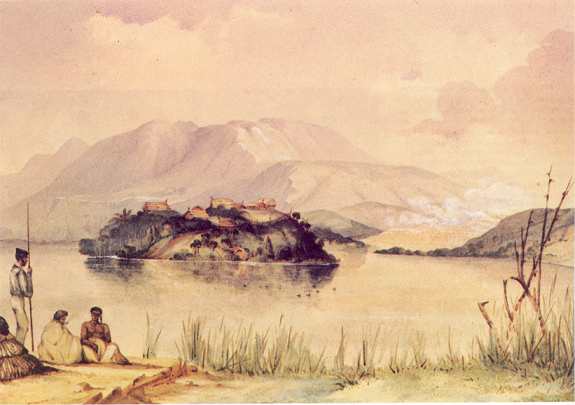
J. G. MITFORD
Puai Island
and Otukapuarangi,
Lake Rotomahana 1845
pencil, watercolour and
chinese white,
226 x 324 mm. (sight)
That Mitford's watercolour technique is purer and many degrees more sophisticated than most of his immediate contemporaries' is evident in an outdoor view such as Mount Eden, near Auckland. Merrett, who was alone in classifying himself as 'Artist' in the 1845 Auckland jury list, must in the topographical department give precedence to Mitford, who called himself 'Gent.'.(11) For with only twenty-odd pictures presently known, J. Guise Mitford ranks as one of the foremost among New Zealand landscape painters of the mid-nineteenth century.
Photographs of works in private collections are by courtesy of the Alexander Turnbull Library.
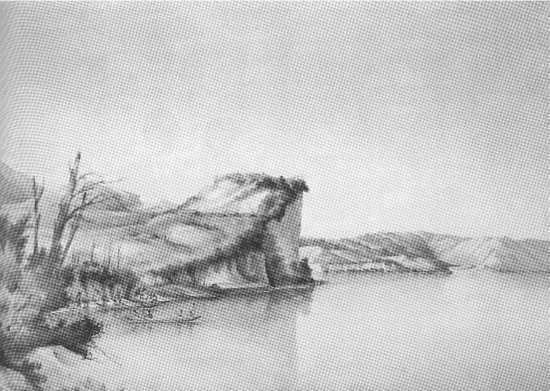
J. G. MITFORD
Tarawhera Lake -
Tauaroa Pah -
Whareroa Pah in
the distance
1. Provision Houses at Whangape, River Waikato (Turnbull). The 'J' is cropped, which explains why Sotheby's and later the Turnbull Library called this artist 'Guise Mitford'. But J. Guise Mitford' (or 'J.G.M.' on several paintings) is his invariable signature, as well as the form his contemporaries use when referring to him. The titles and sizes of the works sold in 1974 are listed in Newrick's New Zealand Art Auction Records, 1975.
2. Mrs Hobson's album is to be published soon by the Turnbull Library. Mitford's work is on pages 31, 33, 35, 41 and 45. The watercolour on page 111 is extremely close to Mitford's Grafton Gully view on page 41, but it is clearly by the artist of the Government House watercolour on page 5. This was Edward Ashworth, possible instigator of the album. For reproductions of two of Mitford's wash drawings, see the frontispiece (Russell from Paihia Wai Keri River) in Ruth M. Ross, New Zealand's First Capital (Wellington, 1946) and opposite page 64 (an untitled view of Auckland and the Waitemata) in Michael Barthorp, To Face the Daring Maoris (London, 1979).
3. There are other instances: the watercolour Whangape Lake, River Waikato is rendered by Alexander into a clumsily Mitfordesque sepia wash drawing. The Alexander copies are valuable chiefly for the titles and dates they provide. For example, Mount Albert, an extinct Volcano near Auckland, and the Kauri Pine Forests on the west coast in the distance, which corresponds to an uninscribed Mitford in the Turnbull Library, is almost certainly a title supplied by Mitford himself. However, the copies also reveal four images for which I have been unable to trace Mitford's originals. These are the two watercolours, Harbour of Auckland, New Zealand and River Waikato at Pukatia Decr 44; and two sepia drawings, Eden Park the Farm of George Cooper Esqr near Auckland and Road through the Bush near Auckland - March 1842.
4. Information in letters from Mitford to the Acting Collector in Auckland, dated July 8 and August 3, .1844 (National Archives, I.A. Col. Sec., 44/1563 and 44/1786).
5. The New Zealand Journal 1842 - 1844 of John B. Williams of Salem, Massachusetts, (ed.) Robert W. Kenny (Salem 1956), page 65. Later in the journal, Williams gives his description of 'John Guise Mitford, a proud assuming upstart of about the age of 25 years, about a 6th rate man, a lecher of Mauries, half educated upstart of a boy, made choice of by the English Government as Queen Victoria's Sub Collector of Customs, passing over an old settler, a worthy man, a man of urbanity Capt. Bowditch (he never left his country for his country's good)'.(page 87)
6. National Archives, LA. Col. Sec. 44/2244.
7. National Archives, I.A. Col. Sec. 45/428.
8. Nineteenth Century New Zealand Artists, page 19.
9. For one version, see The Pah of Oinamutu on the Rotorua Lake (Hobson album, page 23).
10. A Hot Spring in the warm Lake of Rotomahana (Hobson album, page 37).
11. New Zealand Government Gazette, vol. 5, 1845, page 18.
'List of all Men within the District and Town of Auckland, in the Colony of New Zealand, liable to serve on juries ... 4 February, 1845.'