
The Paintings of Glenda Randerson
MICHAEL DUNN
Realist painting is no longer as fashionable as it was in the mid-sixties. An indication of its current status is the exclusion of this type of work from the survey shows of New Zealand painting at the Auckland City Art Gallery in 1983. New Image painting has effectively drawn much of the attention of critics and the public away from the realists. Yet, the realist tradition in local painting continues out of the spotlight. Among the foremost adherents to a realist style is Auckland painter, Glenda Randerson.
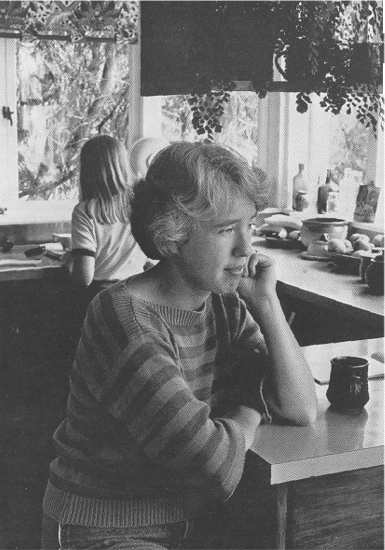
Glenda Randerson 1984 (photograph by Patricia Dunn)
Trained at the Elam School of Art in the late nineteen-sixties she was taught by Garth Tapper and Colin McCahon. McCahon liked her painting enough to buy one of her student works. But she was not influenced by his style. Instead the background to her painting lies in the realist pictures of Michael Smither and Don Binney - then so popular. She found her direction with still-life and interiors painted in 1969-1970. From the start her work was marked by a fine sense of tone and structure. Among admired influences on her style was the still-life painting of the Italian artist, Morandi.
Glenda Randerson chose to paint domestic scenes rather than landscape, to record the interiors of Auckland homes and still-life groups set in them. These works have a peaceful, sheltered quality, as if cut off from the concerns of the outside world. They do not project specific themes about regionalist and conservationist issues in the way some realist paintings do. Instead the values are those of formal order, of colour, tone and the play of sunlight. Thematic concerns emerge imperceptibly from such works.
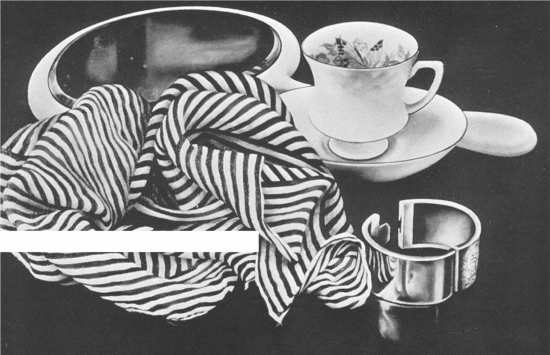
GLENDA RANDERSON The Silk Scarf 1983 oil on canvas, 230 x 380 mm. (Private collection, Wellington)
Although Glenda Randerson has friends who are feminist artists, she does not share their interests in her paintings. Her themes tend to affiliate her more with earlier women artists such as Mary Cassat, whose work she admires. In fact, Glenda Randerson's painting has qualities often thought of as feminine rather than feminist. In her recent works she continues to paint the domestic world she knows, of her friends and children. Much of her subject-matter is private and personal in its references. She prefers to choose even still-life objects from things she owns and cares about. Her well-appointed interiors seem to embody the values of her circle. It is a very different world from that of fellow Auckland artist Tony Fomison, for example, but rather closer to that of Peter Siddell.
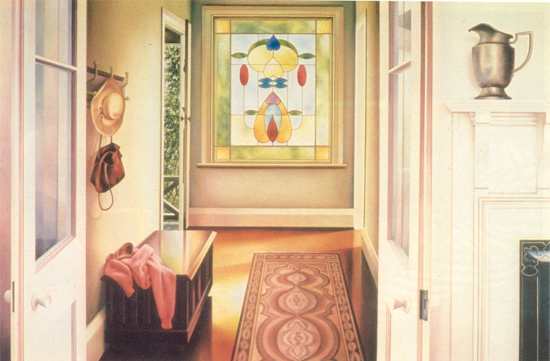
GLENDA RANDERSON The Passage 1983 oil on canvas, 1205 x 1780 mm. (Collection of the Department of Foreign Affairs)
As a painter Glenda Randerson is a traditionalist. She has little concern with fashions in art, or with popularity. She paints her works on an easel in oils on canvas. Each painting takes considerable time to complete - a month or more at least. She prefers to paint direct from her subject where possible. This approach contributes to the unique feel of her paintings when looked at in the New Zealand context. They have a reflective, contemplative quality. Knowing this, it comes as no surprise to learn that she had an early enthusiasm for the abstract paintings of Milan Mrkusich. Her sensitivity for the formal properties of painting distinguishes works like Still-Life with Broken Gift (1983). Each shape, colour and tone has been adjusted to produce a work of deceptive simplicity and order.
One consequence of her working procedure is that her output as a painter is low. Yet her method does not involve laborious preliminary drawings. She prefers to develop her drawing with paint, not to paint over a drawing. Her preliminary compositional studies made on sheets of newsprint have a broad sketchiness to them. By painting in lines with a brush she can suggest the positions of the main forms without describing them. She makes a scaffolding over which the painting can be built. By using oils straight from the tube with minimal amounts of medium, she achieves a substantial quality in her paint surfaces. She always works over a white ground which contributes to the translucency of her colours, even in shadowed areas. Her colouring is usually restrained throughout a painting. But she enlivens the work here and there by a few bright accents - for example, the still-life of flowers in her Portrait of Carole Shepheard (1983).
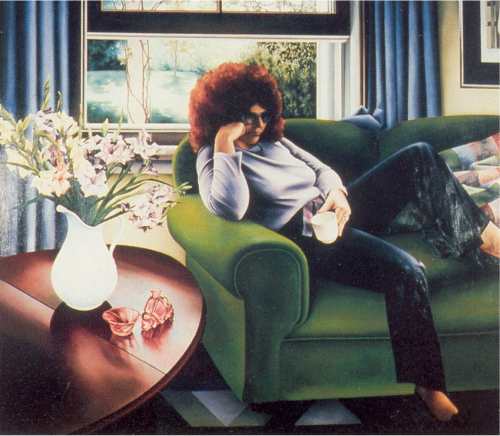
GLENDA RANDERSON Portrait of Carole Shepheard 1982 oil on canvas, 1670 x 1830 mm. (Collection of the Bank of New Zealand)
Her most successful paintings are often the simplest. When she paints a few still-life items in close-up the problems of spatial recession and scale do not occur. Nasturtiums (1983), is an example of a composition where the necessity to draw the background room did not arise. The flowers and their leaves are arranged across the picture surface with minimal, concern for depth. In other still-life paintings, Glenda Randerson avoids depth by tilting a tabletop towards the picture plane, thus cutting off recession. Once complicated perspectival effects occur, in her views of hallways, and large rooms, the sense of order is disrupted and the spatial illusion is not maintained. Also, because she depicts her subjects in sharp focus, they appear to be near the viewer, not set back in space as she intends. Her feeling for pattern, like the shapes made by the dial of a mantel radio or the stripes of a scarf, functions best when not in conflict with deep spatial effects.
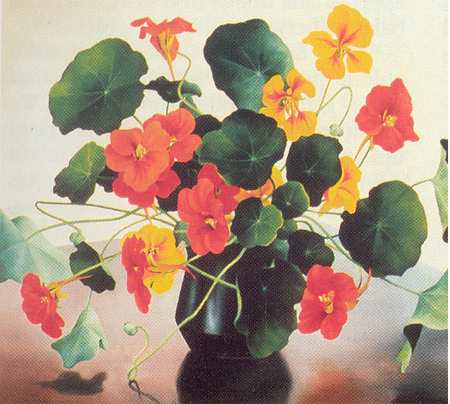
GLENDA RANDERSON Nasturtiums 1983 oil on canvas, 300 x 400 mm. (Private collection, Auckland)
Glenda Randerson's paintings often depict the traditional subjects of the studio still-life - bottles, pot-plants, and flowers. Unlike many contemporary realists she has not sought novelty in her subject-matter by introducing items from modern life. Even the radio in one of her new paintings is an old model, almost an antique. But there is no overt sentimentality in her art. Nostalgia for things past is not a pronounced interest. Her vision as a painter seems to exclude things of a specific type to focus on those of a basically simple and timeless quality. Quite a few of her paintings show an open window looking out on to a view of a garden. The window provides a release, a means of escape, land implies the presence of the outer world from which her interiors cut the viewer off. As in seventeenth century Dutch still-life and genre paintings, the window reduces the hermetic quality of the subjects and also suggests the source of light that illuminates them.
In recent times she has painted a number of portraits of friends. These works were not commissions. Instead the paintings have been made at the artist's request. Unable to work from the model continuously, she has been forced to resort to the use of colour photographs she ' takes during sittings. This may account for some of the stiffness of these figures set amongst still-life objects that often have more vitality. The portraits mark a shift in her painting towards a larger scale and more ambitious subjects. in the process there are some conflicts of interest between the demands of figure painting and her earlier concern with interiors and still-life. Obviously there will be some re-thinking of priorities. She may move her figure-painting to the breadth she has achieved in her best still-life pictures.
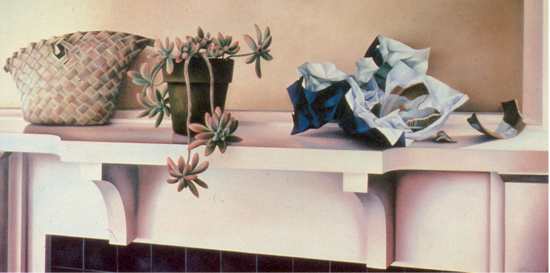
GLENDA RANDERSON Still-life with Broken Gift oil on canvas, 613 x 1220 mm. (Collection of the University of Auckland)
Glenda Randerson began as a realist and has not deviated from that path. Part of her strength and integrity as an artist lies in her independence from fashions. This is not to say that she has ignored recent developments in painting. She has visited New York several times to study directions in realist painting there. But her own evolution has been personal and cautious. Already she ranks as one of the finest contemporary New Zealand realist painters.