
Alternative Projections
The High Voltage Assemblages of Diana Lee-Gobbitt
DIANA BAGNALL
I'm juggling with products manufactured from plastics and balancing the act with neon lighting in association with assemblage.
DIANA LEE-GOBBITT 1982
Not everyone could live with a plastic lobster protruding through the shattered screen of a television console, its claws pulsating with light-emitting diodes, against a glittering background. The plastic crustacean, transmitting vital energy, is part of the high-voltage environment of artist/ creative-technician Diana Lee-Gobbitt.
Although technically the national grid provides the power for this assemblage and for her bleeping neon progeny, the initial source is in the energy of her own brain. Diana, who spent her youth in Suffolk, Essex, Berkshire and London, came to New Zealand in 1966 on a working holiday and stayed, intoxicated with the country's social and creative freedom. The next fourteen years were busy with study, two marriages, eighteen exhibitions, involvement in theatre and travel throughout New Zealand. Her public work was in two dimensions but behind her mental screens other dimensions were forming.
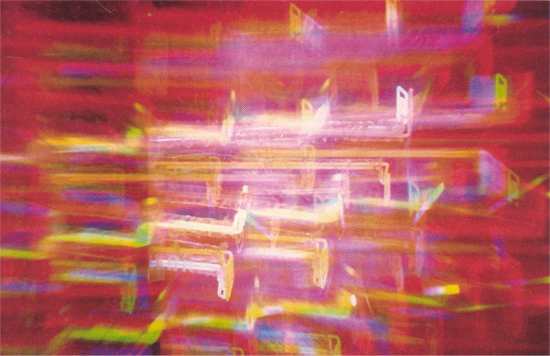
DIANA LEE-GOBBITT
Space Blooms
seen through
Spec-a-Delics
'I was discovering potential for "objects" and began to realise that my interest in collecting objects from the seashore, bush and street was part of a process toward integrating consumer products in order to extend my ideas involving assemblage.'
On a ten-month visit back to London in 1980, the visual impact of shop-window displays and neon signs encouraged 'a fresh appraisal of the familiar Auckland cityscape when she returned in 1981. With new insights, Diana applied successfully to the Queen Elizabeth II Arts Council for an individual grant to pursue her ideas involving assemblage and neon lighting.
'Artists have always used the available technology of their era in order to extend ideas relating to the culture of the time in which they live', she says.
When she began her project, Diana approached eighteen Auckland manufacturers requesting sponsorship of products - in particular those involved in plastics manufacture (a recognition that these products had further creative association). With the blessing of general managers, she transported skylight domes, extruded plastic belting, polypropelene industrial vacuum cleaners, boat engine casings and a multitude of plastic products to her studio in His Majesty's Arcade.
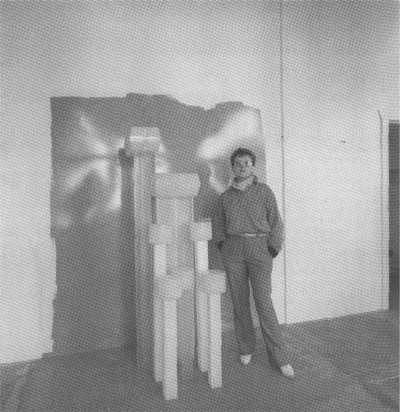
Diana Lee-Gobbitt
(photographed by Real Pictures)
The neon lighting aspect in association with assemblage has been a direct result of observing the use of fighting for window displays and street advertising. Diana approached Mr Ted Maney, lighting co-ordinator at Clearlite Signs, Takapuna, with the idea of using neon in conjunction with assemblage. 'Ted was intrigued by the idea of using neon in association with assemblage, and with the potential for re-discovering neon lighting as an art-form. Ted gave me technical information on neon and when I had evolved a technically feasible assemblage, he and his staff collaborated to produce neon lighting from my designs.'
For the exhibition 'Alternative Projections' at Room Service gallery (November 1 to December 5 1982), Diana introduced aural dimensions' in two of the assemblages, Astros I and Astros II. This involved, for Astros I, a random bleep system, and for Astros II, a light sensitive aural projection.
'I invented a light sensitive apparatus, using micro-light sensors, integrated circuit chips, a sound oscillator and amplifier of the type used in 'Space Invader' machines, The interaction of movement (people) passing through the light beams trained on the sensors activated the sound oscillator connected to the circuit chip, causing sound fluctuation, thus involving those visiting the gallery on a participatory level with Astros II. I had a limited knowledge of electronics, but at the time of the idea I was fortunate to meet a visiting physicist from Waterloo University, Canada, Lyle Robinson, who was fascinated by the idea of introducing sound into the works, and gave his knowledge and advice in assisting with the project.'
Music has always been an important creative association in Diana's life; and for the exhibition she commissioned a 'musical extension' relating to the concept of 'Alternative Projections'. The work was composed 'Sight unseen' of the assemblages, by Grant Leigh Mitchell, in collaboration with Anthony Corban and Terry King, Progressive Music Studios, Auckland. 'The only request that I made to those involved with the music was that the sound be 'futuristic', and relate in part to the evident interest in space exploration, and use some of the latest equipment in sound recording and instrumentation available in Auckland in 1982.'
A further aspect of viewing these works was the provision of a pair of Spec-a-Dellics. The specs are polarised light sensitive spectacles with light refractive surfaces which change white light into a bright (colour) spectrum.
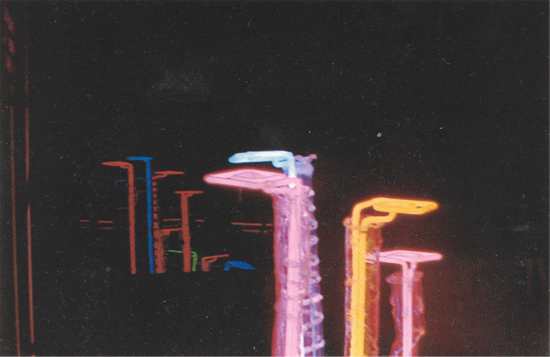
DIANA LEE-GOBBITT
Space-Blooms
During the exhibition, the Papatoetoe Intermediate School and Grey Lynn Primary School visited the show as part of their 'art education' programme. This, with the assistance of Tim Coffey and John Draper, directors of Room Service gallery, led to a show on Video Despatch. A follow-through from the programmes Top Half, and the Good Morning show resulted in Top Half considering the exhibition to be the most exciting and innovative show seen in North Island galleries during 1982; and they chose it as their 'Pick of the Year'.
Subsequently, Television New Zealand editors for Top Half, Mr. Rick Carlyon and Mr. John Harris have authorised sponsorship for a video of the works and music to be presented at the ANZART in Hobart Art Convention 1983 (May 19 to June 12).
Interest and patronage came also from the support of Dartington Interiors, who purchased Space-Blooms (the work can be viewed in their Custom Street Showroom).
Diana Lee-Gobbit's interest in inner city environments is reflected in her present project Wall-REFLEXION - a major concept involving kinetics, neon lighting and related to the 'inner city pulse', with the idea of enhancing our 'cityscape'. She says: 'I would like to provide a work which will give pleasure and interest to our everyday environment and which will intrigue those who visit Auckland and those of use who live and work within a city environment.'