
Exhibitions Dunedin
PETER LEECH
Philip Trusttum
Playing the Game
The psychic parallels between making art and engaging in play have, since the nineteenth century, seemed sufficiently striking to various aestheticians and commentators on art to warrant a general theory of art as a form of play.
The theory has a persuasive force - at any rate, once the proper conceptual clarifications are made. For instance, play should not be thought of as unstructured activity: it is perfectly apparent in the play of children that the rules of a game can be as unbendably rigid (if not always transparent) as any of the rules we are inclined to invoke in governance of humanity. Nor, as Freud pointed out, should play be thought of in contrast to work or serious labour: once again it is plain that children - and indeed adult game and sport players invest quite as much energy and commitment in play as in the painful exigencies of the 'real' world.
But where the theory becomes aesthetically telling is in its pivot on two fundamental features common to both play and art: namely, the exercise of imagination and the interests of pleasure. And these are two features which, detrimentally, with the increasing solemnification and politicisation of modernist art, it becomes easier and easier to lose sight of.
In the art of Philip Trusttum, however, such oversight has never been possible. Vagrant as he may be (and it is part of his essential artistic charm), Trusttum has never been vagrant to those two principles of art. The persona which always communicates - and no more clearly than in the Sarjeant Gallery's recent touring assembly of twenty years of the artist's work - is that of one who responds celebratively to life in games and the pleasures of play.
Games and play have been constant themes in Trustturn's artistic narrative, evidentially established in the titles of well - known works which go back to the 1960s. But recent work - some of it first shown in the Sydney Biennale - takes up the themes in newly concentrated form. The new work at the Bosshard Galleries is no more direct than in its title: Play III.
The covert imagery of the new works derives from the game of tennis; or, more specifically, from the dynamics of playing tennis. Impact, Drive, and Touch, from Play III, each project, with extraordinary clarity, the forces which can prevail in play.
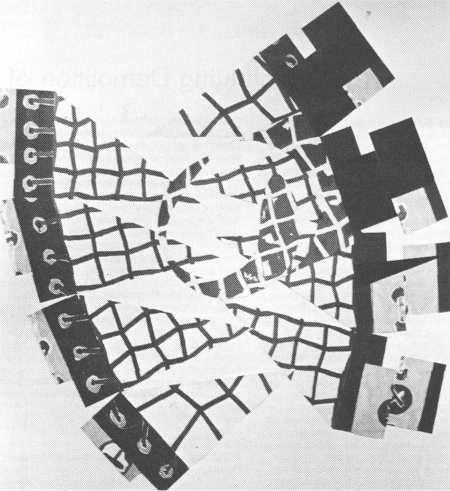
PHILIP TRUSTTUM
Impact
paper collage
(The Bosshard Galleries)
Impact, for example, has the wrist-wrenching power of the tennis ball striking the racquet at full velocity. The fractured patterns of the image - and the subtle and indirect figuration is beautifully conceived - convey, albeit metaphorically, the shattering power of impact.
In Drive, the dynamic focus is the curl of the muscled shot whose kinetic energy bends the line of return and cunningly misshapes anticipated direction. In Touch the focus is the glancing obliqueness - the sliding off - of a miscalculated shot. As in play, these are images for life.
The images themselves are construed in monumental - one wants to say virtually sculptural - manner. Their sheer size on the wall disconcerts the spectator. The inclination is to stand further and further back as if to escape the enveloping power of the forces at work. And if Trusttum has, in the last few years, been getting more and more expansive in his painting, then it is surely now, in Play III, that such expansiveness has reached a perfectly natural termination point.
It is, for Trusttum, a natural termination point, and not a new and different game. It surprises me that at least two commentators on the Sydney Biennale - Francis Pound and Roger Blackley - have remarked relations between Trusttum's new work and Richard Killeen's favoured images. Such relations are, I think, merely factitious: founded on the uninteresting fact that, like Killeen, Trusttum has recently started to work directly to the wall with, as in Play III, assembled goatskin paper cut-outs. But Killeen's interest lies in componential relations between images. Trusttum's, as always, lies in the unitary image, no matter how it is materially established.
In any case, it seems to me critically wrong to make the underlying assumption of such aesthetic diagnosis: namely, that Trusttum has suddenly burst out of a frame which contained earlier work. Always, the significant appeal of Trusttum's paintings has been that frames, or edges, or boundaries, have never much mattered to him. Always, there has been an uncontained, exuberant visual sprawl which overspills fortuitous physical borders. (To put it in the most tediously mechanical terms - I think particularly of Trusttum's paintings on silk - the image is larger than a physical framing or hanging will allow without material obtrusion.)
In Trusttum's game, as in forms of play, there is the invariable sense that rules are not dictatorial, that new rules can be added: more or less as an inventive (but disconcerting) chess player might suddenly make a move off the board and argue that the conventional chessboard is infinitely extendable in other dimensions. And that is one of the delights of play: that rules are for the moment, and not (the other way, and habitually) that moments are constrained by the rules.
Psychologically, then - and materially different as they are Trusttum's new works represent no break in aesthetic continuity. Nor as I have heard it prissily and pompously complained - is it of any significance (except perhaps to some myopic curator or archivist) that the artist fixes up his images with multicoloured mapping pins. That is the inventiveness of play - a freedom of imagination: to use what may be immediately to hand. And how unspeakably dull to encounter someone who could not play chess on a checked tablecloth with beans for queens and prawns for pawns.
Still, there was, in Play III, one work of the four - Kennex - which was an aberration. It lacked the inventiveness of play in merely offering the image of an object (the commercial insignia of an identifiable racquet), and not a dynamic of play.
Otherwise, and much more to the point of artistic character, Philip Trusttum does represent, and continues to represent, the twin foundations of art and its relation to play which define a foundation for absorption in art. He bespeaks a fluency of imagination in concert with the pleasures of play. What more could one ask of art - And how much less do we now accustom ourselves to getting?
When Freud - that great humanist - turned his penetrating mind to art he averred a theory (in Jokes and Their Relation to the Unconscious) that in mature humanity there is a persevering of childish play in the telling of jokes and the making of art. It is, I think, no accident, that Philip Trusttum is the joking bricoleur of life and art; that, in conversation, he gives proper merit to the New Zealand argot phrase 'a joker'; that one of his most forceful and celebrated paintings is actually called joker. He is part of the game: but by his hand he can, like the joker card, transform it - and thereby subvert and snap at the heels of rules.