
Exhibitions Wellington
AVENAL McKINNON
Charles Tole
Ralph Hotere
Gavin Chilcott
Philip Trusttum
Of recent exhibitions in Wellington, four are particularly noteworthy: Aramoana Black Windows by Ralph Hotere, Play II by Philip Trusttum, Love and Painting by Gavin Chilcott at the Janne Land Gallery; and Eight Paintings of 1974 through 1982 by Charles Tole at the Peter McLeavey Gallery.
In his seventy-ninth year, Charles Tole belongs to an older generation of painters. Originally taught by his brother John Tole, he first fell under the spell of John Weeks in 1938. In this exhibition the Weeksian aura of filtered Cubism continues.
Tole's Decoration With Cross (1981) is almost pure synthetic Cubism: although his colour is uncharacteristically sensuous, almost decorative. Here the cruciform shape superimposed upon a circle is set within a series of interpenetrating quasi-geometrical planes in a complex rendering of volumes.
In his landscapes Tole uses a post-Cubist vision to structure his spaces, to intensify his pictorial narrative. His rolling, sculptured hills with their Cézannesque richly-incised outlines have a muscular quality, a formal strength and solidity. Nature is pared down to the barest essentials, his trees emblematic, his houses slots of colour.

CHARLES TOLE
Power Station 1981
oil on canvas
(Peter McLeavey Gallery)
Industrial themes which have preoccupied Charles Tole for a long time were evident in two paintings: Crane (1974) and Power Station (1981). Here, factory chimneys preside over a hierarchy of featureless block-like buildings beneath a chequer-board sky.
Ralph Hotere's exhibition Aramoana Black Windows was a series of oil on board paintings, deeply introspective and darkly minimal. They were set within window-frames, and the golden grainings of the wood complemented the perfect black tonings of the boards' painted surfaces. The poised brass hooks heightened the feeling of being able to fling them up and lookout - but for the reading of these works the viewer turns inwards. These are framed vistas of infinity.
Hotere uses his familiar device of stencilled letters Aramoana Aramoana Viva Aramoana and numbers, arranged in calendar form, May 1981, June 1981, July 1981, visible beneath scribbled veils of overpainting in a suggestion of timelessness, although the political implications cannot be ignored.
A physical sense of suffering is conveyed by the manner in which the initials RH are burnt and branded into the wood. The surfaces of the boards themselves are punctuated with nail holes picked out in white, while the cross gleams out of the darkness - a symbol of hope.
Like Mark Rothko's works, Hotere's pure abstractions have the power of an almost cosmic spirituality.
Gavin Chilcott's paintings in comparison are loose and light. There is something theatrical in his boldly-conceived compositions with their mingled allusions to reality. In essence these soft, unstretched, thickly-painted canvases are like stage backdrops - the curtain is drawn back on a world of images whose bright shapes and seemingly arbitrary arrangement belong to the world of fantasy and imagination, animated with the suggestion of human presence and tangible objects.
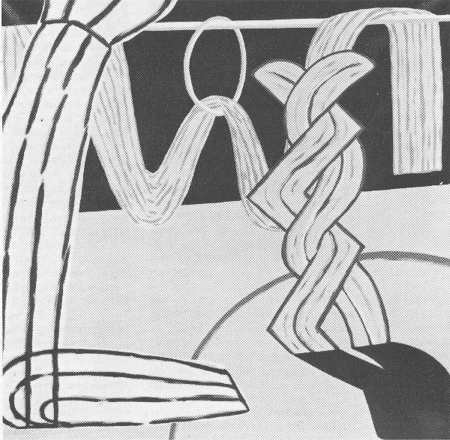
GAVIN CHILCOTT
The Bathers 1982
acrylic on canvas 1400 x 1400 mm.
(The Janne Lande Gallery)
Philip Trusttum's exhibition Play II was a tour de force of pure energy and dynamic colour. Continuing his open form of cut-out shapes superimposed upon one another in frameless collages, these freely registered montages had as their starting point the game of tennis.
The basic accessories: shoes, racquet, court, socks, shorts and the ball itself were transformed into a kaleidoscope of patterned movement and vitality - a co-ordination in visual terms of eye, mind and motion. In L-24 1/4 Trusttum pivots attention on to the thrust of a tennis racquet balanced between two tennis shoes, the taut laces rhythmic with the momentum of the game. Trusttum's vocabulary of pattern magnifies details so that the treads of shoes, the herringbone of socks, the weave of shoelaces, manufacturers' marks and the twist of catgut are juxtaposed in a lively multiplicity of viewpoints.
These assemblages of pulsing, buoyant shapes are mosaics of pure colour reminiscent of Matisse's last great cut-outs; and they testify to Trusttum's stature as one of New Zealand's greatest colourists.