
Exhibitions Dunedin
PETER LEECH
Process & Product: Andrew Drummond
There is a simplistic way of regarding post-object art which leads to the commission of too many pseudo-artistic inanities. That way is to think of post-object art as an art without object - or anyway an art which does not aesthetically depend upon object. What is empty about this negative characterisation is that response to the art is confined by some principle of what the artist is not doing, rather than what he or she is doing.
A positive characterisation of post-object art, however, might be that it is an art of process rather than product: that its object is the nature of artistic thinking itself, not merely the final end or product of that thinking. But here, of course, lies the enormous challenge of post-object art: it proves itself only in the structure, depth and subtlety of the manifest artistic thinking. Hence the poverty of so much of it.
One of the very few New Zealand artists who has the intellectual measure of post-object art - and the inner vitality for it - is Andrew Drummond. And though his May exhibition at the Red Metro Gallery cannot be counted a major show by Drummond's own inventive standards, it is nevertheless instructionally important.
In fact, the exhibition is a fairly selective survey of Drummond's work over five years. Only Trap, two further drawings from the hugely impressive Vein cycle, and a newly constructed residual piece from the 1981 work, Hot Impressions from Earth Plates, are dated 1983.
But even if several other works have been seen before - notably, elements from Fitter Action Aramoana 1980 (discussed in this column in Art New Zealand 16) - the exhibition has a powerful integrity: a signatorial stamp which has to do not merely with the recognisability of Drummond's individual works, but also - intriguingly - with the continuity and inter-connections of those works. Indeed, it might be said, the most persuasive feature of Drummond's art is the sense of a mind which can seize upon disparate content and work it over in a distinctive and characteristic manner: a sense, in a word, of style.
Persistent and basic to Drummond's artistic passion is an alertness to the relations between the physical world and the physicality of the human body. With Filter Action Aramoana, for instance, the ecological significance of the salt-water marsh site (now, happily, un-thunk big) is projected in the bodily image of the filtering action of a kidney. With Vein, the plundering of the land's mineral seams is expressed in the image of a body's veins and arteries, opened up, wrenched out, then artificially sealed off.
That theme, of course, has been persistent and basic to the history of art generally: as that great writer Adrian Stokes once claimed, 'There is a sense in which all art is of the body'. But just this theme is of peculiar importance to post-object art and its performances. The artist, as body, literally comes to participate in the process of the art - gets physically inside the product. (That same urgency to get inside the art is so frequently manifest in Pollock's accounts of his actions in painting.)
The Red Metro exhibition does not enact this participation: no performance or action is involved. But, crucially, the works represent the participation. And here, too, Drummond is leagues in advance of so many aspirants to authentic post-object art. For though process is the central artistic focus, the products of that process must show themselves to be integral to it. In fact, for the most part, the residual products of too much post-object art become mere souvenirs, bits and pieces to occupy a gallery as an alleged mark that something has taken place.
'Documentation', in this respect, is a wholly untrustworthy concept. Documentation is not representation, yet (unless one is there at the time of a performance event) access to post-object art depends critically upon representation: a picture of the process.
Here, Drummond provides a further lesson. For it is just because Drummond's products of process are truly representational that they can be aesthetically considered in the confining, objective context of a gallery. it is not at all irrelevant, that is to say, to consider the products as in themselves artistic artefacts: they are not vague associations to the process; rather, process is internal to the logic of the products. To confront the artefacts within the gallery is to confront the process, not just to be pointed in its general direction.
What this means - as I have remarked before about Drummond's work, especially Filter Action Aramoana - is that, quite uncommonly for post-object art, Drummond's products of process are rich in aesthetic grace and refinement.
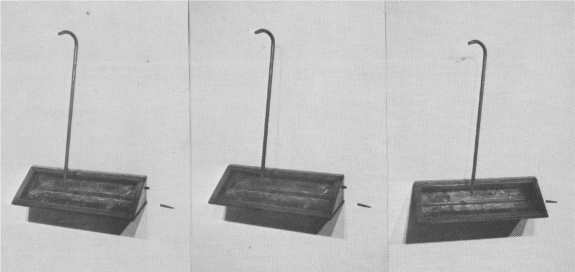
ANDREW DRUMMOND
Stoppages from the
Journey of the
Sensitive Cripple 1982
Two works in particular compel attention in this respect. The first, Nine Stoppages from the Journey of the Sensitive Cripple 1982 (part of the Vein cycle), comprises an encased slate bed, etched and traced with veins of copper filament, with a walking stick suspended over the display case. The cripple starts and stops the journey over the hard terrain; the sealed-off veins come to present the condition of his pauses.
The second, Trap, reveals a different facet of Drummond's artistic address: in particular, his capacity to bring together the materials of nature and of human artifice in ways which are mutually enhancing. In Trap, a stripped limb of hawthorn has grown round and captured the wires of a ferret trap and lifted it high off the ground. The glittering bait of a shellac cheese-wedge and the rich visual enticement of gold-leaf and copper lie within the trap. But their purpose has been subverted by inexorable natural process: no ferret will gain such height. What is it that traps what?