
Exhibitions Wellington
AVENAL McKlNNON
Milan Mrkusich
Janet Paul
Terrence Handscomb
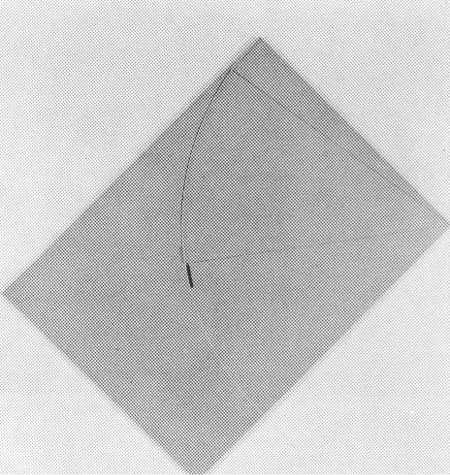
Milan Mrkusich's Segmented Arcs and Constructions at the Peter McLeavey Gallery, a selection of five out of a series of sixteen works painted within the past twelve months, must rate amongst this artist's finest work.
TERRENCE HANDSCOMB
P.P.P. 1983
oil and acrylic
on polyester film,
610 x 3050 mm.
From the impasse of his corner paintings, Mrkusich emerged with a return to geometry. Refining his preoccupation with pure colour, Mrkusich's grounds of green, blue, yellow and red-orange were finely stippled with dots of colour, so that they seemed dematerialised and as meditative as a pointillist landscape. Superimposed on these finely-modulated colour fields were a series of circle fragments and linear divisions, drawn ' with the concentrated geometry and tight control of a constructivist. The circle, broken into an arc was dissected by projecting lines and oblique angles. The sweeping curve of this part-circle was rimmed with brilliant touches of colour throwing open the form of his paintings, while the nucleus of his converging lines lay somewhere just beyond the edge of his compositions.
The crystalline sharpness of his lines suggested a rational balancing of order and proportion which contrasted strongly with the atmospheric depths of his colour field, thus creating a fine counter-pointing of structure and colour.
JANET PAUL
Pehiakura Lake,
Awhitu Peninsula 1982
Japanese sumei ink on paper,
640 x 450 mm.
But the stability and harmony of his finely-drawn divisions were undermined by their occasional subliminal disappearance. In a kind of perceptual dynamics the tight structuring of his surface analysis gave way to a fragile movement in which the shafts of his segments were alternately dissolved within their surrounding colour or existed above it.
The result was a shift in emphasis between one shape and another, an expression of the precarious equilibrium between energy and passivity, change and stability. Using the physical surface of his paintings, colour, line, and the viewer's involvement, Mrkusich offered glimpses of the metaphysical image.
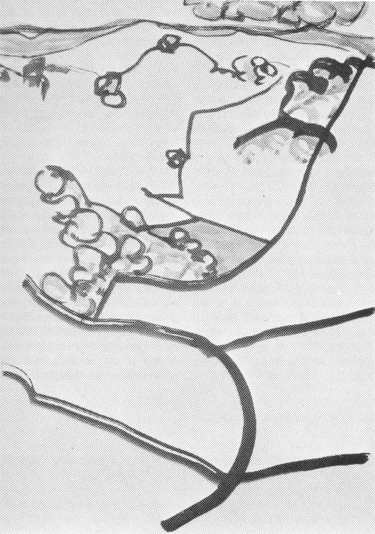
Janet Paul is more generally known as publisher, historian and librarian. The exhibition of her brush-drawings, A Journey Through My Island, at the Wellington City Gallery was an immediate and concentrated response to the landforms of the North Island.
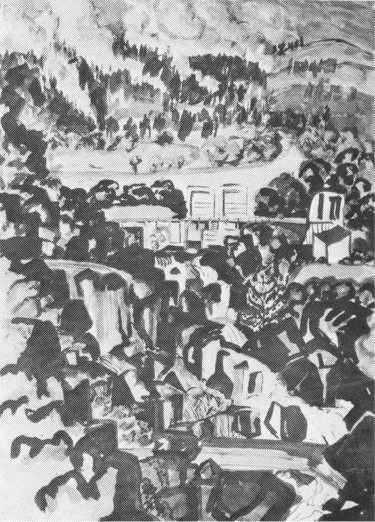
The validity of her work lies in viewing it as a progression-the transition from the stillness of the far North revealed in the bare economy of her drawing through the exuberance of the Waikato, where there is a feverish piling up of detail, to the firmer geometric welding of forms around Taupo. From Hunterville there is a strong layering of contours, while the structure of Wellington Harbour is intruded upon by houses, rooftops and jutting gables.
JANET PAUL
Taupo, Aratiatia Rapids 1983
Japanese sumei ink on paper,
640 x 450 mm.
Space is a vital element within her compositions. Like the Chinese ink painters she reveals an understanding for the vitality of line. The traceable movements of her brush bear the calligraphic emphasis of strokes laden with pigment or partly dry.
Within the New Zealand landscape tradition various influences are discernable: McCahon in the calm outlines of her hills, her sense of shadow and in the superimposition of one view above another; and Woollaston in the massing of her brushstrokes; while her high horizons look back as far as the early nineteenth century topographical painters.
But her drawings emanate a very individual feeling of speed and spontaneity; an aggressive ordering of patterns; a rhythmic control of expressive line, and in innate freshness. Like Cézanne she pulls apart and reassembles the elements of her landscapes with a swift confident shorthand that reveals a passion for form.
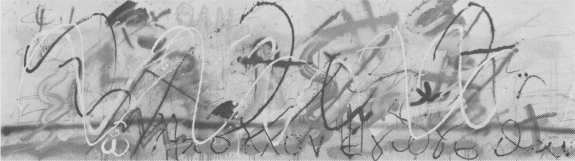
Terrence Handscomb recently emerged from a period of relative artistic inactivity to take part in Wellington's 1982 Factory One project. His recent exhibition of oil and acrylic paintings on polyester film at the Janne Land Galleiy at first glance bore the obvious hallmarks of Abstract Expressionism - its free, gestural scattered slashes, blots and drips of paint. But these fluid works were far from randomly conceived.
As the titles P.P.P., P.Q.P. and Q.P.Q. suggested, Hanscomb, a philosophy student attracted to modern logic and mathematics, exerted a strong control over the form of his compositions. P.P.Q. was in effect a giant theorem slashed and scarred with an intuitive vandalism. The vocabulary of logical mathematics, its equations and theory provided a matrix for his more painterly investigations.
On the basic dynamics of shape, line and colour were imposed the problems of logical philosophy: Truth versus Falsity, the problems of ontology and the mysteries of existence. Interweaving signs, symbols and heiroglyphs with abstract ' linear flourishes and the accidents of chance - Handscomb played out a kind of visual thinking which produced moments of revelation.
MILAN MRKUSICH
Segmented Arc on Yellow 1982
polymer, crayon and
coloured pencil on hardboard,
1200 x 894 mm.
Photograph by John Ashton
Free, open and intuitive forms were balanced against formal, calculated forms, while bright colours and the metallic glint of sprayed gold and silver paint gave his works an urban quality - a modernism related to the Punk movement and street graffiti.