
MICHAEL THOMAS
John Hurrell Paul Johns
The twenty-three paintings shown by John Hurrell in his latest show at the C.S.A. Gallery are mind-orientated. They challenge the spectator to work out the logical system underlying the slight, apparently fortuitous, inconsistencies in the compostion. This challenge is daunting and it may put off the average viewer, even despite the notes and titles which accompany the works.

JOHN HURRELL
Remove to Expose
acrylic,
polyurethane on paper
In the early Mesh paintings, subtle optical changes occur in the colour and shape of grids. These are worked out according to a sequential system which forms the basis of the painting. An experiment in the use of chance to decide between alternatives in the organisation of painting follows with Dice Scores as Content. In the next series, typified by Lozenges with Shifting Bars (shown in the Benson and Hedges last year), the deceptively subdued pastel colours are used as codes to relate elements that have small differences in their shape.
The later map works show a progression from the use of esoteric abstract symbols to a system of communication already in popular use. Symbols within an everyday Christchurch map are made to interrelate and function in a self-contained way: the antithesis of the use for which the map was designed, since it no longer refers to anything outside itself. In all the map pieces the painterly activity consists of obliterating certain parts in order to leave only those elements which are relevant. The key to the principle behind each work is to be found in its title; and with this the viewer is given a clue to the reason for the piece which enables it to be understood. Thus the participation of the viewer is always demanded on a cognitive level.
Humour and verbal tricks abound. In RedLed the postal zones - coded red on the map - are the only remaining lines. And in Yellow Street Map every road except those with street in their names has been painted out. Both Sides Now makes use of the index on the back of the map by including only those roads which coincide with their names on the reverse side. In several other pieces, such as Remove to Expose, Hurrell paints lines across the index to exclude those street names which are left included in the painting.
John Hurrell's painting is not primarily concerned with aesthetics. Nor is the apparent purpose for each work - a kind of visually communicated puzzle - the real substance of each piece. It is the system of communication or dialogue created between the different elements within each work that constitutes its content.
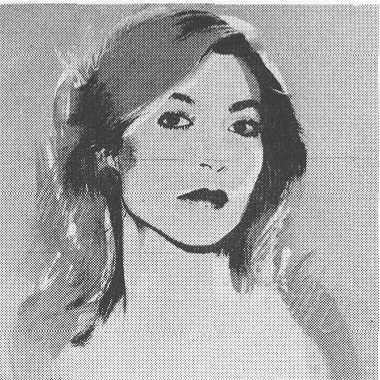
PAUL JOHNS
Portrait
silk-screen /
acrylic on canvas
Paul Johns is also concerned with process. His flamboyant show of screen-printed photographic portraits of Christchurch personalities at the Brooke Cifford Gallery makes different faces look similar because of the technical process employed. Johns paints over tonally contrasting screen printed photographs with stylish graphic panache. He makes the diverse subjects into media images reminiscent of Warhol's portraits. The paintings are paired: two different-coloured versions hanging side by side. This accentuates their anonymity and confirms the multiple-image feeling. The eyes of all the subjects stare expressionlessly from the flat surfaces at the spectator, who is made aware that it is an image and not a person who is confronting him. Each individual is so successfully glamourized that even the least suitable amongst them would grace the cover of Vogue.

PAUL JOHNS
Portrait
silk-screen /
acrylic on canvas
Paul Johns's show is consistent and professional. It is as totally in contrast to the 'usual' Christchurch show as a plastic rose is to a paddock of grass. In this way it is colourful and eye catching. One suspects its authenticity: but perhaps this is what the artist meant the show to be about.