
Exhibitions Wellington
RAY THORBURN
It is not surprising that Malcolm Benham and Rob Taylor were showing in Wellington at the same time for there is an umbilical connection that ties these two together. Both are of similar age, and both have been exhibiting for approximately the same period of time. Both studied at the Art School in Dunedin (Otago Polytechnic) - an institution that in recent years has become a productive and viable alternative to the academic traditionalism of the universities. Both were awarded Q.E.II grants in the mid-seventies and have had similar overseas experience. Furthermore, they both have regularly exhibited together in the past and both live in Wellington.
Benham and Taylor represent a 'new wave' generation of artists totally committed to their art. This intensity is reflected in their current shows - which both have a startling impact in quite different ways.
Malcolm Benham
Compared with the stock works I recently viewed at the Janne Lande Gallery, Malcolm Benham's current works have developed a new and interesting irreverence for formalism. Gone is the security of the underlying grid that has held his work together. it has been replaced by a looser structure that gives the imagery a greater sense of immediacy. Even the colours have a new vitality: complimentaries that don't quite complement each other - that create a rasping friction which is visually stimulating, as if colour theory has been learned, used, then abused in a very provocative and exciting manner.
The works hold together despite the artist's apparent bending of formal rules. Benham's work has a confident maturity that now allows him to have fun with his materials while for the most part maintaining control of his medium. The last time I saw Benham's work was three years ago. Over that period his work has shot ahead in leaps and bounds. Today he speaks with authority. It seems he can afford to take risks where before his work suggested a more tentative searching for identity.
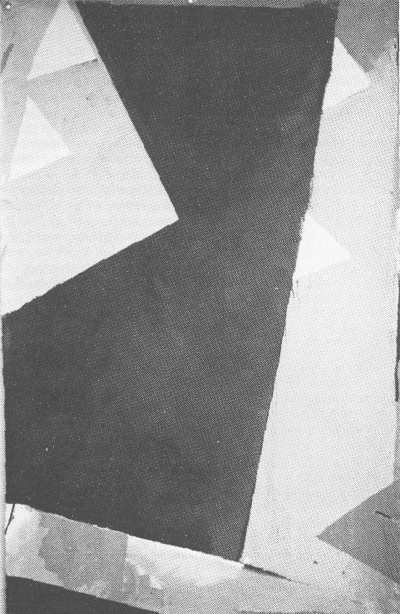
MALCOLM BENHAM
ZZ 1982
acrylic semi-gloss house paint
1560 x 970 mm
(Janne Lande Gallery)
Characteristic of his work are the delightfully cheeky 'squiggles' - i.e. marks scratched into the paint surface that at random 'zing' and dance to their own tune across the surface. Of note in this respect is Neds Head. The calligraphy brings a refreshing sense of freedom from the shackles of abstract formalism.
Typical of his 'off-beat' sense of complementary relationships is Squeeze, a deceivingly simplistic composition with a red ground slashed in half by a green-blue wedge that splits the work almost in two. I say almost because the image is saved from appearing to be in two halves by the subtle use of a crude border which contains the image. In less sensitive hands such a device would read as a cliché employed to save sloppy composition: but this is not so with Benham. The 'edge' is an intentional device used in all his work, adding to the rasping excitement of the other elements and giving sting to their bite.
Malcolm Benham's latest exhibition at the Janne Lande Gallery is substantive proof that abstraction is alive and well in the 'eighties.
Rob Taylor
Rob Taylor is a dynamic artist, who eats and breathes art: and his current work is testimony of this. Taylor is a professional. His work is thoroughly documented (information is readily available as are reproductions of past and present work). It is therefore no surprise that he enjoys the respect and reputation he does today.
Too many very capable people have for too long in this country been prepared to just make art without any thought to keeping accurate records and visually documenting progress. When works are lost on tour or damaged (for whatever reason) all evidence of their existence goes with the works. Quality cannot be measured without evidence of performance. Taylor's professionalism and development is obvious. His output is staggering and the quality of his work consistent.
Taylor loves painting. His current exhibition at the Elva Bett Gallery is an intriguing blend of sophisticated, low-keyed almost monochromatic works, complemented by other works that breathe fire.
The Elva Bett Gallery is not large and Rob's propensity for monumental scale suffers in this confined space. The works were panting for oxygen, fighting for breath to maintain their own existence. This was a great pity, because each of the large works deserves attention: each is a very strong statement that needs breathing space for its individual qualities and personality to materialise.
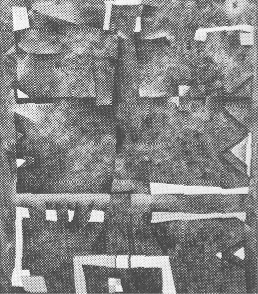
ROB TAYLOR
Menhir Motif 1982
oils, 2000 x 1700 mm.
(Elva Bett Gallery)
Of particular note, (impossible to overlook because they were the first two works facing the entrance) were Dyad Triad and Menhir Motif. Both large works are a startling contrast in mood, exemplifying Taylor's insatiable appetite to give form to ideas and explore materials. Although only a few months separate the works chronologically, they could well have been produced years apart by a less prolific artist.
Dyad Triad (September - October 1981) is a riot of primary and secondary colours that have been bruisingly slashed on to the surface, building up an impasto relief of palette scraping, bouncing like sunlight, only to disappear into cooler depths of darkness. This is an extremely busy work - an exciting jamboree of colour and texture, tightly bound by a very strong horizontal and vertical format within which paint bashes and crashes with vigor, celebrating its own existence. Every now and then hints of recognisable form surface only to merge back into the depths and establishing a carefully controlled balance between light and dark, violence and tranquility.
In contrast, Menhir Motif (February-March 1982) is monochromatic. Gone is the exuberance and wild frolicking of colour and texture of its near neighbour. Replacing it is a calmer and deeper mood of mysterious timelessness. The surface treatment is more considered, creating a feeling of compact solidity. It suggests a revisiting of familiar places: but with a more focused microperception of detail, of looking into the earth instead of at it from a distance.
The smaller works in the show suffer by comparison and are over-shadowed by the larger pieces. They seem like unresolved 'bread and butter' experiments toward bigger ideas. To be fair though, when I visited the gallery the lighting was off, and the smaller works were in shadow, stuffed into a dark corner, and consequently they had little chance to speak for themselves.
Whereas Taylor is at his best when working big, Benham's larger pieces were less successful. The dynamics of his looser more informal attack when 'blown up' became somewhat limp, and lacked the freshness and taut cutting edge of his smaller works. However, there is ample evidence that this will be resolved.