
No More Flags in the Valley
Dean Buchanan
CHRIS PARR
Walking into Dean Buchanan's exhibition at Outreach gallery, several large canvases confront you with massive spherical boulders and angular green and brown plant shapes parted by a descending waterfall. Gleaming blue and white, each waterfall emerges from a gorge at the top, pours right then left between dense vegetation, and disappears between spikes and pyramids 'out' of the picture. The movement and mass of the pictures is dramatic, the mixed colours unmistakeably local.
These are unashamedly Pictures: paintings of recognisable things and places on rectangular framed canvases, following conventional rules of pictorial description, The place, the landscape, is Auckland's west coast, the naturalist 'imagery familiar: but in their intensity the paintings have an expressionist edge, a sense of the artist's own vitality in that place.
This is the land keenly felt and dramatically expressed. Individual objects have been reduced towards abstract forms rendered in thick strokes of colour: the local landscape perceived with the help of past masters like Cézanne, Braque, and the German Expressionists. The paintings have a raw vitality which conveys New Zealand's rugged scenery more bluntly than earlier artists, and in this waterfall series Buchanan has gone beyond his previous tentativeness to create images which are cohesive, vivid, and strikingly energetic.
Not that all the pictures are waterfalls. Another, in more naive style, is a beach seen in summer light from a cliff, with a trail of cotton wool clouds above. Amusingly, the clouds decrease in size from daddy clouds to baby clouds. And, as something of a surprise, there are two versions of a Karl Schmidt-Rottluff, one painted, the other coloured pencil on paper. Three nude women crouch akimbo among the jagged green and yellow shapes of Oceanic foliage - the effect .a strange mixture of innocent savage and uneasy habitation. These copies (After Rottluff) make explicit Buchanan's admiration for European expressionism, which underlies the dramatised landscapes in this show.
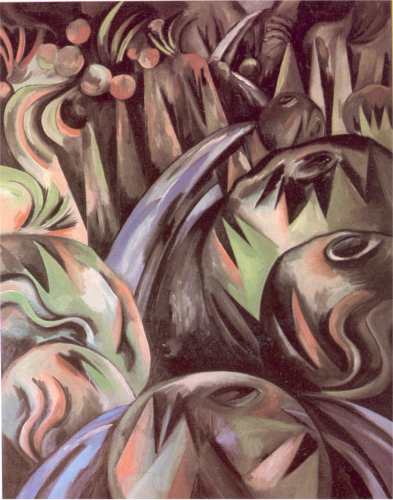
DEAN BUCHANAN
Waterfall
oil on canvas
The specific landscape in Dean Buchanan's case is the hinterland between Karekare beach and the Waitakeres. This has been his theme for several years, working through hillside paintings to kauri trees to waterfalls and, more recently, seascapes. I asked him whether he paints a particular place at a particular time, or from a whole collection of impressions of different places: I think it's the second, though two or three are definitely paintings of one place ... I think it all just registers subconsciously, and when you're painting it comes out.
For Buchanan the central feature or theme of each painting is its colour. One might expect the colour theme of bush landscapes to be uniformly green, but he says this isn't so: At night, and on a dark day it's very dark and murky. So I'll just try and keep it mauve, all the way.
However, he is not keen on colour abstracts - he is attracted to colour as a property of things in the world rather than for its own sake:
I don't want to just paint. Some people just paint big abstracts, paintings, which is just nothing. It's good to paint some thing.
CP: Do particular colours have any significance or symbolism for you?
DB: Well, I did a viridian sea and viridian sky with just white through it, and it looked really violent. The green is a violent colour, and so's black as well. But then I did one that's crimson, and that's violent as well!
The thing is, you've got to do it all at once, the whole thing in one go. I think paint is good when it's put on with one lash.
CP: What about the mauve and pink in your waterfall paintings?
DB: When we went to Anawhata on the west coast the rocks were mauve - every shade of mauve and purple you can think of. And it really impressed me, it was astounding to see so much mauve with black.
CP: Well, if that painting is of rocks by the sea, where does the waterfall come from?
DB: We kept on walking up the streams, and we came to the waterfalls. But I just couldn't resist the mauve rocks. I thought I had to use that colour. I wanted to see what it looked like on the canvas.
It is impressions like these which he tries to get in his paint and the act of painting. Over the past couple of years he's been moving away from careful drawing (representation) towards painting fast (expression). Just recently he produced a cobalt blue and titanium white seascape which clearly captures his excitement in painting it.
It's really starting to get exciting. After seeing the painting appear so fast, it's really good. And I'm getting it exact.
Dean regards Karekare as 'a perfect place', and it is the almost exclusive subject of his serious art, even when he paints in his studio at home 'in Grafton. His inspiration is drawn from weekend and holiday forays to 'the beach', and he has quite a ritual in getting ready to 'go painting':
I have to get all the equipment and paint together, then I have to fit it in with my holiday, so we can just live day to day for a while. Get completely organised: a storage of beer, cigars, untold food, radio, camouflage gear, wind-up phonograph, dartboard, get everything together and then just whack them out.
DB: Two days. Two days at the most. A day and a half, one day. Otherwise they'll get overworked.
CP: Do you work pretty fast?
DB: Yes, extremely fast, and it's quite exhausting. I draw it all out first. I draw it completely out to how I want the composition to be, the structure of it, and then I paint it. But the drawing is nothing, it's when you start painting that it starts coming up.
As an artist Dean Buchanan presents an intriguing paradox. Physically tail and energetic, often clad in German Second World War clothing, he is usually considered rather out of the ordinary. Yet his whole approach to painting, how and why to do it and what it is, is remarkably conventional. Speaking about his work, he makes regular declarations of past values: he wants paintings to be about some thing; they are good to have; they should be built to last. He has an unquestioning confidence in things, in empirical reality, and the ability of paint to get that down, to give it expression. Given the course of twentieth century art, such confidence may seem naive, even archaic. Modernist concerns with ambiguity, materials, anxiety, and the enigmas of perception and representation are virtually ignored. Buchanan's paintings comprise a single viewpoint, illusionist space and perspective, conventional composition, and very little irony. He is satisfied that they capture for him (and whoever else might see or buy them) his experience of phenomenal reality - which perhaps they do, although to a modernist sensibility whole dialogues are left unspoken in such work. He may also be subject to the criticism that it has been 'done before' - the New Zealand landscape is old territory.

DEAN BUCHANAN
Nudes after Schmidt-Rottluff
coloured pencils
On the other hand, the robust energy and sure handling of colour in these paintings is striking; and their aggressiveness isn't out of touch with the present-day world. This painter is not alone in being regionalist, nor in the realist depiction of sea, gorge and bush. But he shuns the painstaking intricacy of Rei Hamon's penwork, and the authorial commentaries of McCahon and Nigel Brown, opting instead for bold uncomplicated statements of the solidity, rhythms and violence of the Karekare landscape. His paintings don't come from 'looking at' scenes, but from being in them, recording the sensations of being surrounded. His enthusiasm for his chosen landscape, and for re-expressing it in paint, is at once the strength and limitation of his present work.
Dean comes originally from a gentler coast. He was born in 1952 in Castor Bay Hospital on Auckland's North Shore and, apart from a few years near Huntly, lived and went to school on the Shore. He wasn't surrounded by much art, although his father, who has been a signwriter and painted houses, had 'how-to-draw' books of horses and the human figure. 'I can remember those books since I was really young. They had a couple of Cranachs in them, and Winslow Homer.' At high school he discovered famous artists in books. 'I think that's what really got me going, seeing how appealing paintings could be.
Paintings are good things to have.' Leaving school at sixteen, he didn't go to Art School - 'Never been to Borstal! I'm really glad I didn't now, really so glad'. He feels art schools enable the art establishment to put people in slots, to predict what they will do. 'But I'm my own name.'
Instead he did things like scrubcutting, and then went to Europe for two years in 1976, which gave him a chance to see 'lots of good art'. Returning to Auckland he got a job at the Auckland City Art Gallery, where he works in the exhibitions department. In mid-1978 he formed a rock band, The Dentists, which lasted seven or eight months - long enough to earn him a reputation as a fanatic for Nazi military regalia (featured prominently on stage).
That interest has continued, though toned down a little. The main appeal is the quality of Nazi design, and the colours and patterns in their camouflage. Laughing, he adds 'There's no heavy right-wing political aspects to me!' But reaction has sometimes been unfavourable - such as when locals objected to seeing a large red Nazi banner displayed near the beach. He remembers such incidents with amusement: The neighbours have put a big no-no on it. 'No more flags in the valley'. We had a little talk about it, and I was told to calm down on the Nazi rallies!
Nonetheless his military collection proved valuable during last year's Springbok tour protests. When the pro-tour group SPIR organised an 'anti-oppression' march up Queen Street, the Artists Against Apartheid decided to subvert it by creatively drawing attention to oppression in South Africa. Their street art and theatre effectively dominated the march, and that night, when the march story lead the headlines on the 6.30 TV news, the image behind the newsreader was of a Nazi officer complete with black leather greatcoat and gloves, jackboots, a rusted German helmet, and a sign reading SOUTH AFRICAN GOVERNMENT. That was Dean (I looked like I'd been dug up out of the grave!') The message was hardly what SPIR had intended: but it was historically accurate, and unmistakable. In general however, he is not attracted to less conventional art-forms, such as performance - although he is aware that a political element is lacking in his painting.

Dean Buchanan
in his Grafton studio
His cultural interests extend beyond German militaria and expressionism. Influences from Oceanic art have appeared in his recent work. For instances the circular 'dent' in the top of the rocks in his waterfall paintings refers to the sculptured stone he found in a cave (possibly the Maoris burnt oil and fibre in the hollow and used it as a lamp). The recurrent angular saw-tooth shapes suggestive of foliage are reminiscent of a similar motif often found in Polynesian tapa. In fact, sharp angularities have recently become a favoured motif with New Zealand painters - partly because of the Oceanic connection, and partly because of their popularity in contemporary 'new wave' design and culture. Dean explains their appeal: 'I like them because they look aggressive. They're sharp, they're aggressive, and they're positive'. He has also studied Maori artefacts quite closely in the Auckland Museum. They have tempted him to try some sculpture as well.
D.B.: I've carved some pumice heads and little sandstone heads at the beach. And I've been carving whalebone. I carved a little polar bear.
CP: That's not very Oceanic.
DB: (laughing) No, no. But on a cold day I was thinking what an Eskimo would do!
The main thrust of Dean Buchanan's work, however, continues to be landscape paintings - taking the sea and foliage as the semi-abstract basis for his explorations in colour and texture. No doubt it will feature in any debates on what New Zealand art should or should not be doing: but he appears unconcerned about that. He doesn't have specific plans for his future career, but remains characteristically confident:
I think I'll keep with painting landscapes for a while. I don't feel like giving it up, it's going too well. I'm really starting to get atmospheric things happening with the paint. Things are looking good!
PHOTOGRAPHS BY JULIAN BOWRON