
Chris Booth at the Dowse
ANNE KIRKER
No Waitete riga kowhatu
No Purakanui riga rakau
No Whana - A-Paki nga muka
Earth, Forest, Sky is the most impressive feature of Chris Booth's recent exhibition, held first at the Hocken Library in May and then at the Dowse Art Museum during June and July. It is essentially a tall, tower-like structure of wooden props lashed together with cord and sealed with a pungent smelling tar which supports two extending rods of muka. At the base, boulders gathered from Waitete keep the whole assemblage upright. Made this year in Dunedin while the sculptor was on a Frances Hodgkins Fellowship, the work immediately puts us in touch with the essential character of Booth's work. He is an artist who is concerned with natural forces, with specific landscapes, and with what is increasingly becoming apparent in his sculpture: the spirit of Maoridom.

CHRIS BOOTH
Earth, Forest, Sky 1982
waitete stone, manuka,
cotton cord, stockholm
tar, muka
3800h x 7400l x 6650d mm.
Brought up in Northland, Booth's childhood was spent with his family on a small holding at Kerikeri that was almost completely self-sufficient. He learnt to appreciate keenly his surroundings and to observe the importance of conservation. A popular pastime was collecting Maori artefacts which '...led us over pas to remains of old eel-traps, and over swamps and midden sites in sand dunes'.1 This fascination with pre-European Maori culture was substantiated by his experience at school, where Pakehas were a minority. At Northland College, Kaikohe, Booth's art teacher was Selwyn Wilson; and it was through such contacts, and circumstances generally, that he gained an insight into the traditional values of the Maori. He grew to understand the importance of land in their terms - land as holding a strong sense of identity and purpose to life.
Booth left art school in Canterbury after only one year to become an apprentice to the sculptors John Milne and Denis Mitchell at St Ives in Cornwall, and to Stephen Walker in Verona. Their professionalism had a marked effect on him, and his own efforts at this period (1968-1970), such as the small bronzes Sandforms and Rapids, are accomplished statements. From these simple, cypher-like images, Booth's approach grew bolder and he began experimenting with other materials such as polyester resin and glass fibre in Road to Claudia. The undulating organic form of this work suggests rolling hills traversed by a highway: but it also evokes a strongly erotic flavour.
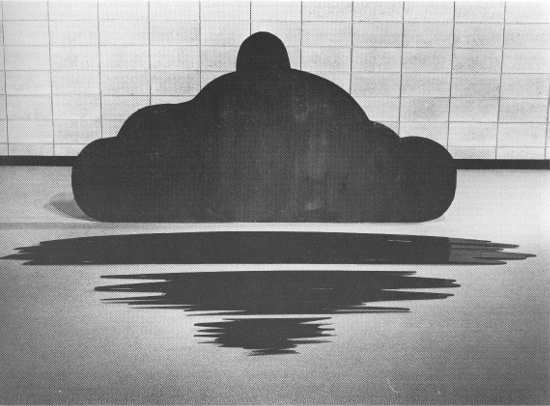
CHRIS BOOTH
Whangaroa 1979
mild steel and baked enamel
1200h. x 2350l. x 3040d. mm.
From 1970 Booth based himself once more in Northland - first at Kerikeri and then in 1976 at Whangaroa. He established a bronze foundry on his family's property, and a workshop. Even though his sculpture was regularly exhibited in prestigious group shows such as the Hansells Sculpture Exhibition and was earning him commissions and a place in public as well as private collections, financially times were difficult and the foundry often lay idle. Booth began turning to alternative metals - often used in combination to suggest the different components of an idea. In Mataka mist (1976), for example, the chromed steel band encircling rough-cut landforms has a fluid and perpetually changing quality in contrast to the static nature of the rest. Later, the frontally conceived Whangaroa (1979) extended the dual role of materials, with enamelled shapes placed directly on the floor to evoke an expanse of water and with the dull, rusted surface of a rudimentary hill shape situated beyond.

CHRIS BOOTH
Mataka Mist 1976
mild steel and chromed steel
300h. x 1250l. x 440d. mm.
(Collection of Hansells,
N.Z. Ltd., Masterton)
Neither piece, however, contains the tension which emerged in two works on display dated 1980. Truck is dramatic, almost to the point of being theatrical. It juxtaposes material from industrial society (cast iron) with a natural material often used in traditional Maori society (manuka). The tension set up between these two elements is compounded further when one considers the scale. The truck is essentially a toy, wedged between eight-metre-long branches. James Mack, Director of the Dowse, sees it as '...involving all the passions in an inanimate object'. Equally compelling, Goodbye Banana Boat, comprises a superbly-crafted vessel of miniature proportions, which is speared by a harpoon; and as Mack points out, 'You read the thing at a soft kind of level so that the dynamic tension of the added bits becomes stronger'.2

CHRIS BOOTH
Hei Hakari mo
Aramoana 1982
manuka, muka,
waxed linen thread,
shells,
900h. x 19001. x 650d. mm.
Booth's disillusionment with things urban is in part related to these works of 1980. A year before, he had moved temporarily from his rural surroundings to Auckland, to seek employment. The Mercury Theatre hired him as a set designer - which provided an opportunity to create very large structures. Adept at manipulating space, Booth's knowledge of raw materials - what they can and cannot be made to do - has equipped him all along for monumental constructions. At the beginning of the 'seventies, for instance, he was involved in recreating a pre-European Maori village at Kerikeri, and learnt simple and effective systems for making dwellings, on this occasion from natural sources.
The last twelve months have witnessed an outburst of creative activity which has been unfettered by financial restraints, or by conditions attached to public commissions. Perhaps most significantly of all, Booth now no longer suppresses an obvious reference to Maoridom in his work. He recently explained, 'I am very aware that I am not a Maori and therefore cannot draw upon their culture directly ... I don't feel I have the right to use Maori symbols in my sculpture'.3 Now Booth believes that distinctly Maori overtones do not matter so long as he is '...working in the area of no-tapu', taking as his source of inspiration, functional structures such as palisades and foodstores.

CHRIS BOOTH
Truck 1980
edition of 5,
manuka and cast iron
800l. x 1000d. mm.
Hei Hakari mo Aramoana stands just under one metre in height and spans nearly twice that measurement. Although it employs thin rods of manuka and hair-like filaments of muka with occasional shells, it has great presence. In accordance with Booth's deep respect for Maori culture it suggests rather than imitates. Mack explains that '...what we are talking about is not a visual manifestation but a spiritual manifestation'.4
By the end of 1982, Booth expects to complete a full-scale piece, out-of-doors, based on the Otago Peninsula. Employing manuka, forged steel, and ironbark, he envisages it will be nine metres high by twelve metres wide.
By accepting his European heritage and acknowledging that it has been enriched by his careful observance of things Maori, Booth is one of the very few artists who have portrayed New Zealand from a multicultural stance. For this reason, his vision is particularly relevant fora country seeking to develop an integrated identity.
1. Taped account of his career by the artist, 16 May 1982.
2. In conversation with the author, 9 July 1982.
3. Refer note 1.
4. Refer note 2.

CHRIS BOOTH
Road to Claudia
polyester resin & glass fibre
(Collection of
National Gallery, Wellington)