
Book review
A World History Of Art by Hugh Honour & John Fleming
Published by MacMillan, London, 1982
Reviewed by ANDREW MARTIN
I can never resist a 'World History'. The best excite admiration and induce a feeling of awe. Stretching, in modern times, from the 'Universal Histories' of such epoch-making thinkers as Hegel, through to magnificent exemplars of 'popular' education like H.C. Wells (his Outline of History) down to books of recent decades that have taken advantage of the increasing sophistication of printing techniques - they are milestones in the dissemination of cultural knowledge. One has to have them on one's book-shelf.
Macmillan's A World History of Art makes its modest, but positive, contribution to such a library. Written with resolution and intelligence by two experienced writers on European art, Hugh Honour and John Fleming, the book is a most useful outline, stretching from the ice age to the present day, embracing the arts of Asia, Africa, the Americas and the Pacific Islands as well as Europe. In the course of this survey '. . . some modern European ideas about art and its purpose and meaning are questioned, especially those about its progress- and it being intended primarily for aesthetic enjoyment. (The intimate connection of art with religious ideas is given full weight.)
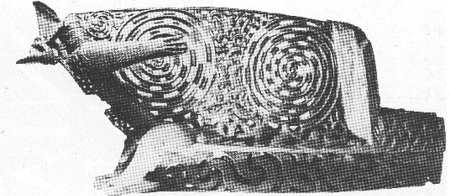
Maori canoe prow pre-1825
carved wood
Honour and Fleming have focused attention on 'historically salient periods and areas, which are also those of most general interest'. They have 'preferred exposition to interpretation and evaluation'. What judgements there are, however, seem unprejudiced, liberal, informed by the most up-to-date scholarship.
This is, of course, not primarily a picture-book: but the in-text illustrations are well-chosen and quite nicely printed, and the list at the back 'For further reading' leads one to some key books in English dealing with particular areas in more detail.
The book is elegantly written and eminently readable. It is one to dip into and to read around chosen topics rather than devour from cover to cover (though it would doubtless make a handsome gift to see an omnivorous reader through a boring stay in hospital or a prolonged convalescence).
It is delightful to find, incidentally, the only mention of 'New Zealand' art under the chapter heading ' "Primitive" alternatives': where the authors have dealt with the term coined in our century to cover 'objects which had not previously been regarded in the West as 'works of art" at all, that is to say objects from areas on the margin of or beyond the cultural influence of Europe, the Near East, India, China and Japan. One is again reminded of the influence that Oceanic art (as well as that of Africa) has had on the work of seminal figures in the evolution of European art such as Picasso and Braque.
At the end of this chapter, however, the authors point out that when objects with a 'magical' significance are taken out of their ritual contexts, and displayed in art museums, they lose a crucial dimension of their meaning.