
Book review
Nicholas Chevalier: Artist. His Life & Work by Melvin N. Day
Published by Millwood, Wellington, 1981
Reviewed by DUNCAN CAMERON
It is reassuring to see at last a book on 'a New Zealand painter' where the colour reproductions are well printed, on suitable paper, the whole professionally designed and set out in a clear and rational manner. I have always thought that a book on the visual arts should, in a measure, be a work of art: but those that live up to that ideal are few and far between in our part of the world. With Melvin Day's essay on Nicholas Chevalier the publishers have been unusually sensitive to such requirements and the book is a pleasure to look at and to read. (The monochrome illustrations are, by the way, as well as printed as the colour - again a rare event in New Zealand art books.)
Chevalier's career as an artist began at a time when eighteenth century models of landscape painting were being replaced by a more 'topographical' approach. In a sense it was the gradual substitution of a species of romantic realism for the classicising obsessions of painters like Claude Lorraine or, closer to home, the British painter Richard Wilson, who studied and worked in Rome. The more informal, journal-like nature of Chevalier's drawings therefore reflects a trend well advanced by the middle of the nineteenth century; and beside the more obvious parallels one could point out a relationship to such 'travelling artists' as Edward Lear (several of whose topographical watercolours are in the Collection of the Auckland City Art Gallery).
NICHOLAS CHEVALIER
Sandfly Bay and Gull Rock,
Nr. Dunedin 1865
watercolour
Born in St Petersberg in 1828 (his father a Swiss national and his mother Russian) Nicholas Chevalier studied both painting and architecture; and it seems was in Melbourne by 1854. In Australia he first worked as an artist on the Melbourne Punch, turning out cartoons from 1855 to 1861, and working on illustrations for the 1857 edition of Victoria Illustrated. It was about this time that he took up oil painting - although he seems always to have carried out his topographical paintings in watercolour and the various graphic media (with only one or two exceptions the plates in this book illustrate works on paper).
Chevalier came to New Zealand in 1865, arriving in Dunedin 22 November on the Tararua. Over the next four months he travelled around the south, producing his sketches with the support of grants from the Otago Provincial Council and the Canterbury Provincial Council. He went back to Australia in 1866: but was to return here in November 1868, on this visit to spend all his time in the North Island. Chevalier was travelling first class on this trip - with the entourage of the then Duke of Edinburgh (the second son of Victoria).
Chevalier left Auckland to return to England in May of 1869, doubtless to follow up the valuable court connections he had been making. During his latter years of success arising from royal patronage he did not forget the Antipodes: in 1872, at Sir Julius Haast's request, he waited on the authorities of the South Kensington Museum, with the object of obtaining material for the Christchurch Museum.
The sub-title to this book reads: 'With Special Reference to his Career in New Zealand and Australia', and, after a brief biographical sketch, the author has carried out an excellent analysis of Chevalier's travels and activities within New Zealand, taking up with this a large proportion of the text. He considers Chevalier's work in three main periods: the work produced in Otago and Southland (November 1865 to February 1866); in Christchurch, the West Coast, the Southern Alps (April to June 1866); and in Wellington and the Manawatu (November to December 1868). Although Chevalier did call in at Auckland with the royal fleet in 1869, the period was short and the work not nearly so significant.
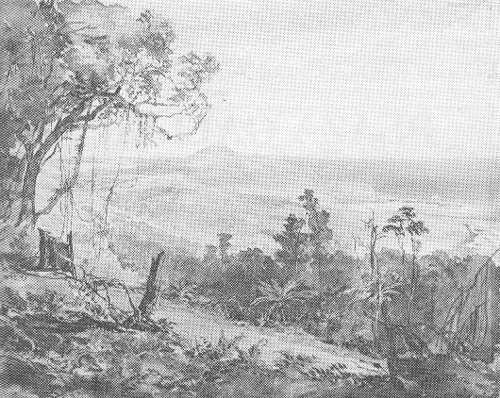
Chevalier's concern for detail and accuracy - his habit of writing on most of his sketches the date, details of local features, names of hills, mountains, rivers, lakes, farmsteads, the type of flora etc. - has enabled the author to reconstruct these sketching trips. He comments on Chevalier's sense of the dramatic as, for instance, moving up from the Mataura Gorge and across the Waimea Plains he encountered landscape unlike any to which he had been accustomed to from childhood in Europe. Chevalier was able to come to terms with the bush (as in Pigeon Bay with its romantic approach) the mountains, lakes and rivers; and so these watercolours and drawings constitute a unique record of the land and its development in the middle last century.
With its superbly printed facsimiles of the watercolours and drawings, handsome presentation, and authoritative text, Nicholas Chevalier is a book that will delight and fascinate all those with an interest in the culture of nineteenth century New Zealand. It is a distinguished addition to the slim corpus of books that make a contribution to the history of art in this country.