
A Conversation with Don Binney
SHERIDAN KEITH
I talked to Don Binney at his Elam studio - in one of those old wooden buildings adjoining the School of Art. It was a Saturday afternoon in winter when many were out on the rugby fields. We sat in the darkened room next to the light-filled studio, and looked at slides of the work.
Binney talks easily about his work. He has a lot to say - things perhaps to get off his chest, explanations be welcomes the opportunity to make.
From almost the first exhibited works the elements of a Binney painting are all there... sky, land, horizon, bird... and something, perhaps a tree, holding sky and land together, along with the implications of human occupancy.
DON BINNEY: These things are pretty consistent in my work. I can go back to that painting and look at it without any sense of shock or transition at all...
DON BINNEY
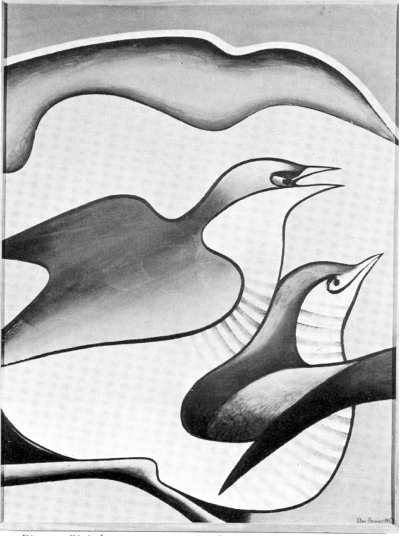
Pipiwharauroa Mating
oil on board 1184 x 888 mm.
(Collection of the
Auckland City Art Gallery)
The Maori names of birds trip off his tongue with ease as the slides pass through the projector So do the scientific names - for Binney not only paints birds: he has studied them since childhood.
DON BINNEY: This is Pipiwharauroa Mating, oil on board - my exclusive medium during the first half of the 'sixties - now in the collection of the Auckland City Art Gallery. One of the works from my second solo show held in Auckland in 1964. The maleness of the one is suggested by the green and yellow; the female is more green and blue. There is no implication that the lower bird is necessarily 'beneath' ... I've tried to suggest the coupling as just a dual thing, not a dominant/passive thing at all. The land, the environment, is in fact the great dominant feature.
... Now this is Kereru, over Cliff Paddock, Te Henga. I think a characteristic of this, and a lot of work from this period is the structural coordination of bird and land form, what I think of as resonance really. Physical resonance between one shape and the other. Why? Because as an ornithologist I've always been thoroughly involved in the way in which the land, the environment the creature lives in, modifies the creature. The creature of course also modifies the land: it's symbiosis really isn't it?
SHERIDAN KEITH: The wonderful sheen there on the white underside of the bird - is there a special technique involved?
DON BINNEY: Yes. The illumination comes from striating the paint with a fan-shaped brush while the paint is carrying a fair quotient of oil... As a painter I've always been very interested in the marks that brushes and knives can make in paint. I'm very interested in areas that carry a high quotient of gloss, of striation, compared with areas that may conversely be flat, atextural, dry or arid, if you like, in quality. There's this alternation of gloss and flatness, of surface texture and physical flatness: it interests me a lot. I suppose I've built up, over the past twenty years or so, my own repertoire in this sort of thing... all artists do as much.
In my case a lot of people who have seen something to criticise in what I do talk about a kind of passivity a kind of two-dimensional rigidity. A thing that offends some is my tendency to simplify. People have tried to imply that this simplification relates to a simplistic, idle or somewhat naive code of conduct on my part. My answer to that is that I simplify one series of things in order to, in a sense, highlight, or upgrade others. I couldn't get a lot of those co-ordinating surfaces, swings of raked paint. I couldn't really achieve the same qualities of either flatness or thickness if I started heaving in a lot of other detail. One has to select a little.
DON BINNEY
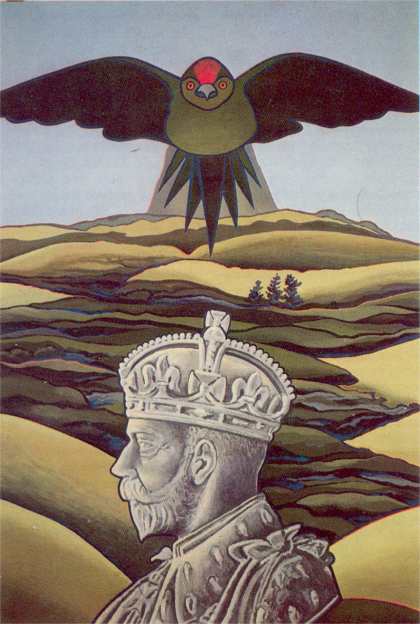
Geo. V/Red-fronted: Waihi to '35 1983
acrylic on Steinbach, 1100 x 730 mm.
Now this work, a commission for the Auckland Copy Centre, was arranged by Hamish Keith; and it was his suggestion that I use oil on canvas. Up until then (1965) I'd been using only oil on hardboard. I still use hardboard - its a good rugged surface. But it was an interesting and important addition.
S.K.: What did you find canvas enabled you to do?
D.B.: I think by moving on to canvas I was able, by virtue of the tooth that canvas possesses, to undertake things in more careful and studied detail, to manipulate tertiary surfaces more. Now - and I'm not trying to take any unnecessary plaudits for this - I think I can hop from canvas to board and back and forth, and engineer certain details on board as happily as on canvas. But just at that time changing to canvas played an important role in getting me more adept at tertiary detail, which I'd hitherto avoided.
S.K.: This next painting -
D.B.: Over Black Rock, Te Henga. You see the harrier hawk - it is in profile and head on at the same time. It's in the Todd Motor Collection in Wellington.
S.K.: You paint from life? When you see your bird do you, as it were, take a mental photograph that you hold in your mind?
D.B.: Yes. One feature that some people have found to be a sticking point in my work is the apparent mis-relation of scale between the overIy dominant bird and the environment. Emphasis on the word 'environment', rather than landscape. 'Environment' is a word that sits much more comfortably with what I am talking about than 'landscape' which has so many sublime and Romantic 19th and 18th century connotations ... a tradition that I by no means despise, and which of course I draw from: but 'environment' is more what I'm on about.
I have been used, since infancy, to reading the fleeting image of a bird. As an ornithologist you learn how to identify a bird from the fleeting glimpse you catch in the binoculars. You pick up the nuance of body shape and the specificity of body movement. The point I am closing in on is that when you are looking through binoculars you are seeing it just like that - and if there is a distortion of proximity then it is literally the legacy of thirty-five years of looking through binoculars.
(A drawing from the Te Henga series is on the screen.)
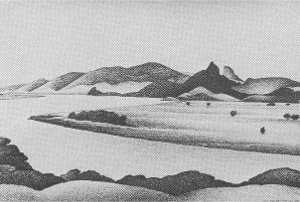
D.B.: This is crayon, carbon pencil on cartridge paper. From about the mid-seventies on I've been as involved with large-scale drawing in dry medium as I have in painting, in terms of output. There's a certain jubilation in this work. The swamp had by then been saved. There is now a bird sanctuary where kiwis are being rehabitated. . .
Of course a great deal of Binney's work and life-energy has gone into, at first unconsciously and later purposefully, the conservationist cause. He is currently working on an interesting series in which the usual elements in a Binney painting - bird, sky, environment - are joined and to an extent dominated by a new, somewhat sinister element - the profile in effigy of a Monarch of the British Empire, as depicted on the coin of the realm. There is of course the obvious link between Sovereignty, land and money. There is also a deeper questioning of the image making of a money-orientated society compared with the animal and bird symbolism depicted by societies in touch with nature.
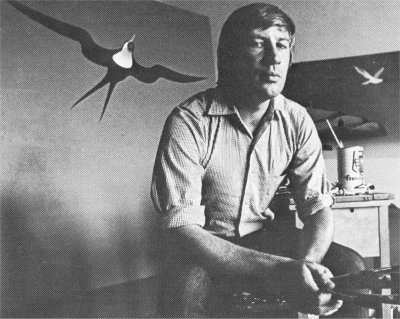
Don Binney at his studio, c. 1970
(photograph by Marti Friedlander)
D.B.: I suppose I've got one type of reputation that is, to a degree, correct. But I'm much more involved with inner resources than people realise. I'm tinkering, I wouldn't like to use the word 'perfecting' because that's talking in ultimate terms... but I am refining. I am very strenuously re-evaluating things I've spent the better part of my life coming to terms with. I am now looking at things with a great deal more personal scruple, if you like. I'm senior lecturer at this University [Elam]. I have time for research. I am encouraged to research, and what might look like treading water and turning out more of the same sort of thing is actually not what I'm doing at all. I am very seriously and carefully re-evaluating things, and I'm not particularly worried about the time that it takes. I'm satisfied that new forms are emerging, and have been for the last so many years.
S.K.: Do you feel perhaps that because your work is popular, that you're not taken seriously?
D.B.: Certainly. I'm not taken seriously. If I sold less, and had perhaps a bit more mystique of unassailability (unssaleability?)... If I perhaps didn't wear my blasted heart on my sleeve quite so obviously... if I didn't make my allegiances quite so frank and so public. . if l wasn't quite so robustly. . . realistic!
S.K.: Obtainable?
D.B.: Obtainable: well I am obtainable, but not entirely so. People who want to know what I'm on about are going to have to walk quite a long way down my road. You know I'm probably superficially one of the best-known New Zealand artists. I'm not saying I'm lamentably misunderstood, but I think a lot of people have only a superficial insight into what I'm doing. And they can therefore write me off - 'Ah, Binney - yeah, he cleaned up a few birds in the early 'sixties, and he's still doing the same thing now.' Sort of over and out. I think a lot of people have demonstrated a slightly cavalier disbelief in my staying power, and I can understand how that comes about. But it can be a fiend of a thing to have to work against. I know I've got so many frontiers yet to cross and to really win ... in an idiom I've demonstrated my right to work within. Often all I get are stifled yawns from a lot of people I would expect to be a more responsive audience. You feel as if you're living in strange isolation. I feel very psychologically and intellectually isolated. I feel actually in some ways a very, very lonely person indeed: but I can understand this is a situation partly of my own making.
The cruellest criticism or warrant for rejection I've had to put up with, particularly over the past decade, is this presumption that because I am still, as I always have been, engaged with the environment, the physical external environment and certain aspects of ecology and biology-I'm considered to be some sort of God-awful rusticated hick! And I'm not! I've never worn a black singlet in my life ... I wouldn't know what to do with a Number 8 fencing wire if you gave it to me. I can't even fix my own car. Yet in some quarters I've been labelled a hay-seed hick, a sort of provincial realist, something that came out of the ark and shouldn't be considered a viable proposition in, if you like, a cosmopolitan art scene.
S.K.: I've just been to the Rita Angus Exhibition. There's a painting there, one of her images, that seems to relate directly to your work. The one of a bird, a dove I think, over a graveyard. Do you know that work?
D.B.: I do. I know that painting so well. Rita Angus had just died when I went to live in Wellington '71. I remember visiting the house that she had occupied near the Bolton Street Cemetery. The bird I think is one of those sepulchral funereal doves that you get underneath immortelles, rising again like a living bird. You can see it as an appraisal of resurrection after death. I think she probably knew she had cancer at the time she did that painting, although I'm talking in suppositions now. But that certainly is my reading of the situation. I've been thoroughly familiar with Rita Angus's work since I was at Elam myself. I was aware of Rita's paintings at a time when her fortunes were going through really straightened gates. Then in the last decade of her life she suddenly got rehabilitated as a sort of wonder grande dame of New Zealand painting.
DON BINNEY
Tikinui Northwood I 1980
pencil and crayon on paper, 560 x 760 mm.
A bit before that, in the 'fifties, I was riveted by the limpid clarity of both her paint and her imagery. There weren't too many people who did impress me personally: Kinder, Caspar David Friedrich, Rita Angus and Olivia Spencer-Bower ... and at a longer shot, Georgia O'Keefe ... I see them all as antecedents. At that time in the 'fifties there was a sort of ho-hum attitude going on towards New Zealand realists. There have always been ebbs and flows in people's fortunes in the art scene.
I was really on the hay wagon in the sixties; then I was put into some sort of premature deep-freeze when I was still in my thirties, which freaked me out really badly. Now I'm forty-three and still feel in many ways a young man. My only child so far is a seventeen month daughter. It's a strange thing in some ways, as I am teaching at Elam the sons and daughters of many of my friends. I don't even know what generation I am. You get to the stage where it doesn't matter, and the same with the ebbs and flows in the fortunes of the art scene.
The most important thing this closes in on is what are our priorities, our expectations, our reasons for maintaining our own present faith. I would like it finally to be clear that why I paint is that I am holding to my own faiths, my own creeds, my own deep loyalties and interests. This is the reason I continue to do what I do. It has got nothing whatsoever to do with the vagaries of fortune on the art scene one way or another - with whether the art auction rooms find Don Binneys acceptable things.