
Skin Deep New Zealand Cinema Comes of Age
WILLIAM DART
For too long New Zealanders have become used to seeing themselves and their country through the eyes of Hollywood and Ealing Studios. Four films that spring to mind are Green Dolphin Street (1946), The Seekers (1954); Until they sail (1957) and Quick before it melts (1965). All these featured New Zealand settings as envisaged within the confines of an overseas studio. Up until the last few years, New Zealand film making has been a very spasmodic affair. To some degree this is understandable, as the geographical position and size of our country would seem to rule against a wholesale commitment in this area. And with the special costs involved in film making, New Zealand must aim at an international or at least an Australasian market.
Since the mid-'sixties there have been fleeting glimpses of what could eventuate. Contemporary publicity stressed John O'Shea's 1964 film Runaway as the first New Zealand feature to be made since Rudall Hayward's Broken Barriers in the early 'fifties. But perhaps it was a film that tried a little too hard, and its hero's journey down through the country had unfortunate Tourist Sales implications.
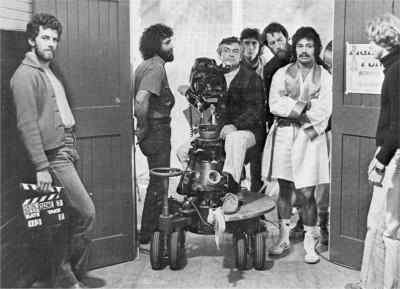
O'Shea's second feature Don't let it get you (1966) was a somewhat cautious monochrome follow-up to Lester and Boorman's films with the Beatles and the Dave Clark Five. Again, the New Zealand scenery was almost too obtrusive; and, with Carmen Duncan, Tanya Binning and Normie Rowe in the cast, there was obviously an Australian market in mind.
It is difficult to assess O'Shea's films - they have been virtually unviewable for over ten years. As I remember, the acting was fairly rudimentary: but Runaway had some visual interest - particularly in the glacier sequences - and it featured a musical score by our expatriate Stockhausen scholar, Robin Maconie. Don't let it get you had a Joe Musaphia script; and both films used Kiri te Kanawa - the later film in a quite amazing scene where she sang Rossini's Una voce poco fa to a circle of appreciative Maori youngsters in a Rotorua pa accompanied by a tape recorder.
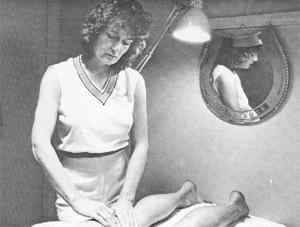
Sandra Ray (Deryn Cooper)
gives a massage
New Zealand's most celebrated director, the late Rudall Hayward, produced To Love a Maori less than a decade ago: but this has had extremely scanty screenings to date. Now, within the last few years, we have had four New Zealand feature films from different directors: Roger Donaldson's Sleeping Dogs (1977), Tony Williams' Solo (1978), David Blyth's Angel Mine (1978) and, last but not least, Geoff Steven's Skin Deep (1978).
Whereas Sleeping Dogs possessed strong literary credentials in C.K. Stead's Smith's Dream, and Angel Mine was to some degree a filmic expression of Derek Ward's Ratz Theatrix troupe, Geoff Steven's film had its origins in a video documentary that the director made about the small North Island town of Raetihi for the Auckland City Art Gallery in 1976.
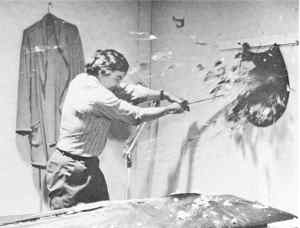
Phil Barrett (Grant Tilly)
destroys the massage parlour
Skin Deep sketches in dramatic form the problems of Carlton, a small community which is eager to make itself felt in the wider national scheme of things (almost a New Zealand parallel to Randy Newman's song The Beehive State). The method which Carlton has chosen is a mammoth cash-raising scheme that will eventually plunge twenty thousand dollars into a fairly vacuous advertising campaign. At the centre of all this is the small-town Hitler, Bob Warner (played by Ken Blackburn), who virtually runs the town through his Progressive Businessmen's Association. Another scheme in which Warner has a vested interest is the introduction of a big-city masseuse Sandra Ray (Deryn Cooper) to add a new perspective to Vic Shaw's Spa Health Club and Sauna. Sandra proves to be the pivotal point of the film's drama, and her presence makes itself felt in a lot of the townspeople's lives. Eventually, when something funny is found going on at the Health Club, and an infatuated accountant has a minor nervous breakdown over her, Sandra leaves town just as Carlton is in the throes of organising its television promotion.
Like Sleeping Dogs and Solo, Skin Deep is certainly aiming at a wider audience than what might be called the arthouse circuit. But then, considering that many of the classics of the cinema were produced by directors such as Alfred Hitchcock and John Ford within the restrictions of Hollywood at its most commercial, this populist approach can be a positive virtue - aesthetic as well as financial. Certainly, Skin Deep is remarkably free of the self-indulgence that flaws some contemporary films. The narrative flow of the work is impressive; and it is here that Geoff Steven has made a considerable achievement. The film is carefully paced, with nothing as embarrassing as the rather vague exposition which marred Donaldson's Sleeping Dogs.
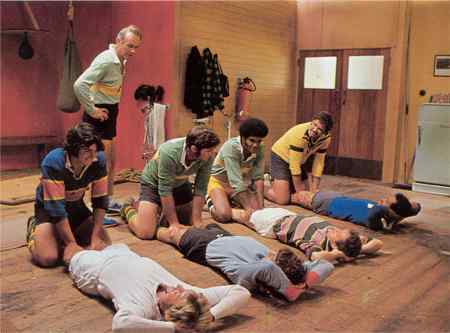
The boys work out
at Vic's gym
One of the remarkable achievements of Bertolucci's 1900 must have been the Italian director's control of the narrative aspect of a film that clocked in at the five hours mark. This is a skill which we might tend to associate with the Hollywood 'B' director - artists who flourished in the genres of the thriller and the western: for example a director like Phil Karlson, whose recent Hornet's Nest and Walking Tall have been miserably underrated. The same talent can be seen in the work of the recent German director Rainer Werner Fassbinder, an artist whom Steven professes to admire.
We have seen the standard of New Zealand film acting making considerable improvements over the past years, particularly in the field of television drama. And with such noteworthy dramas as The Governor appearing recently, it seems to be only the genre of the situation comedy that is proving a more difficult assignment.
Partially as a result of more assured acting and partially through the tighter scripting, the characterisation in Skin Deep has more to offer than that in Sleeping Dogs. The frenetic thriller pace of the earlier film left little time for niceties of character studies: the American actor, Warren Oates fitted uneasily into the film, and many of the New Zealand actors seemed to be a little under-directed. This is not the case with Skin Deep. Grant Tilly's dissatisfied and unhappy small-town accountant makes his presence keenly felt; and Glenis Levestam registers effectively in a nicely underplayed performance as his equally tired and disillusioned wife. The poignant sense of non-communication in their scenes together was obviously a little more than just lines in a script. Ken Blackburn's ebullient minor fascist is suitably repellent: and yet Alan Jervis as the aging Health and Fitness man comes across as a good honest Kiwi. It is a performance completed unmarred by the strained heartiness that might have been expected from many of our actors a few years ago.
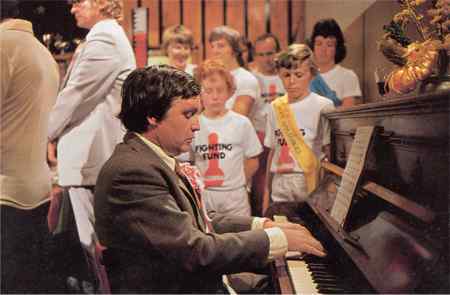
Patriotic songs
at the fund-raising dinner
As the central character, Deryn Cooper has not perhaps quite decided on the level of her performance: vocally she seems to be striving a little too hard at times. But to Cooper's credit, Sandra comes across as a flesh-and-blood character and her lean, weatherbeaten magnetism contrasts well with Heather Lindsay's smooth performance as Blackburn's wife. Steven made an effective point when the Blackburn character started to pursue a woman who was in fact less physically attractive than his own wife. The parallel presentation of these two characters injected a good deal of irony into the sexual tensions of the plot.
All in all, Skin Deep was so accomplished from a technical standpoint that possibly only the musical score could be directly criticised. In the marathon race sequence the music had been so casually timed that there was obviously not enough music to cover the visuals.
Another slightly disturbing aspect of the film is perhaps bound up with the work's realism or lack of it. Steven was aiming at a realistic film, and deliberately avoided a situation that could quite easily have developed into a surrealistic exercise along the lines of the films of the Australian director, Peter Wier - The cars that ate Paris, Picnic at Hanging Rock and The Last Wave. Realism is a difficult genre to deal with in any art-form: for art implies some stylisation, and this often results in the very antithesis of realism. None the less, with the photographic basis of film, as well as its strongly narrative form, it is perhaps the art-form which comes closest to reality.
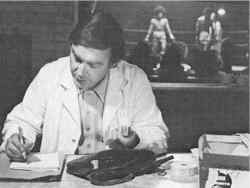
Phil Barrett counts the door-take
for the boxing gala
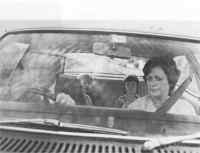
Phil Barrett has an argument
with his wife Alice (Glenis Levestam)
in the car
Steven values the township of Raetihi's identification with the film (as one writer put it, it was Raetihi's biggest event since the town was almost razed by fire in 1918). In fact, he almost gauges his artistic success by the token of the film's acceptance on this level, and it is here that the audio-visual documentary origins of the film are of interest.
And yet, despite all attempts at realism, an artist can often heighten an original experience; and even the most realistic event may be presented in a way that makes it seem quite strange. The wood-chopping contest in the drizzling rain may seem a bizarre spectacle to one not familiar with our New Zealand rituals. And even the idea of a small town such as Carlton trying to break into the massage-parlour scene seems a little unlikely. Yet again, that priceless image of Alan Jervis's team of eager joggers bouncing up and down in the council chambers is a little bit on the far side of reality.
A key scene in this respect was probably the town dance toward the end of the film. At times here it was difficult to see what the director's viewpoint was. Was it a piece of straight reportage, or was Steven deliberately heightening the scene for dramatic effect? Certainly, the vision of Heather Lindsay, clad in a kitsch bunny girl costume, painting in the final inches on the twenty thousand dollar thermometer, had a spirit of exuberant exaggeration that provoked laughter.
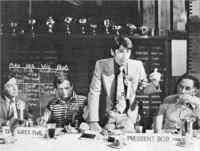
Bob Warner (Ken Blackburn)
addresses the Progressive Association
dinner
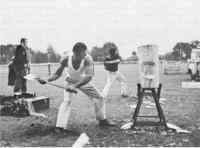
The Wanganui Axemen's Association
in action at the
wood-chopping carnival.
It is really all a matter of tone. A film often works on a multiple of levels. It may have to satisfy its basically populist audience, and yet provide an extra perspective for audiences of greater sophistication. Thus we have a director like Douglas Sirk, whose superb sense of irony and visual style could turn the flimsiest of soap-opera material into high art. If in doubt of the veracity of this claim, you have only to compare Douglas Sirk with, say, Jean Negulesco. More recently, Sam Peckinpah's Convoy started by coaxing the audience into a neo-realist middle-class escapist adventure, then gradually extended the film to the very outer limits of reality, until by the end we had something as much related to a picaresque Superman film as to an ordinary movie about truckies.
Film is a visual medium - pictures which move through the projector at twenty four frames a second - and considered separately each frame may be a work of art in itself. We might term this the Sternberg aesthetic. Certainly Steven in his film has given us some stylish visuals. He has not availed himself of anything as potentially stunning as the geographic allocations of Sleeping Dogs, or the airforce pyrotechnics that end that film: but he has searched all the more carefully around the small township of Raetihi to discover a new reality in the most mundane of events and objects.
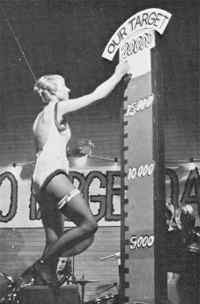
Rita Warner (Heather Lindsay)
paints up the final on the progress
thermometer at the Gala Dance
Two instances stand out: the night scene with the light filtering through the myriad of posters on the window of the IGA store; and the quite disturbing close-up of a man lovingly polishing an axe head prior to the woodchopping.
More than any other art form, cinema cherishes its famous 'moments' or 'coups de cinema': ranging from Marilyn Monroe's dress blowing up over the subway grating in The Seven Year Itch to the 'Play it again Sam' in Casablanca. And since the French new wave directors of the 'fifties discovered this treasure-trove of references, and developed what almost amounted to a modern mythology, we have come to have something of a taste for 'in' references in our films. In Skin Deep there is a clip of Max Cryer on television talking about Davina Whitehouse, one of the stars of Tony Williams's Solo; as well as boxing references to Huston's Fat City; and a small moment of Steven Spielberg's Duel evoked in Sandra's clash with the local truckdriver on the way into town.
Music is responsible for two of the most evocative moments in the film. One is the local band playing The best things in life are free at the woodchopping afternoon; and the other is Sandra singing I wanna be loved by you into Grant Tilly's portable tape recorder. The latter is particularly magical, both by reason of Deryn Cooper's performance of it, and in Grant Tilly's fetishistic use of it later in the film. Perhaps this reveals a darker side of his character that was never really developed. Certainly when he availed himself of the ceremonial sword at the Spa Club, one might have expected a little more in the way of traumatic violence than what eventually came about.
Skin Deep is now out and about and becomes a part of New Zealand's film history. As the first venture by the New Zealand Interim Film Commission, it may signify some exciting things which are to come our way. Although Geoff Steven is now back working in the field of documentaries, let us hope it is not too long before he gives us another feature film.
WILLIAM DART writes a regular Concert column for the New Zealand Listener, and broadcasts frequently over radio in the Concert Programme. He also contributes a column to the rock paper Rip It Up.
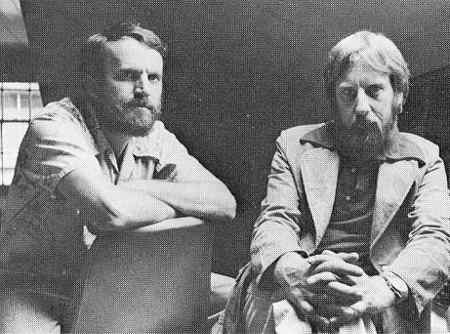
John Maynard (left)
and Geoff Steven
(photograph by Marti Friedlander)
GEOFF STEVEN the Director of Skin Deep, is at thirty-two a well-known independent filmmaker and cinema activist. He pioneered the film co-operative movement in New Zealand, and was a member of the Arts Council Working Party on Film set up in 1973 to explore the establishment of a cinema industry in this country.
In 1974 Steven directed photography for and edited a feature-length (90 minutes) low budget film Test Pictures, which was first screened at the Auckland International Film Festival and the Wellington Film Festival in 1975. Steven's contribution was generally acclaimed by critics and in 1975 he took Test Pictures to Iran, where he was New Zealand's official representative at the ABU-SHIRAZ Film Maker's Festival.
Among his many documentaries are Te Matakite o Aotearoa, 1975, a 60 minute film on the Maori land March through the length of the North Island (co-produced with and directed for South Pacific Television). This was selected as a New Zealand entrant for the Cannes Television Fair in 1976. (Both Test Pictures and Te Matakite o Aotearoa received support from the Queen Elizabeth II Arts Council.)
The film Skin Deep began with a script development grant from the Queen Elizabeth II Arts Council in 1976 (Stevens had made in Raetihi Aspects of a Small Town and shown it as a three-screen colour video presentation at the Auckland City Art Gallery in 1976). later, with John Maynard, the production company Phase Three Films was set up, and the Interim Film Commission came in as one of the investors in Skin Deep.
Since completing Skin Deep, Geoff Steven has been with it to the United States, where it was shown at the Chicago Film Festival last November. It was reviewed extensively in the Chicago papers, and The Museum of Modern Art, New York, subsequently viewed it and chose it for screening as one of the twelve selected films in their New Film, New Directors season this April. The Filmex Festival committee in Los Angeles have requested to see the film and it is expected to be shown in London later this year. In addition it has now been shown in Paris and Prague.
Skin Deep is just completing a successful season throughout New Zealand; and currently Geoff Steven and John Maynard are the production team for a film (the production title is Rewi Alley's China) to be shot in China in May and June. They are also in the middle of planning a new feature film to go into production early in 1980.
JOHN MAYNARD, Producer of Skin Deep, was born in Australia, and was appointed foundation Director of the Govett-Brewster Art Gallery in 1967. The Gallery opened in 1970 with Real Time, New.Zealand's first major light-and-sound environment, set up in collaboration with LEON NARBY, who was Director of photography for Skin Deep.
John Maynard resigned from the Govett-Brewster in 1971 to travel and study in Australia, India, Europe and Great Britain, and work at a variety of jobs including teaching art history, film-making and exhibition design. He was appointed Exhibitions Officer at the Auckland City Art Gallery in 1975, where he was occupied with a number of major exhibitions, notably the very successful Van Gogh in Auckland, the Fernand Leger exhibition, and many special project exhibitions. He is currently working as a free-lance exhibitions consultant and as producer for Phase Three Films.
PIERS DAVIES, script-writer for Skin Deep is best known for his collaboration with the Australian Director Peter Weir on Holmesdale and The Cars That Ate Paris. (Holmesdale won the Director's prize and Grand Prix from the Australian Film Institute for the best Australian film of 1971; The Cars That Ate Paris won the Silver Plaque Award at the prestigious Chicago Film Festival (New Directors) in 1974.) Davies has also published articles on literary and film criticism, as well as poetry in New Zealand, the United Kingdom, Switzerland and America.
ROGER HORROCKS, the other script-writer, is an Auckland writer, film critic, and lecturer in Film Studies at the University of Auckland.