
Regatta
A Photo-Installation by Ron Brownson
PETER H. HUGHES
Regatta is the most thought-provoking photographic show seen in Auckland for quite some time. In it, Ron Brownson explores notions of implicit/explicit movement in space and time.
This, of course, is paradoxical, for his exploration is carried out in a static medium - photographs pinned to the floor just as surely as butterflies in a display case. Movement, however, is present: in every image, in the relationships between the images, and between the images and the viewer. These allusions are reinforced by sound within the gallery. From a tape loop we hear a dinghy being rowed - oars creaking in rowlocks - but the rowing stops and the dinghy, we assume, is cresting on to shore. Movement is being implied again, but now with an ambiguous and anti-climactic end. For the tape begins once more and no shore is reached. Is this one part of a never-ending cycle?
The answer is yes, as we discover when we turn to the photographs. As I've said, they're on the floor. Sixteen very big (510 x 610 mm.) prints, laid down in groups of four on common horizontal and vertical axes, so that each group is viewed at 90° to any other. En masse their dynamic and suggestive power is immediate. We need to move around them to view them (describe a circle?); and even within their four by four arrangement movement is implied, for diagonally opposite groups form squares and rectangles respectively, and the whole group 'moves' in the same way the swastika symbol does.
Regatta:
view of installation
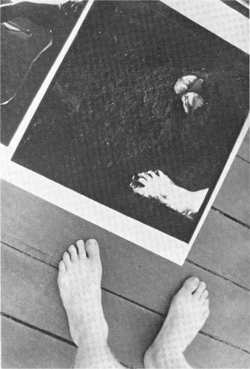
Look at the first 'panel' nearest the gallery door: that which confronts us when we face due west. (Adjacent to the photographs, on a rectangle of felt, Brownson has laid a compass - a nice touch - suggestive of a journey and of the four points, but also of orientation, of place). The first, lower right photograph contains a woman dancing on a beach. She's incomplete; cut in half by the picture's inner edge. Beneath her, closer to us, a pair of supine legs stretch across the picture surface. From this, our sight is drawn upwards and into the second picture above, an enlarged (and slightly altered) version of that below. Now, our perspective has changed: we are closer to the ground and nearer to the woman. Then, eyes left to a white sheet (the sky?) which is bled over into the fourth picture, the one below it, with again, two feet now covered by a protective hand. Standing motionless, we've travelled considerably in space: we've advanced several yards, changed our angle of vision, and have scanned from horizon to horizon, in a 180° arc overhead.
'Panel' two, by contrast (we're now facing north), alludes to time by adding (or perhaps subtracting) elements to two pictures which at first sight seem the same. Footprints appear in the sand before a colonnade of legs, and a different wave breaks beyond them. In 'panel' four we are given still another perspective: we're now looking down on to objects. In fact, our legs and feet become the photographer's, intruding into the bottom of the frame.
The over-all dynamism of the installation then is superb. But what of the 'elements' within each photograph: the feet, legs, arms, torsos, heads, watering cans, sheets, kittens, footprints, and even the location: sand, sky and water? How are we to read these? Are we to read them?
We have one of two options. We may consider them either as important to Brownson's concerns or incidental to them. From their arrangement the intention is clear. Brownson has set up each picture quite deliberately; each element is carefully choreographed. In one photograph in 'panel' four, for example, a female arm loops down from the upper picture edge. It is the only change/addition to an otherwise replicated photograph below. Brownson obviously wants us to ponder upon that arm.
But why? Do the visual elements he has supplied provide sufficient clues for our 'symbolic ingestion(1), or, as E.H. Gombrich has put it, are they sufficiently 'crunchy' for us to chew on?(2). I can see that the portrayal of disembodied bodies is one way of forcing us to 'complete the incomplete' visual image we're given, and that arising from this is the possibility that Brownson is exploring notions of portraiture: the idea, for example, that a hand, a foot, or even the stance of a foot can act as a marker of a personality, a symbol for a portrait.
Perhaps the figures are those 'land-locked mariners/sailing for an unknown destination' or the 'invaders/deserters [who] litter the sea shore' either 'drowned or sleeping' that Brownson mentions in a poem accompanying the installation. Perhaps. But I feel the associative nature in the 'elements' he has provided is not sufficiently strong to allow our whole-hearted participation in what would have been, otherwise, a first-rate show.
1. Richard Hennessy, 'What's all this about photography?', Artforum, May 1979, p. 23.
2. Quoted by L.C. Knights 'Poetry and "things hard for thought" ' Times Literary Supplement, February 1980, p. 240.