
Rainbows of the Naive Eye
BRIDGET IKIN & PETER WELLS
We first came across Mr Ross Michie's surprising environment when we were travelling to Cape Reinga. Distance had accustomed the eye to the sombre tints of the Northland landscape: mangrove greens, silver tidal flats, burnt-off paddocks, the startlingly white churches with their red iron roofs. It is a colour scheme McCahon has added to our perceptual awareness, investing it with a certain spiritual weightiness: a sense of its own oppression and majesty.
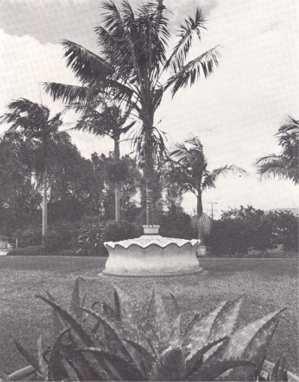
Kentia palm with decorated concrete base
Kaitaia begins, like many other towns up North, as a loose straggling of bungalows by a strip of tarseal. A large sign bedecked with Rotary and Kiwani badges welcomes one in Maori, Yugoslav and English. Ross Michie's home is on the main road through town. It would be hard to miss. It wells up before the eye with all the vividness of the Saint Heliers Bay fountain in play: a choreography of pastel tints recalling rainbow cakes, sunset Mexicana shades, iced milkshakes. A line of Irrawarra palms looks across to pots bedizened in shades and shapes as contemporary as Chilcott, Paine and Hartigan. The house, a superior bungalow of the 'fifties, is painted 'flamingo pink'. The environment, covering a third of an acre, is as carefully calculated in its effects as an Italianate garden. This sense of control, of stasis, expressed in heightened colour, gives the house and garden an almost hallucinatory vividness. This contrasts with the raw improvisation of surrounding houses and with the hills which loom at the end of every street.
Yet its uniqueness should not obscure its place in at least one art tradition in New Zealand: the almost fetishistic decoration of the suburban house: the creation of 'show homes', whose effects are oriented to the passing motorcar. This tradition could perhaps best be termed an informal folk art, one which incorporates the painted Subber tyre and hardboard butterfly. Ross Michie's achievement is to translate the rainbows of the naive eye into a fully realised exotic environment.
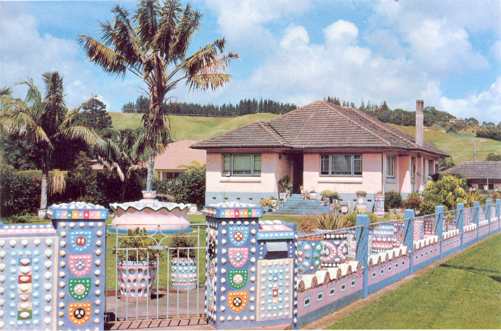
The Michie residence,
South Street, Kaitaia
Ross Michie at eighty-six is slight and wirey. 'Blind in one eye, deaf in one ear, and soft in the head' is his ironical self description. The first impression he conveys is one of extraordinary energy. He considers his garden to be a work in progress. 'Even an idiot can learn something if he lives long enough', he told us self-deprecatingly. He is a man who, on being approached by Jehovah Witnesses pointing to the garden and announcing, 'God inspired you to do this', replied,'No, I worked it all out for myself'.
There is some truth in this. In the early 'fifties, he was a farmer looking for a section in town to retire to. He chose a corner section, 45 South Street, which was then a rough paddock on the flat southern outskirts of the town. Kaitaia's climate is sub-tropical: in summer the earth bakes hard, and is susceptible to flooding. He built his retirement home himself, first excavating downwards, then using the earth as fill for what is now a bowling-green-like front lawn. Neighbouring houses are set squat on the land: he raised his high on its base. One senses that locally this was the subject of some derisory comment, a point of view which the 1958 flood perhaps went some way toward disillusioning. His solution to the local problem of flooding is typical of Mr Michie's astuteness. Wanting a low-maintenance house, he chose to build in concrete. Proudly, he told us that the house is still coated with the cement-based paint applied on construction.
It is the colour of the concrete, however, that transports Mr Michie into an area beyond the rather comforting traditions of kiwi home handyman. The concrete is pink, and two stripes streamline round the walls: blue and yellow, echoed by panels on the wooden window frames. Its appearance in a small farming community is daring to say the least. It is a proclamation of individuality via taste, all the more extraordinary in that its expression is through something as lyrical and painterly as gaudy pastel colours.
Mr Michie's approach to colour is intuitive. Producing a series of old bowling score cards which he had coloured with each of the twenty tints of his palette, he moved them round experimentally. It says a lot for his sense of heightened colour that he placed a shade of mauve called 'Antoinette' centrally in his personal colour spectrum. According to him, it has the unique property of being able to enhance any of the other colours.
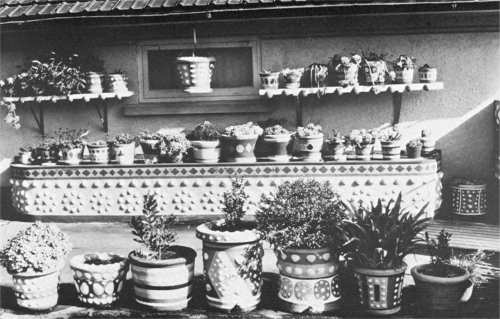
Some of Mr Michie's
decorated pots
But Mr Michie's concerns are by no means limited to ethereal colours. He has created spaces and perspectives which, on a suburban property, are remarkable. The garden works on two axes. These are lozenge-shaped, perfectly mown, carpets of lawn. The house, as befits a show garden, is set far back on its section. The larger lawn lies between the house and the main road; the other lawn runs along the right side of the house, narrower and elegantly oblong. Large painted and decorated pots parade along the two road frontages with all the panache of a marching-girl team.
A low concrete fence, topped with crenellations, encloses these two public sides. Handmade, it is painted 'flamingo pink', with outlines in blue and white. At evenly spaced intervals deep-blue ceramic tiles are inset. Mr Michie had those sent up from a hardware store in Auckland. The first lot were sent back the three hundred miles as they were wrong in shade. A line of smaller palms in pots marks a boundary of the property. A dense scarlet camellia hedge is Mr Michie's typically sensitive response to the problem of terminating a perspective.
It is significant that Mr Michie has created a visual unit whose total impact is greatest from the road: the eye travels past the decorated fence, through to the pots, across a broad pink path, to the velvety lawn and thence to the irruption of flowering concrete, its central stamen an arching Kentia palm. This, his chef d'oeuvre, was inspired by the shape of the waterlily (some local opinion saw only tombstones). Certainly, it has the monumentality of an obelisk.
Thus he has created a self-referential unit within the limits of his suburban section. Its spatial organisation, with illusory distances, emphasises the fact that it is a miniature kingdom referring only to itself, by which standards it is 'perfect', complete to the last detail, curiously timeless. It becomes an enchanted kingdom of colour, a circus arena in which plants are the performers.
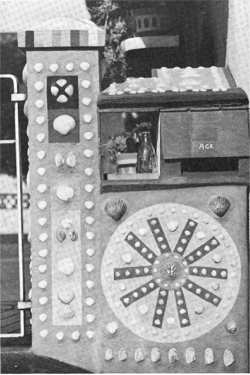
The Michie residence, detail of gate
Mr Michie made his first pot in the 'fifties when one he bought fell apart. He worked out his own methods of construction. He fashioned moulds of flat-iron, gradually experimenting with cement until he produced a satisfactorily malleable mixture for his work. Each pot is reinforced inside with wire meshing. The sand he uses varies and he has his favourite beaches for particularly fine sands. Similarly he and his family search for shells on particular Northern beaches. It is from start to finish a do-it-yourself process in the tradition of the home handyman: but with the fastidiousness of a man in pursuit of a vision.
Then begins his extraordinary decoration of the pots, their colouring and shell patterning. His patterns recall the excitements of the simple life: carnivals, circuses, sand castles, a bag of children's sweets, exploding fireworks. Abstract geometrical motifs are common features, along with representations of birds (tuis), plants (orchids, kowhai, Virginia stock), and a simple 'legend' of Kaitaia. These patterns are meticulously hand-painted in water-based acrylics, using hard bristle brushes. Each pot is dated, its pattern recorded in a book kept for the purpose. His orderliness and precision contrast with his intuitive use of hallucinogenic colour combinations.
It deepens one's understanding of the man, and his creation of an environment if one understands that these pots are, containers for specimens of rare plants. Mr Michie is a conservator from an age when burning forests was considered public work. His opinions are highly sought after by university experts. He leads them on walks to plants which they wish to include in learned books. A variety of placostylus, the land-snail, has been named after him. It adds a dimension if one realises that this man, whose own created environment appears determinedly anti-natural, has a great sensitivity towards the natural landscape: a feeling for its worth, rarity and inherent value. His pots can be seen as celebratory vessels of containment; his garden a public statement of the botanical potential of Northland.
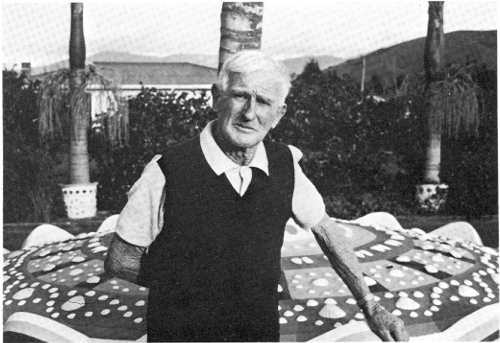
Mr Ross Michie
It seems that with Mr Michie one always comes back to parables. He is a great talker. There is even something biblical about him: a paterfamilias who lost his religion, regretfully he says, in the slaughter of the 1914 war. He professes disappointment with the present state of New Zealand society. At one point he stopped to tell us that rainbows are frequently pointed out as God's testament that he would no longer flood the world. The Michie's house, high off the ground, built on metaphorical rock, points to a preference for self-reliance. He told us that a rainbow was not God's message: anyone can create a rainbow: all you need is a bucket of water. This is in essence what he has done with 45 South Street, Kaitaia. He has made for himself and his family an environment which stretches no further than the borders of his suburban section. Yet it is a version of paradise, a simple man's version, constructed with all the patience and skill of a home handyman. He has turned this personal paradise into a public display, giving a glimpse to passers-by of the possibility of an individual's expression within the regulation of his local surroundings. It seems a pointed irony that a plaque directly facing the Michie property, on the far side of the road, offers praise to a local citizen who 'beautified' a grass verge in a more acceptably anonymous fashion. Yet it would seem that it is Mr Michie, who, in establishing his environment, has gone to the heart of the original suburban dream: the desire to create an ideal existence, self-defining, a miniature world of order, sense, rationality, 'peace'. That it should appear surreal is perhaps a quiet comment on the disorder and disunity of our larger environment.