
Christine Lloyd-Fitt
Images of Reflection and Confrontation
MEGAN JENKINSON
Christine Lloyd-Fitt photographs people almost exclusively. Sometimes the subjects of her images become part of a complex interplay of juxtapositions and contradictions that work in creating oblique social comment. At other times she concentrates solely on the individual to create portraits that go well beyond the mere recording of a likeness.
Of course, what she chooses to express of her subjects is finely balanced against what the subjects are prepared to reveal about themselves. Sometimes this is not very much. One of her sisters, in a photograph titled Katy, hugs a pillow with her arms crossed to ward off the camera. A restraint is also evident in the eyes which, although staring directly at the viewer, appear withdrawn in feeling. So physically near, yet psychologically distant. This photograph is part of a series of Polaroid images taken at different times, which have stylistic similarities. All of them were taken at close proximity to the subject, and the head and upper torso dominate the picture plane. Eye-to-eye contact establishes the relationship of the photographer to the subjects, all of whom she knows well or intimately.
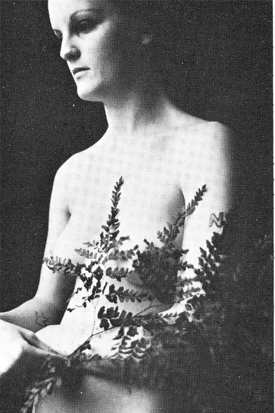
CHRISTINE LLOYD-FITT
Jacky with Fern
colour photograph
(Snaps Gallery)
Characteristic of her earlier work are images such as Sue and Spence (illustrated in issue 43 of Photo-Forum) and Bridegroom and Best Man. Such images have been chanced upon In the general run of life, and recorded in photographs that contain social comment. She seems very much aware of the position of women in a male-dominated society.
Her more recent work retains this latter quality, but chance is replaced by previsualisation of images. The Jacky with Fern series and the Jacky - Red series are poignant images that have been deliberately staged. In the former, Jacky appears statuesque in a light that is soft and golden, against a black background, with skin smooth like marble. The delicately-leafed fern leads the eye in gently. Around these few elements reveries of association can be made on idylls and nymphs. But the subterfuge is revealed with the discovery of the actual lifelessness of the fern, and how it only partly disguises the tattoos that mar the perfection of her body. On one level, the photograph happens to deal with a personal concern of Jacky's. Christine writes in the catalogue of her recent exhibition: My sister, Jacky, beautiful, but with those tattoos she put on herself with her friends when she was thirteen and which she hates now.
But on another level, the classical ideal of beauty is parodied.
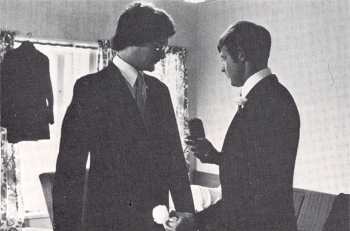
CHRISTINE LLOYD-FITT
Bridegroom and Best Man
black-and-white photograph
(Snaps Gallery)
The Jacky with Fern photographs have an exterior superficial romanticism which makes them more accessible; much harder to accept are those in the triptych Jacky - Red (No.111 is illustrated). The number of elements have been reduced to a bare minimum - the nude and the background - and many ideas of conflict / complement relate the two.
The figure is abstracted. Her outline is strongly emphasised against a background of fully-saturated red. The flesh colour complements the red but closer inspection reveals a faint tint of blue - veins showing through the surface of the skin. In quick succession other details of the reality overwhelm - the blemishes; the bruised skin where an unsuccessful attempt to remove a tattoo has been made. These give an impression that is slightly horrific. The red symbolises aggression, physically suggested by the slight pressure of fingertips on the skin, and implies also mental violence, violation and tension on Jacky's part.
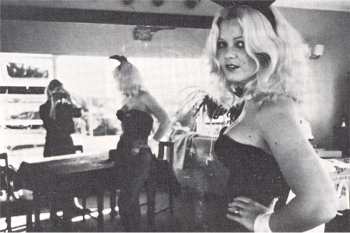
CHRISTINE LLOYD-FITT
Marieka and Myself
colour photograph
(Snaps Gallery)
There is a series of four images of Marieka; in one, glamorous but with a slightly faded quality, she lounges one afternoon in a pink evening dress dotted with pearls, with unmade face struck by sunlight, in a living room that overlooks Epsom, Auckland. In another image she is dressed in a 'Play-Boy' outfit (illustrated). Christine discusses the 'Bunny' persona:
It is in our society one of the most full-blown forms of male-oriented feminine display.
Marieka's pose is not unlike those perpetuated in male-associated magazines; but her manner of assertiveness and self-awareness challenges this. Her physical context. also belies this illusion.
There is an extra human quality in these pictures of Marieka: a kind of camaraderie apparent between the subject and the photographer. Christine discusses this in the taking of the photographs:
Two women creating something that says something about themselves, and Marieka certainly was half of that creation - I even go so far as to say more than other women I have photographed because not only did she willingly acquiesce to being photographed, she constantly proferred ideas to help in the making of them.
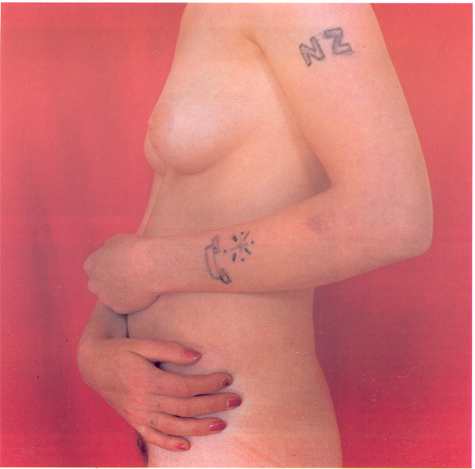
CHRISTINE LLOYD-FITT
Jacky - Red III
colour photograph
(Snaps Gallery)
So in the taking of photographs of other women Christine is crystallising things about them that she identifies with in herself: I recognise things in me that I see in other women that I photograph, and I think that relates to the idea that in [doing] any form of creative work you learn about yourself as well, in the process.
Her own Self Self-Portrait - a black and white photograph - is similar to her portrait with Marieka as in both she is not trying to establish too strongly her own image/ identity; I don't think that it is necessarily coincidental that in her recent exhibition at Snaps Gallery the two photographs most subdued and delicate in feeling - Self-Portrait and Poppies - occur adjacently. In the portrait a soft light enters from a window to the right, delicately modelling form, and there is a calm that is suggested in the oval of the mirror. In Poppies, simply a bunch of the flowers wrapped in wax paper rests on her lap. Perhaps this could be considered as a self-portrait, similar to that of Frances Hodgkins.
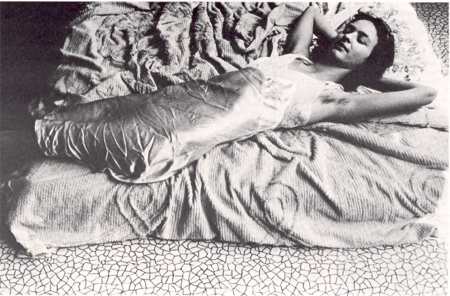
CHRISTINE LLOYD-FITT
Deirdre
black-and-white photograph
(Snaps Gallery)
In her Self-Portrait her face is hidden from view behind the camera, her vehicle of communication. Only the eye of a plastic parrot stares out. Christine prefers to establish the image of others, but in doing so also says, more quietly, a lot about herself.