
Exhibitions Dunedin
Art and Narrative: Colin McCahon and Andrew Drummond
PETER LEECH
It could be said that, when figurational art yielded to the intellectual artillery of the modernist movements, a sense of narrative was lost. It was no longer possible to convey an impression of visual art by relating what the art was about. That loss, of course, explains much of the popular disenchantment with post-figurational art (and perhaps, too, the popularity of the neo-realist revival). For, since it is not about anything in a narrative sense, post-figurational art seems to many people to be about nothing in any sense.
But modernism never finally consigned the idea of narrative to the graveyard of moribund aesthetic issues. As cases in point two junctions in the recent history of New Zealand art - Colin McCahon in 1958, and Andrew Drummond in 1980 - prompt some exploration of the idea. It is a prompting occasioned by the first two exhibitions at the new Hocken Gallery: the reprise of McCahon's The Wake during March, and, in April, Andrew Drummond's show, Relics.
Bluntly considered in terms of the attachment to narrative, McCahon's work is ill-accomplished. For however much one must admire his painterly talent, however much one needs to acknowledge his still pervasive and generally benign artistic presence, the fact is that his introduction of a narrative in The Wake is a flawed gesture.
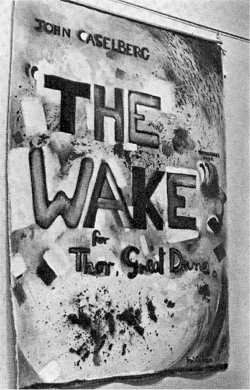
COLIN McCAHON
title panel from The Wake
(Hocken Library, Dunedin)
Photograph courtesy Otago Daily Times
The Wake is McCahon's inscription of John Caselberg's poem of the same title, about a dead dog. As a narrative, it veers unhappily between crude sentimentality and over-elaborated mythologising. To the degree that the work is seriously committed to its story, it is deeply banal.
Is The Wake, then - at least in its inscriptive aspect - a failure of modernist nerve? Essentially, I think it is. The work's aesthetic salvation, however, lies in the exquisite half-panels which interrupt the full-panel inscriptions of the poem. In these the narrative does not interfere: we see only the characteristic modernist celebration of paint richly articulated on canvas: a bejewelled though indeterminate intensity of colour and form. That is McCahon's world.
On the other hand, that it should have occurred to McCahon to introduce a narrative at all perhaps indicates that even the modernist of sophisticated sensibility can have experienced the sense of a loss, or lack, of narrative in art.
The continuation of that sense of loss, up to the present day, is clearly indicated by the advent of a form which - to an even greater degree than figurational art depends crucially on story: namely, performance art and its broader conceptual manifestations. For what is importantly at issue for the art-performer and the art-conceptualist is somehow to remove our attention from the object, on to an idea which can be paraphrased.
The problem which we encountered in The Wake, however, also occurs in this mode for in underplaying the object in favour of the narrative, the artist has to be assiduous in proving to us that his story has value in itself. McCahon fails precisely to do that in The Wake, but at least he retains a residually aesthetic object. Whereas the monumental triteness of a great deal of performance and conceptual art is present because the aesthetic potential of objects has been exchanged for simplistic, pretentious and flatly underwhelming narratives.
Andrew Drummond's work escapes that diagnosis. For in the narrative actions or ideas which are the focal points of his art he is generally too acute an artist to succumb to intellectual triviality.
Where Drummond cleaves to the conceptual mode - for example, in Within, the Organ (a sheep skeleton set on a plinth of straw and enclosing a battery-operated insistently bleeping heart-beat) - the idea itself is a well-defined and complex one. Cynically, a response might be to ask what is so seductive about the idea of life surviving organic decay. Drummond provides subtler determinations of that idea. It is not merely a dried-out skeleton which surrounds the organ within. The skeleton itself retains residual qualities of life: minimal chords of flesh remain, and the (cooked) olfactory presence of the object is unignorable (and it is unique in art for the sense of smell to operate as an important aesthetic parameter). We are asked here not only whether life survives death, but also whether our skeletal notion of death is sufficiently rigorous actually to define that question.
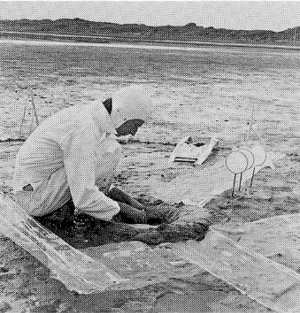
ANDREW DRUMMOND
Filter Action, Aramoana 1980
In the performance mode of his work, Drummond can offer an equivalent subtlety. For instance, in Filter Action, Aramoana, he risks the topical Dunedin temptation to read the documented action as a conventional political protest: the too-easy inclination to look in the action for a sloganised opinion.
There are no facile slogans here, one way or the other. There is a narrative, certainly (declared in a continuous projection of slides and in the displayed artefacts of the action), but we are being asked to reconsider our slogans, and ourselves, in terms of Drummond's aesthetic response to Aramoana as it is: as a filter-bed. Filter Action is about Aramoana; it is not about the political and ecological significance which, we suddenly realise, the place has come to have. And what have we forgotten in only suddenly realising that?
Still, Andrew Drummond occasionally fails to persuade us that his narratives have value in themselves. That failure of persuasion seems to me to occur with Action for Skin/Robe - the documentation of the dipping of a white boiler suit and its subsequent, altered state. The relevant thoughts can arise without the artistic provocation, and they find no interesting aesthetic resolution in the work. For different reasons, the same failure to provide narrative value is apparent in Warmth Stick - a stripped willow-branch wrapped in the centre with cotton-wool glutinised with beeswax. The nature of its presentation on the gallery floor under a simple title-card does not disclose the artist's observed point that the stick, bound in this way, varies in tactile temperature along its length. The idea, the narrative, remains in this respect too closeted with the artist - though one is anyway unsure that, even if plainly declared as a narrative, the work would have much to commend it.
There is an intriguing and important feature of Drummond's work which may serve as comment on the role of narrative in art. What is not at all customary in his approach to the performance and the conceptual mode is that it invariably gives rise to a documentation which itself comprises subtly beautiful objects. Pack, from Filter Action - a copper-framed canvas pack elaborated with small stripped-willow divining rods - is, independent of its documentary function, an arresting sculptural object.
To re-introduce McCahon, one wants to say that in The Wake there is a narrative which interrupts the beauty of the object. By contrast, many of Drummond's Relics have an objectified beauty which can interrupt the narrative. Of the two manners of interruption, it is Drummond's which is the more aesthetically compelling.