
Exhibitions Wellington
Diaries
BRIDIE LONIE
Women's art, as a movement, must be distinguished from art created by women: the latter may embrace any style or preoccupation, while the former is concerned with subjects arising out of a feminist consciousness. like any movement, women's art is eclectic, using what it chooses to present its ideas. It concerns itself with the experience of being a woman.
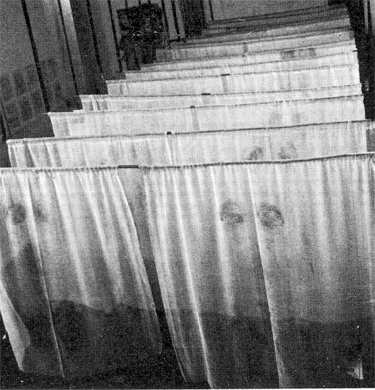
DIANE FFRENCH
Hanging Diary 1980
Mixed media
The movement has certain principles, some of which derive from the history of feminism is a political movement, and some of which derive from the particular ways in which women have been creative over the centuries: especially private, domestic ways. There is thus a mixture of polemic and intimacy: a feminist artist may work anywhere between these poles, or she may use the private as a political act. A paradigm of this mixture of privacy and publicity is the use of the diary as an artistic form.
Traditionally a woman's life has been measured in small acts such as those of the domestic routine, which involves minute organisational ability and concern for the nuances of feeling of those in her family. She could not devote time to making masterpieces, but she did things: sewed patchwork quilts which told histories of families; from baby's smocking to mourning dress; painted watercolours suggesting spaces she could not enter, or developed a skill at the piano which she could not pursue. Time unfolded slowly, offering little room for grand schemes, or eccentric individuality - that province of the professional artist.
So she cared for each day and all this was private: she could talk to her friends or she could talk to herself, and often she wrote a diary.
A Season's Diaries was the first exhibition in New Zealand using the diary as a form. It was held in the Victoria University Library in December 1977 and shown subsequently in Christchurch and at the Women's Studies Conference in 1978. The women contributing were asked to describe the months from July to October 1977 using a common format - that of a measured grid: a matrix of days. Another compositional device was that of including some element from the previous day, and adding a new one each day, so that days led into one another. Objects were gathered, and hung from the painting or collage, or placed in boxes attached to the pieces. The exhibition was anonymous, allowing the personal to enter without self-consciousness. The ordering implicit in the form suggested a celebration of time.
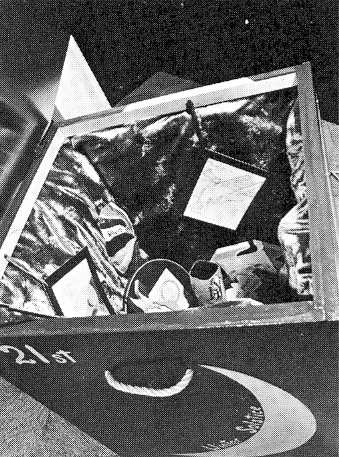
PAT HUNTER
Diary 1980
Assemblage
A second exhibition was held in the Women's Gallery in Wellington in July 1980. Women were asked simply to describe a month, and forms varied widely. The exhibition included some of the women who had worked on A Season's Diaries. There were twenty-one contributors. The artists' approaches included sculptural pieces, paintings and typed or handwritten diaries; and the focus ranged from minute analysis of each day to pieces describing only the major events of the month.
Pat Hunter sent a large box from which one retrieved things, and a jigsaw puzzle. Juliet Batten sent a three-piece sculpture: between the moon and the sun was a small wooden cage with two of its bars raised. Di Ffrench sent a hanging calendar: a row of gauze days, two each across, were hung on bamboo rods attached by fishhooks to leather straps suspended from the ceiling. A red greasepaint image of her torso was imprinted on each day, and a tag from the paper or some other common object was attached to the outside corner. Carol Stewart's diary, for women only, described meetings and relationships in a traditional way, while on the facing pages were symbols from the sign language of the deaf. Claudia Eyley sent a drawn grid, and a written diary of the month's: events, including photographs fro& the family history she is working on.
Allie Eagle showed misty watercolours with notes, Bethells in winter, horses in the rain ('they are so patient'). Linda Landis's diary, with photographs and drawings, complemented this by describing the same days, working on the lake at Te Henga. Linda James sent a grid, one day of which bristled with nails.
The approach to personal revelation was often equivocal. Di Ffrench's hangings actually allowed one to enter between them. Barbara Strathdee's paintings and photographs were superimposed on pages of script, allowing one to read only a few words at a time. This created a tension between habitual privacy and a feeling that the details mattered. Keri Hulme, a professional writer, complained in her diary of a sense of constraint, and wondered if the reader would be interested.
The exhibition was the most successful the gallery has yet had: people were interested, and the sense of richness, of time present translated into coherent form, went some way toward closing the gap women artists often feel exists between the private concerns that remain deeply important, and the public realm of the artistic statement.