
Exhibitions Auckland
WYSTAN CURNOW
What bothers me is all those stumps:
What did they do with the wood?
Them Xians out to steal souls & grab land
'They'd steal Christ off the cross
if he wasn't nailed on'
The last decent carpentry
Ever done by Jews.
Logging 10, Gary Snyder(1)
Crucifixion Performance
What happens when a couple of Christians, of Christchurch, come across a naked man crucified in a Christchurch art gallery? They take offense, of course. Lay charges (under Section 3(d) of the Police Offenses Act.) Five months later, Mr D.J. Sullivan, Stipendary Magistrate, of Wellington, judges the man's behaviour 'ill-mannered, in bad taste, crude and offensive'. But he dismisses the charge. Washes his hands of the matter. The right of the artist to be crude and offensive is affirmed. The man on the cross had charges of his own to lay.
What did they do with the wood? The CSA's contribution to the 1978 ChCh Arts Festival was called Platforms: 15 NZ sculptors and performance artists were invited to use a wooden platform as that - a platform for their work. Were given the choice of 3 shapes, each 9 ft. square, one in the shape of a cross. To Andrew Drummond, a St. Andrew cross. The proposal said: take this as your given. Crucifixion Performance was, in the first place, a meeting of givens. An artist is known by his given name, and makes his name with his work. Enter, stage right, the Bastions, practising Xians of Xchurch. The point of the name is obvious enough: 'A projecting part of a fortification, consisting of an earthwork in the form of an irregular pentagon, having its base in the main line, or at an angle, of the fortification.' Where, in other words, the artist laid his charges.
Andrew Drummond
Like a Bull at a Gate
The vulnerability was really important. It was bloody difficult for me to go out there naked and lie on the cross... People, I guess, can look at me and feel vulnerable, but hell I was more vulnerable than them. They had security in the fact they had clothes, and the fact there were other people there, and it was dark. I had the insecurity, the vulnerability of being naked and spread-eagled, and having the lights on me.
How remarkable that the sight of this so helpless man should expose the vulnerability of such formidable fortifications. like some half-wit art historian, the Law simply recognised Andrew Drummond as the first performance artist to go naked among us. But what the Bastions stumbled on, recoiled from, was more than mere flesh. It was the experience of witnessing, and indeed contributing to, a physical ordeal an artist had chosen to undergo. Those who saw Bruce Barber locked in stocks for 48 hours, Gray Nichol trapped under a two tonne block of concrete for 24, or Drummond's Auckland ONTO SKIN performance, will vouch for the potency of such an experience. And its complexity. Performance is a 'post-object' art, yet in each of these pieces the artist knowingly poses as an art object. What I make of such objects is inescapably more like myself than I am used to. Nakedness is exposure of a certain kind.
Andrew Drummond,
Twenty Directions in an Enclosure
The artist was helpless because he was re-enacting the crucifixion of Saint Andrew. That ordeal which was itself a re-enactment, of Christ's crucifixion. The artist was naked for the same reason:
And in thus saying, he despoiled and unclad him, and gave his clothes unto the butchers. And then they hung him on the cross, like as to them commanded. And there he lived two days and preached to twenty thousand men that were there.(2)
The question: Why do they - I mean Drummond, Nichol, Barber - do these things? can be met with another: Why do you just stand there, why don't you do something? Help them out, or down? Or answered by saying: you treat them as art objects and they make exhibitions of themselves. Related questions are: Why does St. Andrew let himself be martyred? Why do you crucify him?
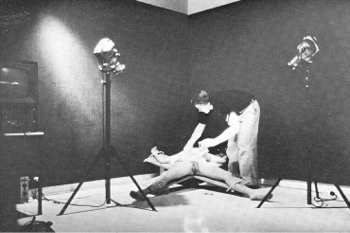
Drummond did no preaching to his smaller audience, but did what was proposed in the catalogue:
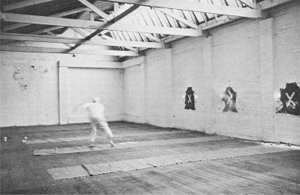
On the given date I will enter the gallery and proceed to cast a skin using my body as a mould. The casting process will take place with me stretched out on the cross. I will be wearing a gas mask and heart pulse visual display monitor mounted on my head. The mask will save me from ammonia poisoning and the visual heart rate monitor will give the audience a constant image pertaining to my physical/emotional state. When the skin is formed I will proceed to rip off the skin and remove myself from the cross. The skin will then be stretched over the cross and the gas mask and visual heart rate monitor left discarded. A series of ten polaroid colour photos documenting the process will be mounted on the cross. I will then leave the gallery and return to Wellington.
Andrew Drummond,
Onto Skin - a ritual for three skins
That Saint died. He split. For a place better by far than Wellington. Least his soul did: he split. Or, did he? So the story goes, but it is only a story. And over against it Drummond put this other: a 'heathen' story according to which, in 'the old days', men were immortal, and kept themselves so by a periodic sloughing off of their skins. As with some animals, some insects and plants, the body was not abandoned, but reclaimed its youth. Does this birthday suit offend? Think of these - these duds - as old clothes. Imagine having an entirely new skin. Imagine getting in touch with this world all over again.
The surface of the skin has some 50 receptors per 100 square millimeters... The number of sensory fibres from the skin entering to the spinal cord by the posterior root is well over half a million.(3)
Andrew Drummond
Crucifixion Performance
What I make of the man on the cross changes. This is some cave. I have trespassed on some secret, awfully intimate, rite. What are they doing to that man? What re-incarnation is imminent? Nakedness has become exposure of a less than certain kind. Again: this is a theatre, in some hospital of the soul. (Check the ECG monitor will you?) Some sort of operation is being performed.
So the Christian story gets revised, questioned. And Drummond's is, obviously, a fake rite - composite, improvised, electric. With regard to his sources, he's no theologian. An anthropologist, maybe, and a casual one at that. His attitude to them is pragmatic: what on earth are they good for now? At the present moment? After that there's the skin, for evidence of the artist's cast off pre-performance life, and polaroids for mine, since that's how I saw it. The artist is charged with wanting to lead a life of permanent revolution.
The Ngauranga set
Man is a beautiful animal. We know this because other animals admire us and love us. Almost all animals are beautiful and paleolithic hunters were deeply moved by it. To hunt means to use your body and senses to the fullest: to strain your consciousness to feel what the deer are thinking today, this moment; to sit still and let yourself go into the birds and wind while waiting by a game trail. Hunting magic is designed to bring the game to you - the creature who has heard your song, witnessed your sincerity, and out of compassion comes within your range. Hunting magic is not only aimed at bringing beasts to their death, but to assist in their birth to promote their fertility. Gary Snyder, Making Love with Animals.(4)
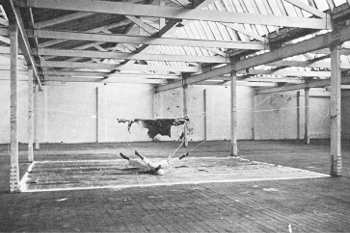
Andrew Drummond
Skin/Body Suspension Performance
Hunting, as ritual activity, does survive among us. Among some of the rich and powerful. 'A 12-day itinerary in Mongolia will go about $16,500 a person.' (Chris. Klineberger) It's odd how makers of this 'civilisation', masters of its ceremonies, are sole preservers of the 'primitive'. They're being shamed out of it, of course. And for the very reason they got stuck with it in the first place: their exemplary freedom from necessity. For hunting, removed from need, is an empty, and thus bloodthirsty, ritual. What we call a sport. The first golf courses were laid out on hunting grounds abandoned to suburbs. Now golf: there's a game, for you and you. With class, and without game. And what became of the game? Well, meat, I guess. From the meatworks. There was the need.
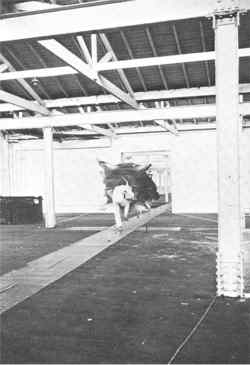
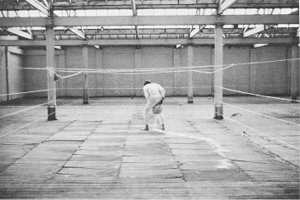
In May and June this year Andrew Drummond performed a set of works at the Artists' Co-op in Wellington. Named the Ngauranga Set (Twenty Directions in an Enclosure, Skin/Body Suspension Performance, Onto Skin - a ritual for three skins, and Like a Bull at a Gate) after the now demolished meatworks in Wellington, it is now touring, in the form of documents, with the NZ Sculptors at Mildura show. It's his best work: the most ambitious, the most compelling, as well as a summation, of the ritual-like performances he's done since his return to New Zealand in 1976. like most of those, these feature the hides of beasts; here, as there, Drummond is after a sense of self as at one with its animal body.
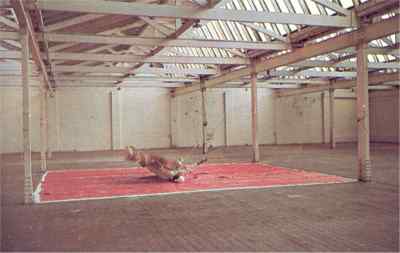
Andrew Drummond
Skin/Body Suspension Performance
In the event of demolition, the Co-op's old Woolstore. had to pass muster for the cool room at Ngauranga. It was better, certainly, than the anyplace of an art gallery. For this work, unlike its fore-runners, was context specific. Outcome of a year of frequent visits, during which Drummond sought to enter the ghost life of this derelict slaughterhouse, Ngauranga is of, and for, meatworks. Much would have occurred to the artist: the lives and deaths of countless animals, animals hung by the legs, stunned, slit, bled, gutted... the thought that animals ear-marked for slaughter outnumber us fifty to one. That we are butchers to the world. That we are the least ceremonious, and the most sports-minded of peoples. That there is not much love lost among us. That we seldom touch one another. That freezing-works are offensive places, as are people who man them. That Ngauranga's cool room looked like a neglected art space. Each piece involves the performance of a simple, clearly-defined activity. None, I'd guess, taking more than half an hour. Each differs in the kind and intensity of its physical demands. Props are few: some string, polythene sheets (red), a knife, livers, candles, magnets and compasses, flour, and animal skins. That's about it.
While each performance can stand alone, the set does read as a sequence of sorts. One which begins with the animal penned - 20 Directions in an Enclosure - and ends with its death under the knife - Like a Bull at a Gate. Or, one which begins with the man caught in a round of pointless busyness and ends with his breaking and entering his animal self in an act of liberation. Such readings coexist, and cohere, because, in the artist's words, 'the statements were made from an animal point of view, human or otherwise.' They make it clear that these performances are no vegetarian's lament.
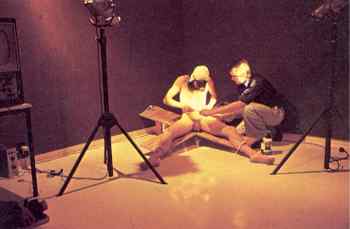
Andrew Drummond
Crucifixion Performance
Body/Skin Suspension Performance is subtitled: 'A performance in which a confined animal is confronted with a past reality of himself', and described thus:
An animal hide is stretched parallel to the ground within a defined space, under which I am suspended by my wrists and ankles. Four candles, one at each of the skin's anchor points, are lit. The ropes burn through causing the skin to drop on to my body. A period of intense activity is seen as I try to free myself from my bonds. (5)
Like the others, this piece was performed in private. The documentation is not for the record, it is the work. Which may seem odd. The artist who conceived Crucifixion Performance has to be keen on directness, immediacy. The performances do come through, by their very force and simplicity. Documentation here distances action and disperses attention. Of course, Ngauranga was an abandoned meatworks. That is, the performances took place in a specific context, but were addressed to what the place once was. There was, to begin with, that distance, and the presentation is a reminder of it. The documents which are the Ngauranga Set read as a set of meditations in performance form.
1. Myths and Texts
2. The Golden Legend, or the Lives of the Saints, as Englished by William Caxton
3. Touching, Ashley Montagu
4. The Poetics of the New American Poetry ed. D. M. Allen
5. The Ngauranga Set, Andrew Drummond, 1978