
Exhibitions Wellington
NEIL ROWE
Richard Killeen; Robert McLeod
Richard Killeen's first Wellington exhibition at Peter Mcleavey's since 1976, when he won the Benson and Hedges Award and an Arts Council Grant made an overseas trip possible, was an occasion that was awaited here with considerable interest. Over the last ten years we have seen the multi-faceted Killeen's painting develop, chameleon-like, through a number of different and diverse phases: from hard-edged realism to equally hard-edged formal abstraction with, at times, a fair dollop of whimsy and sophisticated satire thrown in, as in the 1976 Benson and Hedges Award winner Frogshooter. Consistent throughout this development however has been the constant concern in his work with the combination of figurative' and abstract elements. At his most apparently realistic, in the social-comment-laden paintings of people from the late sixties, visual puns and painterly tricks combine with purely formal preoccupations. His people are highly stylised shapes like cardboard cut-outs. It is the abstract qualities of these shapes and their arrangement within the picture plane that is his primary concern.
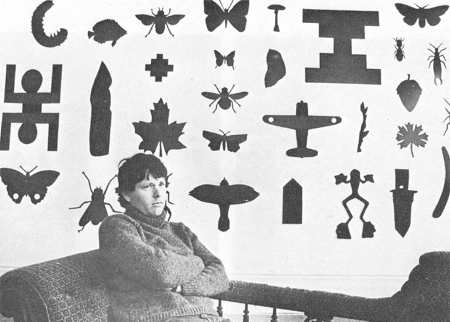
Richard Killeen in front
of his work
From a Japanese Garden 1937 (1978),
cut out assemblage
(Peter McLeavey Galleries)
Conversely in the most rigorously formal of his abstract paintings, in which the saw-toothed comb motif is explored, expanded and exploited in a wide variety of forms and treatments, figurative associations abound. like Gordon Walter's koru this device is firmly rooted in Polynesian art and in its various expressions retains an indigenous local quality. It can be read as a fern-leaf, as Maori or Melanesian artefact, as a garden rake, the blade of a shearer's handpiece, a lace doily, or, in its most recent and, according to the artist ultimate form, as a flag-like emblem of place. Anyone of these immaculate geometric arrangements of triangles, executed in automobile enamel on sheet aluminium, which were exhibited this year at Gallery Data and in this exhibition at McLeavey's and one of which, Assimilation, was Killeen's entry in the 1978 Benson and Hedges, could happily serve as a surrogate New Zealand flag or as an emblem for any newly-emerged Pacific nation.
Excellent as these paintings are as fully resolved exercises in geometric abstraction they are not the most interesting aspect of the exhibition. Killeen is, as always, full of surprises. In a radical departure from anything he, or anyone else for that matter, has ever done, in this exhibition, in typically clever and witty fashion, he has liberated his paintings from their frame and the picture-plane by actually cutting out the pictorial elements from sheet aluminium, painting them red or black and hanging them directly on the wall. In the two works of this ilk exhibited here, From a Japanese Garden 1937, the inspiration for which came from an entomological specimen drawer in the Auckland Museum, and Two Black Dogs, Killeen has returned to the repertoire of insect and animal imagery of an earlier period of his work. These combine with logo-like, pictographic shapes, which swarm silhouetted over the wall in an infinite variety of pictorial arrangements. Nor is social comment far away. The incongruous appearance of the aircraft in From a Japanese Garden 1937 is a pointed reference to political events.
Where will Richard Killeen, the country's most innovative and idiosyncratic painter, jump next? Are these cut-outs a witty oncer: or do they herald a complete new direction in his art?
In the most exhilarating display of painterly fireworks and virtuoso paint and colour application seen in Wellington for a long time Robert McLeod's latest exhibition of recent paintings burst on to the walls of the Elva Bett Gallery. These paintings represent the high point of McLeod's career to date and represent a major development in his art. They are also the most successfully-resolved paintings he has ever executed. McLeod has always been an exciting painter. The first paintings he exhibited in New Zealand after his arrival here from Scotland in 1972, although firmly within the 'sixties movement of British painting and owing a great deal to fellow-Scot Alan Davie, displayed a strongly individual stamp.
Those first years in New Zealand were spent working the early influences and the Davie inspired alphabet of pictographic motifs and compositional devices out of his system. Typical of these earlier paintings was their exuberant use of colour and lustily ribald, if ambiguous, anatomical imagery. A breakthrough in his work came in 1976, when he took the grid structure, favoured by a number of local painters, and turned it to his own ends. A swatch of tartan textile samples from Scotland provided the impetus for McLeod's first grids. In these paintings learned conventions of composition and pictorial arrangement could be put aside and he was able to concentrate exclusively on the dynamics of colour and surface.
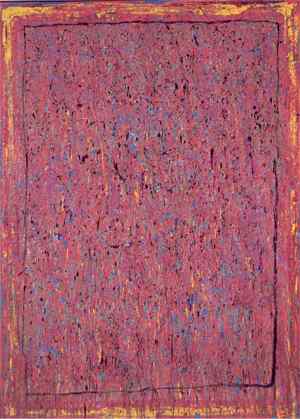
ROBERT McLEOD
Turkish Splattered 1978
oil on canvas, 2130 x 1510 mm.
(Elva Bett Gallery)
Useful though the grid was in freeing McLeod's painting from external influences and in opening up new areas of colour and texture to explore, it proved to be as much a liability as any other compositional device. It was a necessary step: but one which also had to be worked through and eradicated.
In the paintings exhibited at the Elva Bett Gallery this has been achieved with great brio and panache. The strait-jacket of the grid has been broken out of and these works sing with a new-found freedom. Energetic physical involvement in the act of painting and a delight in the sensual qualities of oil paint has always been a characteristic of Robert McLeod's painting. Here paint is thrown, splashed, spattered and sprayed with tremendous verve but also with tight control. Spontaneous as they may appear, these are highly structured paintings.
Colour has always been important to McLeod. In these complex surfaces of built-up oil paint it develops a breathtaking new depth and luminosity and is handled with great skill and sensitivity. When the mood threatens to become too lyrical as in the poetically evocative With a Red Swipe - McLeod deliberately roughs the painting up by splashing a crudely incongruous border around it. In spite of this rather bravado reaction against prettiness and good taste, this painting remains as perhaps the most exquisitely beautiful work in an exhibition of nine paintings of consistently high quality.
How can a writer convey in words the power of the flamboyant and fiery Turkish Spattered with its smouldering reds and blues, magentas and oranges; or the cool tranquillity of the green and mauve Red: Green: Running? The answer is - not easily! Suffice it to say that these are brilliant essays in colour and in the technique and mechanics of oil painting. After six years in New Zealand Robert McLeod has now 'arrived' in no uncertain terms.