
Exhibitions Auckland
JOHN TARLTON
From Suburbia: Paintings by Nigel Brown
Nigel Brown's one man exhibitions are usually dependent on a single, over-riding theme. In the past these themes have included anything from bicycles, people in beds, to various depictions of lemon trees. His latest exhibition at the Barry Lett Galleries is also a thematic one, with Brown now turning his palette towards suburban living, complete with its follies, its pastimes, and the isolation of the human spirit that is associated with urban man's existence.
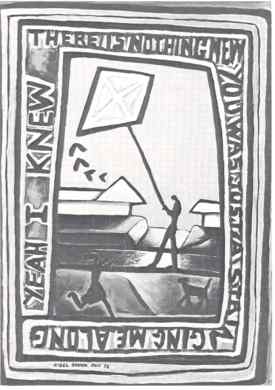
NIGEL BROWN
There is nothing new 1978
oil on board
(Barry Lett Galleries)
Many of Brown's paintings also rely on the impact of repetition - a relentless bombardment of repetition in terms of compositional devices, colouration, and form. By his use of striated sequences of right-angularly-lit houses and driveways, executed with a straight-on perspective, he creates a geometric fractioning of atmosphere not unlike that found in the works of Feininger. Brown seems to be exploring the more formal qualities of abstraction, as well as pursuing the dramatic possibilities inherent in the use of a limited palette. He has relinquished, for the time being, the primitive, expressionistic depictions of identifiably New Zealand-related subjects and colouration for an archetype - views of suburbia which are as true in Pakuranga as they are in Pasadena. Universal man has become trapped within his own urban architecture. Men, dogs, and kites are abstracted and heavily outlined to a point of caricature. These stick-figure humans hold their animals and kites with deathlike grips. The freedom symbol of flight connotative in the kite forms is reduced and restrained like that of leashed pets. Urban man has become both the prisoner and the gaoler.
In addition to this visual symbolism, Brown further intensifies his canvas by the employment of lettering and phrases, ranging from simple titling of works to paintings which are almost totally engulfed by razor-like literal phrases. In certain paintings such as For Crying out Loud, the human and kite forms seem almost engaged in a struggle with the overpowering and growing border of painted words. Brown himself is aware of the possibility of 'symbolic over-kill' associated with the use of written messages on paintings (see the latest Islands,) and it is to his credit that he is able to incorporate his phrases (both in literal content and design) into an integral component of each painting's over-all make-up.
Nigel Brown's paintings attempt to stir the viewer's conscience. Unlike other painters who revel in the neon-lit facade of modern life, he prefers to take the part of the brooding visual poet, at home more with Van Gogh than Warhol. Yet Brown does not preach: he simply exhibits what he sees in a manner in which the viewer must determine his own place within the vision.